Is anything off limits for content anymore?
Explain | 09.08.2026 15:20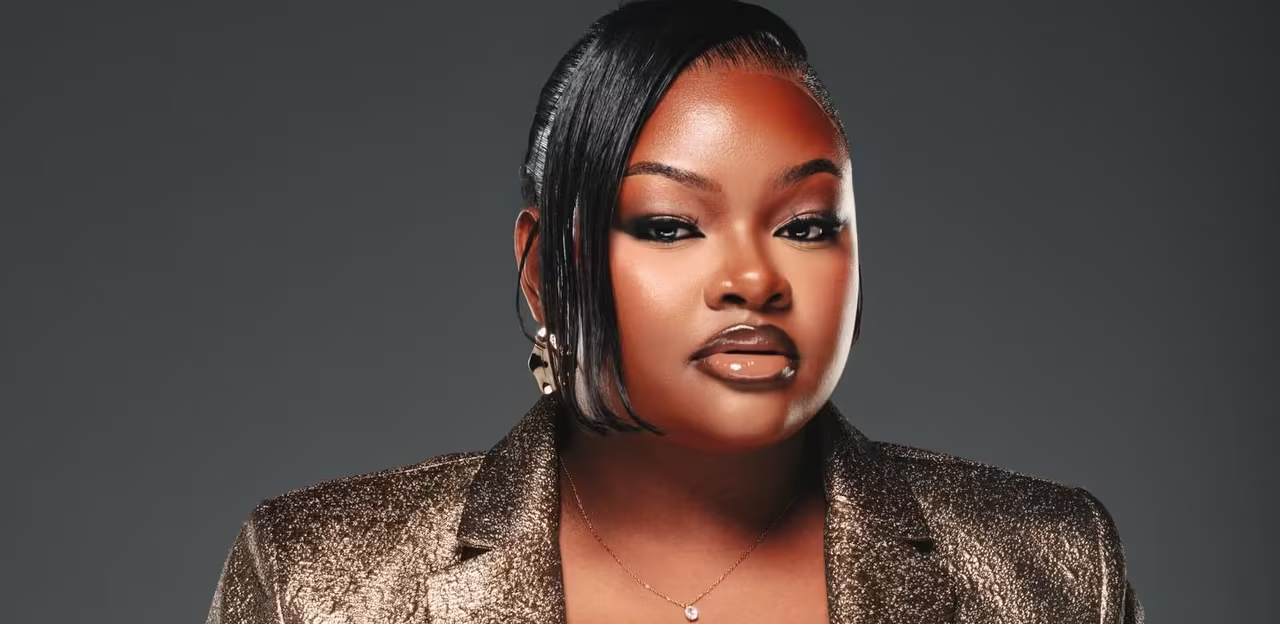
Grace Mondlana’s hospital vlog has revived an uncomfortable question about influencer culture: we demand authenticity from people online, but how much of someone’s real life do we actually want to see?
There was a time when being “authentic” online meant posting a photo without a filter or admitting that your morning routine did not, in fact, begin at 05:00 with lemon water and gratitude journalling. The bar has moved.
Now we watch creators give birth, grieve loved ones, navigate break-ups, discuss diagnoses and, increasingly, document themselves from hospital beds.
South African creator Grace Mondlana became the latest person at the centre of that conversation after sharing her experience of being hospitalised following a frightening fall and subsequently learning of an underlying neurological condition. Many followers responded with concern and support.
Tweet
Others had a different question: Did we really need to see this?
And there, in six words, is one of the strangest contradictions of modern influencer culture. We tell creators we are tired of perfection. We demand vulnerability. We want the “real” version of their lives. Then sometimes they give it to us, and we recoil.
When does authenticity become oversharing?
A birth vlog that one viewer finds beautiful might feel invasive to another. Someone documenting grief might help thousands of people feel less alone while leaving another viewer wondering why such a private moment is being filmed at all.
/explain/ News Editor, Sinawo Bukani, who has previously worked extensively in content marketing, says, “Sometimes people genuinely don’t mind sharing those parts of their lives.”
We can become so accustomed to thinking of every post as a calculated piece of “content” that we forget people have wildly different boundaries. What feels unimaginably private to you may not feel private to someone else.
But there is another complication: once a camera comes out, even sincerity becomes curated. “I don’t care how authentic you say you are on social media. There’s always a level of curation,” Bukani said.
“Whether it’s the script you prepare, how you shoot something or what you choose to share, you’re curating a version of your life.” That does not necessarily make it fake.
We created an economy out of being relatable
Influencers occupy a strange job. Their product is often partly themselves. Unlike an actor promoting a movie or a musician selling an album, a lifestyle creator may build an audience because people enjoy their personality, their family, their routines, their opinions and the feeling of knowing them.
The more audiences feel connected to a creator, the more valuable that creator can become to advertisers. But maintaining that connection often requires sharing enough personal information for followers to continue feeling that they know the person behind the account.
Researchers Barbara Duffek, Andreas Eisingerich, Omar Merlo and Guan Lee have studied this tension. Their research into influencer authenticity found that authenticity is not simply a quality a creator either possesses or does not.
It is something different groups, audiences, creators, brands and influencer agencies continually judge and negotiate. In other words, you cannot simply announce, “I am authentic.”
That helps explain why the exact same hospital vlog can produce comments praising a creator for being honest alongside others accusing them of turning everything into content.
But audiences are part of this bargain too
Followers ask creators what happened when they disappear for a few days. They notice when relationships change. They ask why someone looks sad. They speculate about pregnancies, illnesses and break-ups.
Sometimes a creator then explains what happened, only to be told they shared too much. This is where the relationship becomes contradictory. We want access, but not always that much access. We want creators to be honest, but preferably in ways that remain comfortable to consume.
We complain that social media is fake while maintaining surprisingly strict ideas about which parts of reality belong there. That does not mean audiences owe creators unconditional approval. Viewers are allowed to find something uncomfortable, distasteful or simply not for them.
But discomfort is not automatically proof that the person posting has crossed some universal moral line. Sometimes it simply tells us where our line is.
Then there is the algorithm in the room
There is another character in this story that does not have feelings about privacy at all: the platform. Social media rewards attention.
Posts that provoke strong reactions tend to generate comments, shares and watch time. Highly personal stories can therefore perform extremely well, whether the reaction is sympathy, outrage or curiosity.
That does not mean every vulnerable post is secretly an engagement strategy. It does mean creators operate inside systems where sharing more can be rewarded with more attention. When attention can eventually translate into followers, sponsorships and income, the boundary between “my life” and “my work” becomes unusually difficult to draw.
An office worker can generally have a terrible week without wondering whether they should turn it into a three-part TikTok series. A full-time creator’s personal experiences may also be the raw material of their profession. That does not make their emotions fake. It makes the economics uncomfortable.
Maybe the question is not what is ‘off limits’
There are circumstances where stronger ethical questions do arise. When a creator shares someone else’s vulnerable moment, that person’s consent matters.
Children create an even more complicated problem because they may be too young to meaningfully understand what it means for thousands or millions of strangers to know intimate details about their lives.
There is also a difference between deciding to tell the story of your own medical experience and filming another patient in the background who never agreed to become part of it. Those questions are more useful than simply declaring that hospitals, births, funerals or grief should never appear online.
Because place alone does not determine whether something is ethical. Consent, dignity, context and who else is affected matter too.
We may be asking creators to perform an impossible version of authenticity
The modern influencer is somehow expected to be spontaneous but professional, relatable but aspirational, open but not attention-seeking, commercially successful but never visibly motivated by money, and vulnerable but only up to the exact point where the audience becomes uncomfortable.
Mondlana’s vlog did not invent this contradiction. It simply exposed it again. Perhaps there will never be a universal boundary separating “authenticity” from “oversharing”, because those words describe judgements rather than fixed categories.
Creators still have responsibility for what they publish, particularly when their content affects other people. Audiences also have the right to decide that certain content is not for them. But maybe the healthier question is not, “Why would somebody share this?”
It is: Who gets to decide which parts of another person’s life are too private to share when that person has chosen otherwise? Because in a culture built around demanding that people online “be real”, we may also have to accept an awkward truth. Real life is not always comfortable to watch.



![More than 2 500 classics shine at Cars in the Park 2026 [Video & Pics]](https://cdn.thefuse.co.za/images2/7/d/8/b/b/7d8bb8bc-bb1e-3e45-a668-4019abce0bd4-1280x720.jpg)