Do Wrong, Get Punished
Medium | 28.12.2025 23:10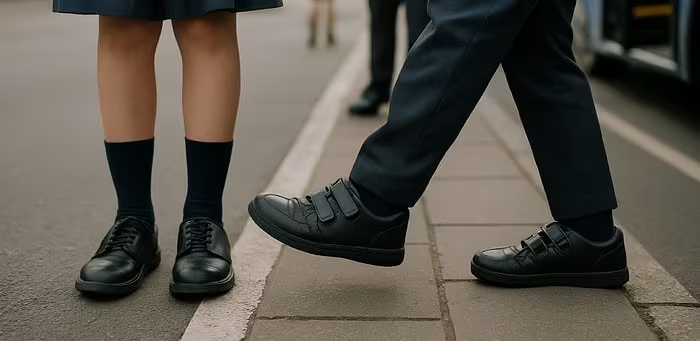
Do Wrong, Get Punished
Follow
5 min read
·
Just now
Listen
Share
To shield a child from punishment can look like kindness. But when the act was theirs to understand, what is spared is not just the rule but the chance to learn from it.
“Do wrong, get punished.”
That is the rhythm everyone knows.
A push in the playground, a snatched toy in the shop aisle, a slammed door at home. The act is usually followed by consequence. Quick, clean, familiar. Strangers expect it, teachers expect it, even other children expect it. A wrong without punishment feels like an unfinished sentence.
But neurodivergence does not fit that rhythm.
Some acts are, at times, reflex, survival, meltdown, or even a body pushed past their limits. The slammed door might not be defiance; it might be noise turned unbearable. The shout might not be rudeness; it might be language breaking under pressure. To punish that is to punish the wiring itself.
This creates a paradox. If you never punish, never hold a child to account when (and only when) they understand what they have done, you create another kind of unfairness. Because in sparing them consequence, you quietly tell them: the rules do not fully apply to you.
That can look like kindness. It can feel like protection. But it carries its own sting because not only is the boundary blurred, the lesson that could have been learned is left untaught.
Take the supermarket.
Your child grabs something from a shelf they know is not theirs. They know because they looked at you first. Because you had this conversation before. Because they laughed, testing the line. Yet when the stranger turns to see what you will do, you hesitate. You know how fragile your child’s regulation is. You know how fast this can escalate. You let it slide.
To the stranger, you appear indulgent. To the child, you seem unclear. They have been handed a rule that bends only for them. That is not equality. That is exclusion disguised as gentleness. In sparing them the consequence, you also spare them the chance to connect action with outcome and the kind of learning their peers would take for granted.
At the bus stop.
Two kids in line, one cuts ahead, your child pushes back harder than necessary. A parent glares. You are expected to step in, to show that the shove has weight. You know your child is impulsive, that waiting feels like fire under their skin. But you also know this shove was chosen. They clocked it. They aimed it.
So what do you do? If you say nothing, you strip the act of meaning. You teach your child and the one they shoved, that their discomfort does not count. If you intervene, if you give consequence, you risk overload. But at least you are saying: I see your choice. I see your responsibility. I see that you are capable of learning from this as any other child would. Sometimes that is the more respectful path.
This is the calibration no one outside sees.
Strangers do not know whether the slammed door was survival or mischief. They do not know whether the push was meltdown or cheek. They just see the act and wait for punishment. Parents, teachers, carers are the ones having to hold a fine line. We are the ones asking: did they understand? Could they have chosen differently?
That is the real test. Not blanket punishment. Not blanket exemption. But the courage to read the act for what it was, and to offer the consequence when it can actually teach, not just wound.
Get Ken O’Brien’s stories in your inbox
Join Medium for free to get updates from this writer.
Subscribe
Subscribe
At home it gets even trickier.
A sibling is teased. Words chosen carefully, just enough to sting. You know your child understands because you saw the pause before they spoke. The flicker in their eyes coupled with the satisfaction after. If you ignore it, you excuse it. If you punish it, you affirm: you are capable of better, and I expect it of you. In that moment, the expectation itself becomes a lesson. A reminder that their words carry weight, and that they are trusted to learn from that weight.
That is the heart of the consequence when it is deserved. It is not cruelty. It is recognition. It says: I believe you are strong enough to carry this weight, and to grow from it. Because without that, pity takes over. And pity, however gentle it looks, is another way of saying: you do not fully count.
Schools wrestle with this daily.
Every slammed desk or shouted “no” looks like defiance from the outside. But some of those moments are survival, not choice. Punishing them is a mistake. Others are wilful, fully grasped, fully intended. Sparing them is a mistake too. The hard work is in knowing which is which. And the tragedy is there is rarely enough time to even ask, let alone react.
Efficiency is easier. Rules applied the same way to everyone. Punishment dealt quickly, no matter the cause. Or else the opposite: blanket leniency, because the child is “special” and consequence feels unkind. Both approaches miss the mark. Both are forms of inequality wearing different masks.
But understanding is not binary. A child can grasp a rule in the abstract and still lack the executive function to apply it under stress. They can know what they are supposed to do and find their body does something else entirely.
The question is never just “did they understand?” but “did they have the capacity, in that specific moment, with that specific demand on their nervous system, to act differently?” That question takes time. It takes knowledge of the child. It takes humility about what we cannot see. Anything faster than that is not discernment. It is just efficiency.
The truth is, children learn as much from consequence as they do from compassion.
Mercy teaches them they are safe when their body betrays them.
Consequence teaches them they are trusted when their choice is clear.
Together, those lessons build dignity. Separated, they erode it.
Because if we never let neurodivergent children feel the ordinary weight of consequence when they are ready for it, we exclude them from the very circle fairness is meant to draw. We deny them the same chance to learn from it that their peers are quietly afforded every day.
And the wider world beyond our homes and schools will not offer that calibration. It will punish first and ask questions later, if at all. It will not sift survival from defiance, meltdown from mischief. That task falls to us.
Our job is not to erase consequence but to shape it. To know when it teaches and when it wounds. To know when to step back and when to step in. That is the paradox of fairness.
Not every act deserves consequence. Not every act deserves exemption. The art is in the difference. The love is in the calibration.
The real respect that sees a child as both vulnerable and capable, is found in holding both mercy and consequence side by side. That is where equality lives.
Not in pretending the rules are the same for everyone. Not in pretending they never bend. But in giving each child the dignity of being seen fully, precisely for what they can and cannot carry.
Sometimes the kindest thing you can say to a child is: I expect more of you.
Sometimes the fairest thing you can do is let that expectation stand.