'More chaos in races' from new F1 rules - Norris
BBC | 05.02.2026 14:00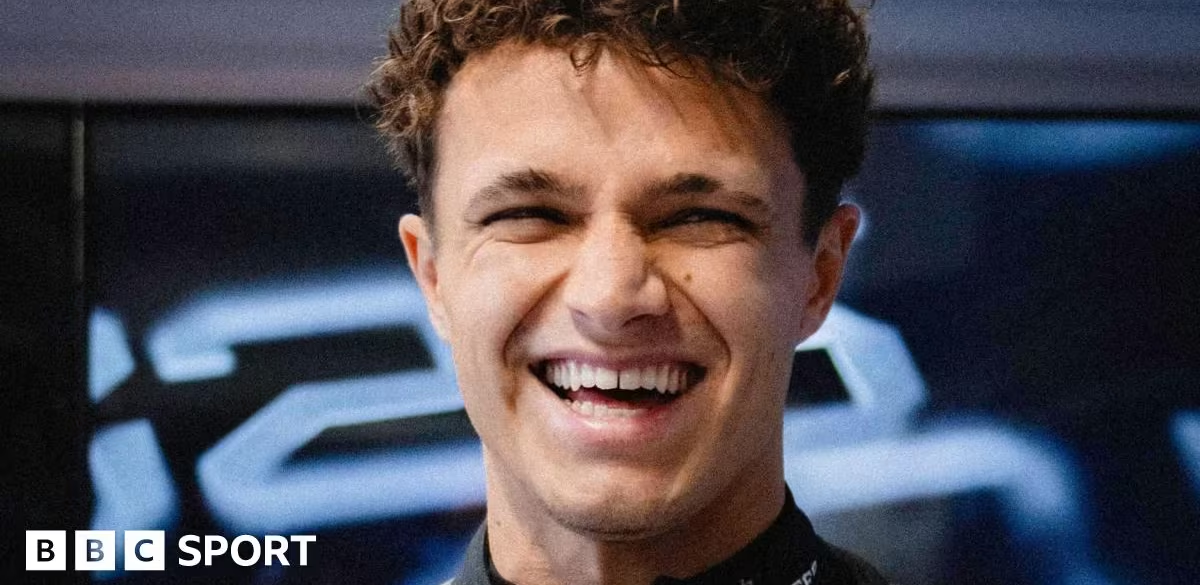
World champion Lando Norris says he expects "more chaos in races" this year as a result of the new rules introduced to Formula 1.
The sport has its biggest regulation change in history, with engines, chassis, fuel and tyres all subject to new requirements.
Energy management of the battery will be a central feature, with engines that now have more of their total power output provided by the electrical hybrid elements.
Briton Norris said: "You're going to see more chaos in races where a driver has to be a little bit more on top of all of these different situations that can happen.
"And that will happen through the whole year, I would say. There's more emphasis on drivers' ability to control all of these things."
The McLaren driver said the use of the new 'boost button', which gives an extra burst of electrical energy, and the effect that has on the battery's state of charge will be central to the new format of F1.
"You'll be able to force people more in different positions and create racing potentially in better ways than you have been able to in the past," Norris said.
"And that's probably a better thing, a good thing."
Norris is basing his early assessment of the cars on the 'shakedown' test that was held in Barcelona last week. There are two further three-day pre-season tests in Bahrain over the next two weeks, starting on 11 February.
He says the new engines and the need to manage energy could lead to drivers swapping positions more often.
"You'll see more yo-yoing, more moves with extra speed. But then that person might have to defend more than what you've seen in the past and that will create more chaos, which is great for you guys," he added.
Cars 'feel more powerful and quicker'
The engines are still 1.6-litre V6 turbo hybrids, as they have been since 2014, but one of the two electrical motors that recovered energy has been removed.
The total amount of electrical energy has been increased by a factor of three, but the battery is more or less the same size. If the battery is fully depleted, the engine loses 350kw (470bhp), leading to potentially dramatic speed differentials.
Drivers will be backing off towards the end of straights - and being careful about when they apply the throttle - to ensure the most efficient energy usage, even on a qualifying lap.
The cars are also smaller and lighter, have less downforce and have 'active aerodynamics' - where both front and rear wings open on the straights to increase speed and the possibility for energy recovery.
Norris said the new car "certainly feels more powerful and quicker" on the straight.
"The biggest challenge at the minute is battery management and knowing how to utilise that in the best way," he said.
"It's not simple. You can explain it in quite simple terms. It's just you have a very powerful battery that doesn't last very long, so knowing how to use it in the right times, how much energy, how much of that power you use, how you split it up around the lap...
"The biggest challenge is how you can recover the batteries as well as possible, and that's when it comes down to using the gears, hitting the right revs.
"Obviously, you've got some turbo lag now, which we've never really had before. All of these little things have crept back in, but I don't think that changes too much.
"In a perfect world, I probably wouldn't have [all] that in a race car, but it's just F1. Sometimes you have these different challenges."
His team-mate Oscar Piastri said the cars were "not as alien as I think we might have feared" and insisted he "didn't think F1 had lost its identity at all".
The Australian added: "There's going to be some things to get used to but in terms of some of the fears that maybe we had before we got on track, a significant majority of those have been alleviated now.
"There'll be some differences, but I think fundamentally they're still the fastest cars in the world."
The reduced downforce has lowered cornering speeds and ensured some of the quicker corners, where drivers did not have to slow down before, will be more challenging.
Norris said: "Quite a lot more corners that were easy in previous years or the last few years are going to become much bigger corners again.
"So that's a good thing in some ways and therefore you can see more racing.
"But you might have different strategies because what was then flat last year and not really a grip-limited section, now when you put a new set of tyres on you'll be able to gain in a lot more parts of the track."
Norris won his first title last year in a close season-long battle with Piastri and Red Bull's Max Verstappen.
The 26-year-old said he was revelling in the fact he had achieved his "life's ambition" and was keen to continue his success.
"If I don't achieve something again, I always have something that I'm very proud about. If anything, I enjoyed last year a lot - and of course I really want to do it again."
Norris' success in 2025 was the consequence of a big step in performance in the second half of the season, after assiduous work with his team on improving following a difficult first few races.
"I'm always trying to improve on my things," he said. "I know there's still areas that I'm not at the level I need to be - and it's still a good level - but when you're fighting these guys, you need to be close to perfection. There's still plenty of things I want to work on and I want to be better on, but the baseline level of where I'm at now is already pretty good.
"My motivation to win is exactly the same. I've definitely not lost anything and, if anything, I think I just have more confidence because I've said in interviews and stuff in the past that I'm very much a guy who has to see something to believe it, especially when it's been on anything to do with myself."