A Woman Is Born, and the World Takes Possession
Medium | 19.01.2026 19:29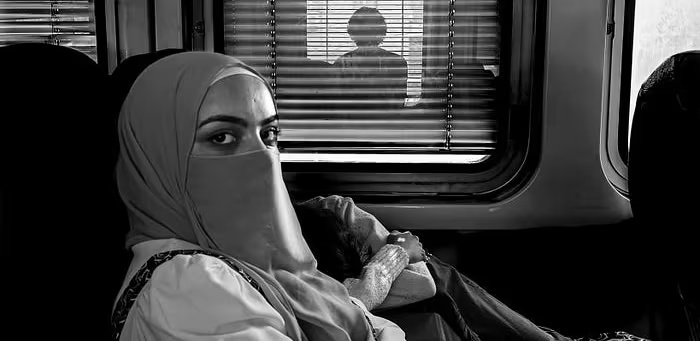
A Woman Is Born, and the World Takes Possession
5 min read
·
2 hours ago
--
Listen
Share
How culture, law, and fear quietly claim what belongs only to her
A woman is born into a body, but she does not arrive alone. The moment she opens her eyes, the body is already crowded. There are instructions waiting, expectations folded neatly like clothes in a cupboard, warnings spoken softly and sometimes not spoken at all. Long before she understands language, her body has been named, measured, imagined, and claimed. It is spoken of as something precious, something dangerous, something that must be protected, controlled, corrected. Slowly, without any official declaration, the body becomes a territory.
This is not a loud transformation. It happens quietly, almost politely. A hand that adjusts her dress. A voice that tells her to sit properly. A look that lasts a second too long. None of it feels political at first. It feels domestic. Familial. Normal. That is how power prefers to enter. Not through violence alone, but through routine. Through love that comes with conditions.
The language of honor is often the first border drawn. It arrives wrapped in care. Do not go there. Do not laugh like that. Do not stay out too late. The body is told that it carries something fragile and priceless, something that can be broken by the wrong street, the wrong hour, the wrong pair of eyes. Slowly, the body stops feeling like a place of breath and movement and becomes a responsibility. A burden to carry correctly. A mistake waiting to happen.
What is rarely said is that honor never lives inside the woman. It lives around her, hovering, watching, judging. It belongs to the family, the community, the nation. The woman becomes its storage unit. If something goes wrong, honor is not questioned. The body is.
The state eventually learns this language well. It speaks of protection while tightening its grip. Laws are written with careful words, but they touch the body directly. They decide which pregnancies are allowed to continue and which must be explained. They define violation in narrow terms, asking the body to prove its pain in acceptable ways. They demand timelines, evidence, and a perfect victim hood. The body, already tired, is asked to perform its suffering neatly.
Paper becomes more powerful than flesh. A form can invalidate an experience. A signature can legitimize control. In the name of order, the body is slowed down, examined, delayed. Justice arrives late, if it arrives at all. Meanwhile, time keeps moving through the body, leaving its quiet marks.
Religion often enters gently, through stories and symbols. It speaks of purity, of light, of discipline. It tells the body that it is a test. That desire must be managed. That silence is grace. In many homes, these ideas are not taught harshly. They are passed down like heirlooms. A grandmother’s warning. A mother’s fear. A prayer said out of habit. The body learns to shrink its questions. To confuse obedience with peace.
Get Sadman Sakib Ayon’s stories in your inbox
Join Medium for free to get updates from this writer.
Subscribe
Subscribe
Yet beneath these layers, something else survives. A private awareness. A sense that the body is not only a site of danger but also of knowing. Breath during dawn. Stillness during prayer. The quiet clarity that comes when the noise recedes. This is where something older than law and fear continues to live. A truth that does not need permission.
During conflict, the illusion of protection collapses completely. In moments of war, occupation, or communal violence, women’s bodies are no longer symbolic. They become literal battlefields. Violation is used as a message. A way to humiliate communities. To rewrite power. The body is attacked not because of who the woman is, but because of what she represents to others.
Afterward, there is silence. Not the peaceful kind. A heavy, suffocating quiet. Survivors are asked to move on without making others uncomfortable. Their pain is acknowledged briefly, then stored away. The body is expected to forget faster than memory allows. In public, these stories become statistics. In private, they live on as interruptions. A sound. A smell. A moment when the present suddenly collapses.
Class decides which bodies are believed. Some women are mourned loudly. Others disappear quietly. A poor woman’s body is easier to doubt. A marginalized woman’s pain is easier to explain away. The state calculates loss differently depending on whose body is involved. Some lives are counted carefully. Others are rounded down.
Media plays its role with practiced efficiency. It frames the body into narratives that are easy to consume. Victim or villain. Innocent or suspicious. The complexity of a real life does not survive headlines. The body becomes content. Its suffering trimmed to fit attention spans. Its voice replaced by experts, panels, opinions.
What remains missing is consent in its truest sense. Not the legal version, but the lived one. Consent shaped under fear is not freedom. Consent shaped by dependency is not choice. When a woman learns early that refusal comes at a cost, agreement becomes survival. The body learns to negotiate quietly. To choose the least painful option. To call endurance strength.
And yet, there is another way of seeing the body. Not as territory, but as a passage. Not something to be owned, but something to be listened to. In moments of deep stillness, the body remembers this. In breath that slows. In grief that softens into understanding. In the realization that the body is not an object placed in the world, but a witness moving through it.
This understanding does not arrive through rebellion alone. It arrives through attention. Through reclaiming small, ordinary moments. Drinking water without apology. Walking without explanation. Resting without guilt. These acts are not dramatic. They do not trend. But they quietly undo centuries of possession.
To see a woman’s body as sacred is not to control it. It is to leave it alone. To trust its intelligence. To accept that it carries its own map, written in pulse and memory. The body does not need guardians. It needs space.
Perhaps the most radical act is not resistance, but listening. To the body’s fatigue. To its boundaries. To its longing for simplicity. In that listening, something shifts. The body stops being a site of negotiation and becomes a place of arrival.
And in that arrival, power loses its language.