Pitfalls loom as Trump's Gaza peace plan enters second phase
BBC | 15.01.2026 19:31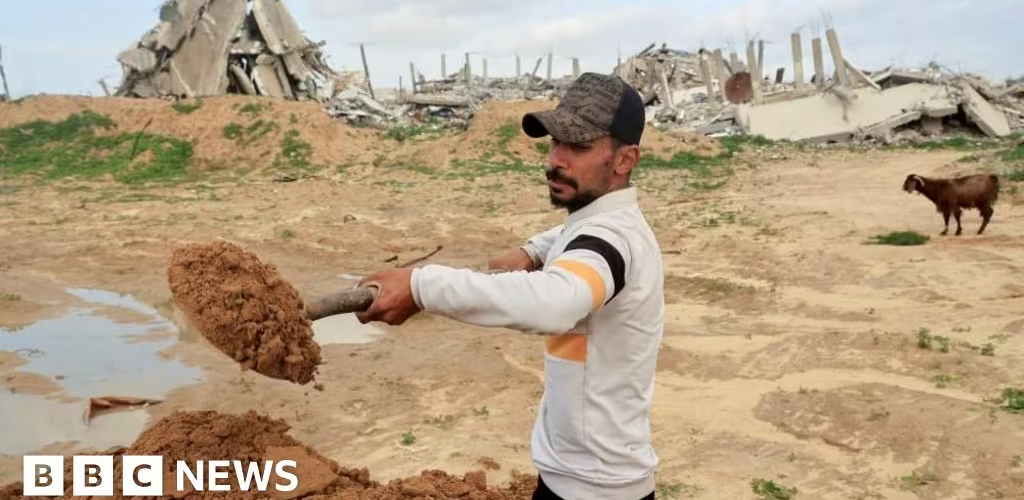
On the face of it, the announcement of phase two of President Donald Trump's peace plan for Gaza would seem like progress.
But there remains a huge lack of clarity and detail about the future of the strip and the 2.1 million Palestinians who live there.
Furthermore, there are many pitfalls.
First, Trump's plan demands that Hamas, as well as other groups in Gaza, agree to disarm.
Announcing phase two of the deal, the US Special Envoy to the Middle East, Steve Witkoff, said failure to do so would "bring serious consequences".
But Hamas has so far adamantly refused to give up its weapons, which it sees as tools of resistance to Israel's decades-long military occupation.
If it maintains that position, there are already far-right members of Israeli Prime Minister Benjamin Netanyahu's coalition government who are champing at the bit to resume the war and "finish the job".
While massively diminished militarily, US intelligence has long estimated that Hamas has likely recruited more new members in Gaza than have been killed by Israel during the war.
The ceasefire, which has been in place since October last year, is already fragile at best.
Both sides have accused each other of repeated violations.
More than 450 Palestinians have been killed in Israeli strikes since it came into force, according to the Hamas-run health ministry in Gaza.
The Israeli military says three of its soldiers have been killed in attacks by Palestinian armed groups during the same period.
Secondly, there is little clarity over to what extent Israel will be required to withdraw its forces from Gaza.
It has given no indication that it is willing to pull back completely, insisting it needs to maintain a strong security presence in Gaza.
Israel officials talk of "a new reality" in Gaza, insisting that the strip will never go back to the way it was before Hamas launched its deadly attack on 7 October 2023.
So, there could be continued wrangling over how far Israeli forces withdraw.
Then there is the issue of governance.
Who will run Gaza, if not Hamas, which came to power after winning Palestinian elections almost exactly 20 years ago?
Who will provide policing, security, schools, hospitals?
For more than a year now, there has been the idea that some sort of International Stabilization Force could provide security in Gaza.
Egypt, Turkey, the UAE, Qatar and Saudi Arabia, as well as the West Bank-based, Palestinian Authority, have all been suggested as potential countries that would make up this force.
But none have committed and, again, the detail is unclear.
Anyone seen as "riding in on the back of Israeli tanks" is likely to meet a frosty reception from Palestinians in Gaza.
Under Trump's peace plan, Gaza will supposedly have three levels of governance.
As the lowest level, the strip will be run by a new government of technocrats made up of figures from civil society within Gaza.
The names of its members were announced on Wednesday, with Hamas having agreed to have no role in the government.
Above that will be an Executive Committee based outside Gaza to oversee the new government's work.
It is likely to be made up of non-Palestinians, with former British prime minister Tony Blair said be among those who will sit on the committee.
Blair is widely distrusted by Palestinians, being seen as too close to Israel, and for his role, alongside former US president George W Bush, in the second Iraq War launched in 2003.
Finally, above the Executive Committee will be the Board of Peace, with Trump as its chairman.
The current British Prime Minister, Keir Starmer, Italy's leader Giorgia Meloni, and Turkish President Recep Tayyip Erdogan are rumoured to be among the board's proposed members.
Many Palestinians say having foreigners in effect running Gaza smacks of colonialism.
The question is: do they have a choice?
And all the while, the humanitarian situation in Gaza remains utterly bleak.
Since the ceasefire was announced last October, more aid has been allowed into the strip, but aid agencies say it is still nowhere near enough.
Hundreds of thousands of Gazans remain homeless and are living in makeshift tents.
The last few months in the region has seen grim winter weather, with torrential rain, high winds and temperatures below 5C (41F).
Gaza has experienced severe flooding, with buildings collapsing and tents blown away.
Most children have had little or no education for more than two years.
What does the future hold for them?
So, while phase two of the peace plan may seem like progress, there remain many reasons for pessimism.