Jacob Zuma Reinstates John Hlophe as MK Party Deputy President After Probe
iReport South Africa | 19.03.2026 00:53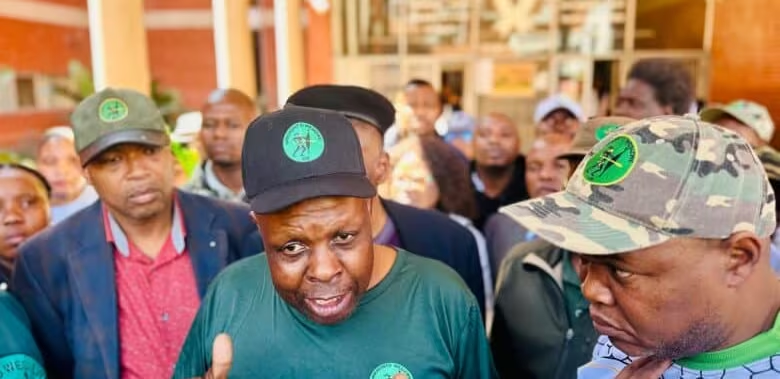
Former president Jacob Zuma has reinstated Dr John Hlophe as the uMkhonto weSizwe (MK) Party’s first deputy president and parliamentary leader, lifting a suspension that had been in place since November 2025 .
Suspension and Investigation
Hlophe was suspended after allegedly “acting unilaterally” by removing then-chief whip Colleen Makhubele and appointing MP Des Van Rooyen as acting chief whip without consulting Zuma, who was on a trip to Burkina Faso at the time . The party nullified those leadership changes and placed Hlophe under precautionary suspension pending investigation .
An independent legal panel, led by an advocate, was appointed to investigate the allegations against Hlophe and make recommendations . After receiving the panel’s findings, Zuma held a bilateral meeting with Hlophe where all allegations were discussed .
Reinstatement Confirmed
In a memo to party structures, newly-appointed MK Party secretary general Sibonelo Nomvalo confirmed Hlophe’s immediate reinstatement to both leadership positions .
“The suspension of Dr Hlophe arose out of matters that necessitated the President to appoint an independent legal panel… to investigate allegations levelled at Hlophe and make recommendations to the President on the necessary course of action,” Nomvalo said .
Nomvalo encouraged party members to extend a warm welcome to Hlophe as he resumes his duties “in pursuit of the party objectives, social cohesion, and human solidarity” .
Party spokesperson Nhlamulo Ndhlela confirmed to EWN that Hlophe’s suspension was lifted as of Wednesday, 17 March 2026 . Des van Rooyen, who served as acting parliamentary leader during Hlophe’s suspension, was thanked for his service .
Context of Leadership Changes
Hlophe’s reinstatement follows a recent leadership reshuffle within the MK Party. Last week, Bongani Mncwango was removed as secretary general and replaced by Nomvalo, who is currently a member of Parliament’s Ad Hoc Committee investigating allegations by KZN Police Commissioner Nhlanhla Mkhwanazi .
Since the formation of the MK Party in 2023, Zuma has either pushed to resign or sacked at least six secretary generals . Political analyst Andre Duvenhage has suggested the frequent changes reflect Zuma’s desire to place trusted individuals in key positions .
Nhlanhla Mkhwanazi, KwaZulu-Natal Police Commissioner, has made a startling revelation during his testimony, stating that even high-ranking officers within the South African Police Service are afraid to mention the name of Steve Motsumi.
Appearing before a parliamentary forum, Mkhwanazi painted a concerning picture of fear and intimidation within law enforcement structures, suggesting that the influence attributed to Motsumi has created a climate of silence – even among senior officials tasked with upholding the law.
“It is deeply troubling when those entrusted with enforcing the law feel unable to speak openly,” Mkhwanazi indicated, underscoring the seriousness of the situation. His remarks have sparked widespread debate about the extent of criminal influence and the challenges faced by police leadership in confronting powerful figures.
While details about Motsumi’s alleged activities remain under investigation, the commissioner’s statement has intensified calls for decisive action and stronger protections for officers who expose wrongdoing. Analysts warn that such a climate, if left unchecked, could undermine operational effectiveness and erode public trust in policing institutions.
The testimony comes amid broader scrutiny of SAPS leadership and internal dynamics, with Parliament seeking answers on issues ranging from organized crime to accountability within the ranks. Mkhwanazi’s disclosure is expected to form a key part of ongoing discussions around reform and oversight.
Experts say the situation highlights the need for robust internal safeguards, whistleblower protections, and clear lines of authority to ensure that no individual—regardless of perceived influence—can operate above the law.
Civil society groups have also weighed in, urging authorities to act swiftly to investigate the claims and restore confidence in the criminal justice system. “Fear cannot be allowed to dictate how law enforcement operates,” one activist said.
As the matter unfolds, attention will remain on how SAPS and oversight bodies respond to the allegations and whether concrete steps will be taken to address the concerns raised.
Mkhwanazi’s testimony has not only raised alarm bells but also reignited the conversation about power, accountability, and the rule of law within South Africa’s policing environment.