Some People in the Spectrum Relate to the 52-Hertz Whale
Medium | 08.12.2025 21:02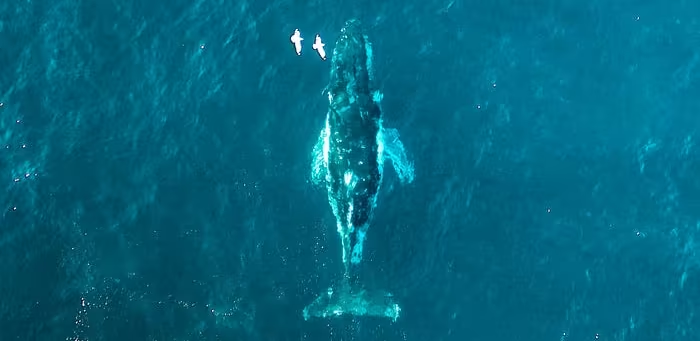
Some People in the Spectrum Relate to the 52-Hertz Whale
8 min read
·
Just now
The Loneliest Frequency: When your song is perfect but pitched to an empty ocean, and what that teaches us about neurodivergence, connection, and the unbearable weight of singing alone
There’s a whale somewhere in the Pacific Ocean who has been singing the wrong song for decades. Not wrong in the sense of being broken or badly composed—by all accounts, the 52-hertz whale’s call is structurally perfect, complex, beautiful even.
It's just that no other whale can hear it. The typical blue or fin whale communicates between 10 and 40 hertz; this whale broadcasts at 52. Scientists have tracked its migration patterns since 1989, a solitary path traced through acoustic data, each year the same haunting signature. Each year, apparently, unanswered.
I think about this whale more than is probably reasonable.
The 52-hertz whale has become something of an internet phenomenon, a symbol of loneliness that’s been romanticized in songs, documentaries, and countless essays about isolation. But what strikes me isn’t the loneliness itself—it’s the specificity of the problem. This isn’t a whale who can’t sing. It’s a whale who can’t be heard, despite singing exactly as whales are meant to sing. The mechanism is perfect; the frequency is just... off.
If you've spent any time in autistic communities, or ADHD communities, or really any neurodivergent space, you'll recognize this feeling immediately. That sense of broadcasting at the wrong frequency through no fault of your own.
In The Left Hand of Darkness, Ursula K. Le Guin writes about the concept of "shifgrethor"—a complex social protocol on the planet Gethen that the human protagonist can never quite grasp, no matter how carefully he studies it. He understands the rules intellectually, can even follow them most of the time, but the intuitive sense of it—the feeling of when and how that native Gethenians possess—remains forever just beyond his reach. He’s always translating, always a half-second behind.
I've never read a better metaphor for what it feels like to be autistic in a neurotypical world. Or what I imagine it feels like to be that whale.
The crucial thing Le Guin understood—and what makes the 52-hertz whale such a potent metaphor for neurodivergence—is that this isn’t about deficiency.
The protagonist in The Left Hand of Darkness isn’t stupid or socially incompetent; he’s an experienced diplomat, for god’s sake. The Gethenians aren’t being deliberately exclusionary or cruel. Everyone is operating in good faith. The mismatch is structural, built into the basic operating systems.
When you're autistic, people will often tell you that you're "not trying hard enough" to connect, to read the room, to pick up on obvious cues. When you're ADHD, you'll hear that you're "not listening" even as you're desperately trying to hold onto the thread of conversation. But the 52-hertz whale is trying. It's been trying for thirty-plus years. It's singing its heart out, following all the whale protocols, showing up where whales show up. The problem isn't effort.
The problem is frequency.
I've been thinking about this in terms of my own experience trying to explain autistic experience to neurotypical friends. There's this moment that happens sometimes, where I'm describing something—the way fluorescent lights feel like they're screaming, or why I can't just "get over" an unexpected schedule change, or how exhausting it is to maintain eye contact—and I can see the exact moment when the other person's face shifts into what I've come to think of as "polite confusion mode."
They want to understand. I desperately want them to understand. I'm using all the right words, providing examples, trying different angles of explanation. And yet something fundamental isn't transmitting. It's like we're both underwater, both singing, but operating at frequencies that simply don't overlap.
The cruelty—and I don't think that's too strong a word—is that this looks like a failure of effort rather than a mismatch of hardware. The 52-hertz whale can't simply "try harder" to sing at 20 hertz. That's not how vocal cords work. But from the outside, to whales who have never had to think about frequency at all, who just naturally produce and perceive the right range? It might look like the 52-hertz whale isn't really trying to communicate. Isn't really interested in being part of the pod.
When actually, it's trying more than anyone.
In Ocean Vuong’s On Earth We’re Briefly Gorgeous, there’s a passage about his grandmother, who survived the Vietnam War but never learned English. He writes about watching her interact with Americans, seeing her intelligence and humor reduced to gestures and confused smiles. "The tongue," Vuong writes, "is the only muscle in the body attached at just one end." A leap of faith every time you use it, trusting that the other end will find purchase somewhere.
That image has stayed with me: language as a muscle anchored in faith that someone, somewhere, is positioned to catch your meaning.
Get Misty Ayke’s stories in your inbox
Join Medium for free to get updates from this writer.
For neurodivergent people, that faith is constantly tested. We extend the tongue—the metaphorical one, the one that means connection—and often find nothing to grab onto. Not because we're speaking nonsense, but because the neurotypical world has built its entire communication infrastructure around frequencies we don't naturally produce.
The 52-hertz whale keeps singing anyway. Year after year, across thousands of miles of ocean, it maintains its call. I find this simultaneously heartbreaking and strangely inspiring. What kind of faith does that take? Or is it not faith at all, but simply biology—the imperative to communicate regardless of whether anyone's listening?
I suspect it's both. And I suspect that's true for autistic people too, for ADHD people, for anyone broadcasting at a frequency the mainstream can't quite process. We keep singing not because we're confident anyone will hear, but because the alternative—silence—is somehow worse.
When we talk about the 52-hertz whale or about neurodivergent experiences of isolation, there’s a risk of falling into a narrative of tragic nobility—the misunderstood genius, the lone wolf, the beautiful sad outcast. And while that narrative feels good in a certain painful way, it also obscures something crucial: other 52-hertz whales might exist.
Scientists don't actually know if the 52-hertz whale is alone. They've only ever tracked one, but the ocean is vast and we're not listening everywhere. There could be a whole population of 52-hertz whales out there, finding each other, forming their own pods, creating community at their own frequency. We just wouldn't know, because we're not listening at 52 hertz. We're listening for the "normal" range.
This, to me, is where the metaphor becomes not just sad but potentially radical. Because the same is true for neurodivergent community. When you find your people—when you’re in a Discord server full of other ADHD folks, or at an autism meetup, or just texting with that one friend who gets it—suddenly you’re not broadcasting into the void anymore. Suddenly there are people who can hear you at your natural frequency, who don’t find your intensity overwhelming or your directness rude or your interests bizarre.
The mainstream can't hear this community forming. To them, we still look isolated, still seem to be struggling to connect. But we're not. We're just connecting at 52 hertz, and they're still listening at 20.
Of course, the reality is more complicated than choosing one frequency or another. We don't actually live in separate oceans. Most neurodivergent people have to navigate neurotypical spaces constantly—work, family, public life. And most of us get quite good at it, developing what's sometimes called "masking": adjusting our frequency, moderating our signal, learning to approximate 20 hertz even when our natural resonance is 52.
This works, sort of. It allows connection, sort of. But it's exhausting in a way that's difficult to explain to people who've never had to do it. Imagine the 52-hertz whale spending all day forcing its call down to 20 hertz, straining to hit notes that don't come naturally, maintaining that false frequency for hours. Then imagine coming home and having just enough energy to wonder who you even are when you're not performing someone else's frequency.
In Adaptation, the film about screenwriting and orchids and identity, there’s a moment where Charlie Kaufman (or the fictional version of him) breaks down because he can’t figure out how to be himself and also be successful. His twin brother Donald, who takes a paint-by-numbers approach to screenwriting, seems so much happier, so much more connected to the world. Charlie’s trying to create something true and authentic, and it’s killing him, while Donald just follows the formula and thrives.
The movie doesn’t resolve this cleanly—it can’t, because it’s not resolvable. But what it does suggest is that maybe the goal isn’t to choose between authenticity and connection, between 52 hertz and 20 hertz. Maybe it’s to find contexts where your natural frequency is allowed, even if you have to code-switch in others. Maybe it’s about building enough 52-hertz spaces that you have somewhere to rest between performances.
I don't know if the 52-hertz whale is lonely.
I know that's what we've projected onto it, because we're human and we anthropomorphize and also because the idea of perfect isolation is terrifying and fascinating. But maybe the whale is fine. Maybe it found other 52-hertz whales years ago and scientists just haven't been listening at the right frequency to hear them answer. Maybe it prefers the quiet, the space to think and sing without the constant chatter of the pod.
Or maybe it is lonely. Maybe it spends its whole life singing into the void, never quite sure if anyone can hear, never quite giving up hope that someone might.
Both scenarios feel true to the neurodivergent experience. Some days I'm fine with operating at my own frequency, grateful for the small community I've found who can hear me, unbothered by the mainstream's inability to tune in. Other days I'm desperate to be heard by the wider world, exhausted by the translation work, wondering what it would feel like to just... naturally resonate with the people around me.
The ocean is vast, and we're all singing into it, trusting that our particular frequency will reach someone, somewhere. Most of the time, for most people, it does. Their songs find their pods, their calls get answered, their frequencies align without thought or effort.
And then there are those of us broadcasting at 52 hertz.
The 52-hertz whale has been singing for over thirty years. That’s not just loneliness—that’s commitment to the possibility of connection even in the absence of evidence that it’s working. That’s showing up every year to broadcast your truth at your natural frequency, regardless of who’s listening.
Maybe that's what neurodivergence requires: not the faith that everyone will eventually hear us, because they won't. Not the hope that we can permanently adjust our frequency to match the mainstream, because we can't, not without losing something essential. But the faith that our song is worth singing anyway. That there's value in the broadcast itself, regardless of reception. That somewhere in the vast ocean, someone might be listening at 52 hertz, waiting to hear a call that finally sounds like home.
There's a whale somewhere in the Pacific Ocean who has been singing the wrong song for decades. Except it's not the wrong song. It's just a different frequency. And maybe—I have to believe this—that difference is exactly what makes it worth singing.