The by-laws you may not know exist in London
BBC | 29.01.2026 12:57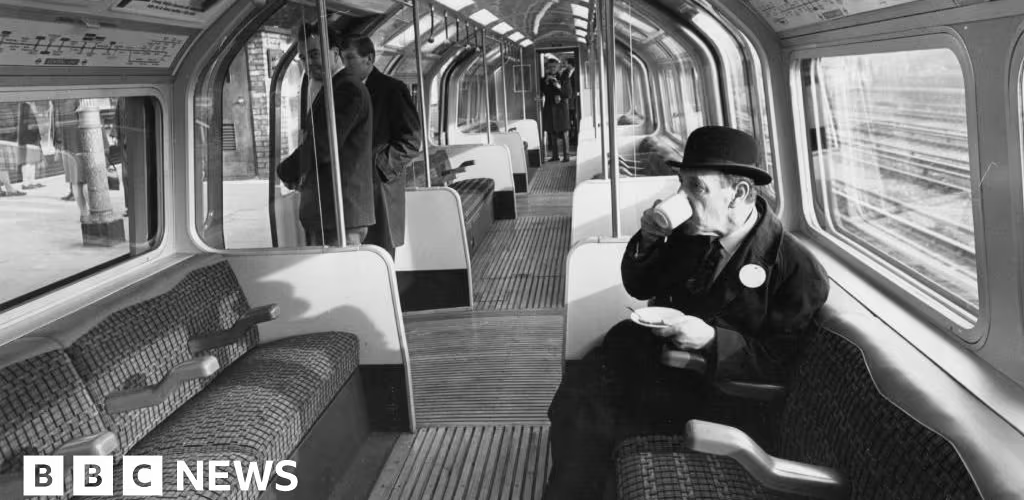
What do spitting on the street, feeding a pigeon and carrying a ladder on a pavement all have in common?
They are all acts that are banned in some areas of the capital under London's lesser-known by-laws.
How many of these quirky rules are you aware of?
What is a by-law?
A by-law is a law designed to deal with local issues and is made by local authorities or certain bodies under powers granted by acts of parliament.
By-laws covering public areas in London's boroughs are enforced by the local authority through a magistrates' court. Contravening a by-law can result in a fine.
They are considered measures of last resort after a council has tried to address an issue through other means. A by-law cannot be made where alternative legislative measures already exist that could be used to address a problem.
Government guidance says by-laws must always be proportionate and reasonable. When a by-law is no longer necessary, it should be revoked.
Unusual by-laws in London's boroughs
In 2013, both Enfield and Waltham Forest councils criminalised spitting in public and became the first London boroughs to do so.
In Enfield, a specific ban on spitting cand result in a £500 fine, and in Waltham Forest a fixed penalty notice of £80 could be served for committing a "littering offence".
Harrow Council enforces a public spaces protection order prohibiting the feeding of pigeons in town centres. Anyone who does so runs the risk of a £100 fine.
In Tower Hamlets, the council has tightened restrictions in parks, banning wildlife-feeding, including pigeons and squirrels, in a bid to reduce vermin and keep sites well-maintained.
In Westminster, there is a prohibition on entering Parliament in armour, which comes from a 1313 law that is still in force.
And the Metropolitan Police Act of 1839 is the source of a number of quirky rules.
The act details a ban on carrying planks and ladders on pavements in London, except for the purpose of loading or unloading a vehicle, or crossing the path.


And those looking to fly a kite should review section 54 of the Metropolitan Police Act first to be clear on the rules. It says kite-flying is an offence if done in a public area where it may become an "annoyance or common danger of inhabitants".
The act also says that Londoners cannot beat a carpet, rug or mat in all of the capital's boroughs except for the City of London. However, it is permissible to shake a doormat, as long as it is done before 08:00.
Transport by-laws that could result in a fine
Could drinking a coffee on a commute be against the rules? According to TfL by-laws, hot drinks could be classed as "potentially dangerous items". The organisation also prohibits passengers from carrying anything that may "soil a person or property".
By-laws on the network also cover more familiar acts, including fare evasion, which saw its highest level of prosecutions in 2024-25 when 13,118 penalty fare notices and 850 written warnings were handed out.
There is a TfL by-law on playing music or other content out loud, and the transport body's by-laws also cover travelling the wrong way on an escalator, which can lead to a fine of up to £1,000.
TfL said its by-laws were an important way to help passengers travel easily and safely.
A spokesperson said: "While most customers comply with our by-laws, in rare instances where enforcement officers encounter someone breaking a by-law, they will engage, explain the rule and ask the individual to stop.
"Most people comply at this stage. If someone refuses, further enforcement action may be taken – this could include being asked to leave the service or station or being reported for possible prosecution."