All Grown Up
Medium | 31.12.2025 22:59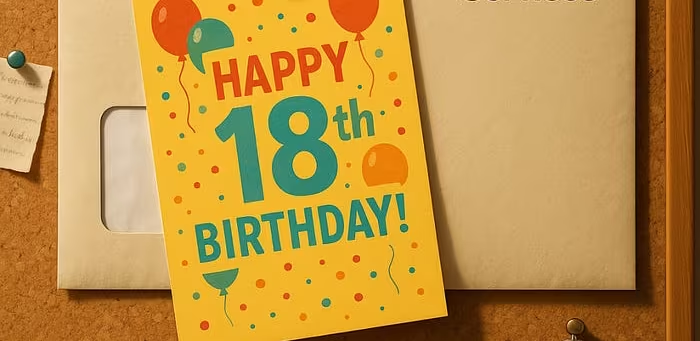
All Grown Up
Follow
7 min read
·
Just now
Listen
Share
It sounds like achievement. It sounds like the end of a story well told. A milestone reached, a door opened, independence earned. It is the phrase people use when they mean progress, when they mean ready, when they mean safe to let go.
“All grown up.”
But here is what it actually means: a date appears on a letter. A form that once said child now says adult. The person has not changed. The language around them has.
Nothing in the room has moved, but the world records a transfer. Responsibility shifts from system to family, from family to individual. The threshold is administrative, not developmental. The calendar declares what the body and mind have not declared.
That is how adulthood arrives here. Not as readiness, but as notice.
You receive the letter on a Tuesday.
The language is polite. The tone is familiar. Thank you for your patience. We are writing to inform you. As of the date below, services will transition. It does not say “end”. It says “transition”. The word suggests movement, planning, passage.
In practice it is a transfer. The file goes somewhere else. The relationships that took years to build become a set of handovers.
You notice the difference in tone first. Meetings that once began with questions now open with limits. Where a year ago support could be assumed, now it is queried. Where a behaviour was once recorded as distress, the same behaviour is read as non-compliance.
The vocabulary shifts accordingly. Safeguarding becomes risk management. Care plan becomes service agreement. The change is almost invisible until it is tested, and then it is visible enough that the shape of your days changes with it.
The people on the new side of the handover are not unkind. They are unfamiliar. The unfamiliar costs time you do not have.
At eighteen, society declares readiness. It is the age of permission. Vote, marry, sign, consent, refuse. Gamble if desired. Drink if able. Work if possible. Every door that was locked by law opens at once.
The world assumes that understanding has arrived on schedule.
For many, those openings mark independence. For others, they mark exposure. A rule written for the average becomes risk for anyone outside it. The same law that once shielded now stands further back.
No form asks whether comprehension moved at the same pace as time. No form asks whether regulation, judgment, or impulse have the same shape they did the week before the birthday.
Society presents adulthood as independence. It speaks about autonomy as a universal milestone and treats support as optional. Independence is framed as choice when it often depends on assistance. When assistance is reduced, choice narrows with it.
The public story of adulthood rarely matches its private reality.
This is what transition means in practice.
The files move. The support does not.
The network that supported your child dissolves and reforms under new headings that sound similar but operate with different thresholds. Education ends. Employment begins, if it can. Where there was plan there is paperwork. Where there was care there is criteria.
The adult pathway is described as empowerment. It becomes delegation and distance. A task is reassigned to the person least resourced to do it, and the success of the reassignment is then measured as independence.
The assessments repeat. Each new service requires history in its preferred format. You learn the grammar again. Evidence is asked for as if age itself should have produced progress. Progress is recorded when dependence is hidden successfully enough to be called choice.
If you have become efficient, the efficiency is read as capacity. Capacity is used to justify withdrawal.
The loop is tidy on paper. It is untidy in your kitchen at nine o’clock at night when care still needs to happen and the service day is over. The plate that must be washed. The medication that must be checked again. The routine that must be followed because routine is regulation, and regulation is survival.
The adult world is written for those who meet its rules. It assumes autonomy as default and calibrates help as exception. The phrase “age of accountability” appears in reports. Accountability, in this context, means absence of allowance. The vocabulary hardens while the nervous system does not.
The difference is not in the person. It is in the interpretation of the person.
Small artefacts show the scale of the change. The bus that used to arrive at eight stops arriving because the route exists only for pupils. The letter that used to come from school does not arrive because there is no school. The form arrives from a new office with the old questions in a different font.
The same diagnosis must be proved again. The same needs must be described again. The same days must be translated again into a language that treats assistance as a benefit rather than as an access condition.
It is not new work. It is the old work under a new heading.
Professionals do not vanish. They change shape.
Get Ken O’Brien’s stories in your inbox
Join Medium for free to get updates from this writer.
Subscribe
Subscribe
Some bend rules to bridge gaps. A worker holds a file longer than policy allows. A therapist calls between shifts. A doctor writes a sentence that prevents a clock from resetting.
These acts matter. They preserve safety at the edges of a system that cannot admit the centre needs changing. Kindness keeps a person held until the fix becomes possible, or until the need passes.
But kindness cannot scale when the design insists on repetition.
Outside, adulthood is narrated as self-determination, maturity, freedom. The posters are bright. The slogans are clean.
Inside your house, adulthood becomes risk.
It means that the person who could not yet hold the day is now expected to hold the day, or else to accept that the day will not be held at all. It means that you, who once had recognised standing, must now demonstrate harm before permission to stand is granted again.
The distance between help and harm is smaller than the language suggests. The risk sits in that distance.
There is also a social change that the paperwork cannot name.
The world that forgave difference when it was a child’s difference fears it when it is an adult’s difference. The same sound is heard as threat. The same movement is read as intent.
The same person is now an object of supervision rather than of teaching.
You learn routes that avoid places where a misunderstanding could escalate. It is not caution as preference. It is caution as survival in a world that believes a birthday erased context.
Money sits underneath all of this.
Resources that were pooled for education are scattered across assessments with smaller budgets and narrower remits. Support that once travelled with a person stops at the border between services, and the new service requires proof that the old support should be re-issued.
The proof takes time. Time is the thing you do not have.
The hours spent producing proof are removed from the hours spent providing care. The arithmetic is simple and punishing. It is not experienced as policy. It is experienced as fatigue.
The picture is not only loss. Skills continue. Adults learn in their own ways. A routine that kept a child steady keeps an adult steady. A visual schedule remains a schedule. A keyboard remains a voice. A quiet corner remains a corner where calm can be rebuilt.
None of this depends on a category. It depends on design.
You build structures that outlast services because the structures were never only services. They were the arrangement of rooms, the order of days, the rules of leaving and returning, the expectation that support is a condition for participation, not a reward for passing a test.
It is tempting to call the difference between the promise and the provision failure. It is more accurate to call it exposure.
The child label hid the gap. The adult label reveals it. The same world continues with less cover. The same work continues with fewer hands allowed to hold it.
The system did not decide that need ended. It decided that the category moved and took responsibility with it. The consequence looks like independence. It often feels like distance.
None of this is improved by sentiment. The story is factual.
A date arrived. Services shifted. Language hardened. Risk rose because interpretation changed. Some professionals made the day safer than it would have been. Many could not because the rules prevented it or the hours did not allow it.
You continued the work because the work had to continue. The person at the centre did what they have always done: lived inside a body and mind that need support, with or without a label that fits.
There is a way to define adulthood that does not depend on the calendar.
It is not freedom from support. It is not distance from dependence. It is not the end of supervision.
It is the capacity to remain present in a life that still needs design. It is the continuation of learning under a different name. It is the refusal to equate permission with understanding. It is an arrangement of days that makes participation possible and keeps dignity intact.
The date still arrives each year. The number changes. The file grows heavier. The need remains the same.
The world continues to measure adulthood by distance from help. You measure it by the stability of days that still work.
The person who was called a child is called an adult. The support that allowed participation is now argued for rather than assumed.
That is the factual difference that matters.
“All grown up” perhaps means only this: the work continues, and the language around it changes.
But it cannot remove what still must be held.