Bellville’s Award-Winning Buy-Back Centre is Tackling Waste and Joblessness
Good Things Guy | 18.02.2026 13:30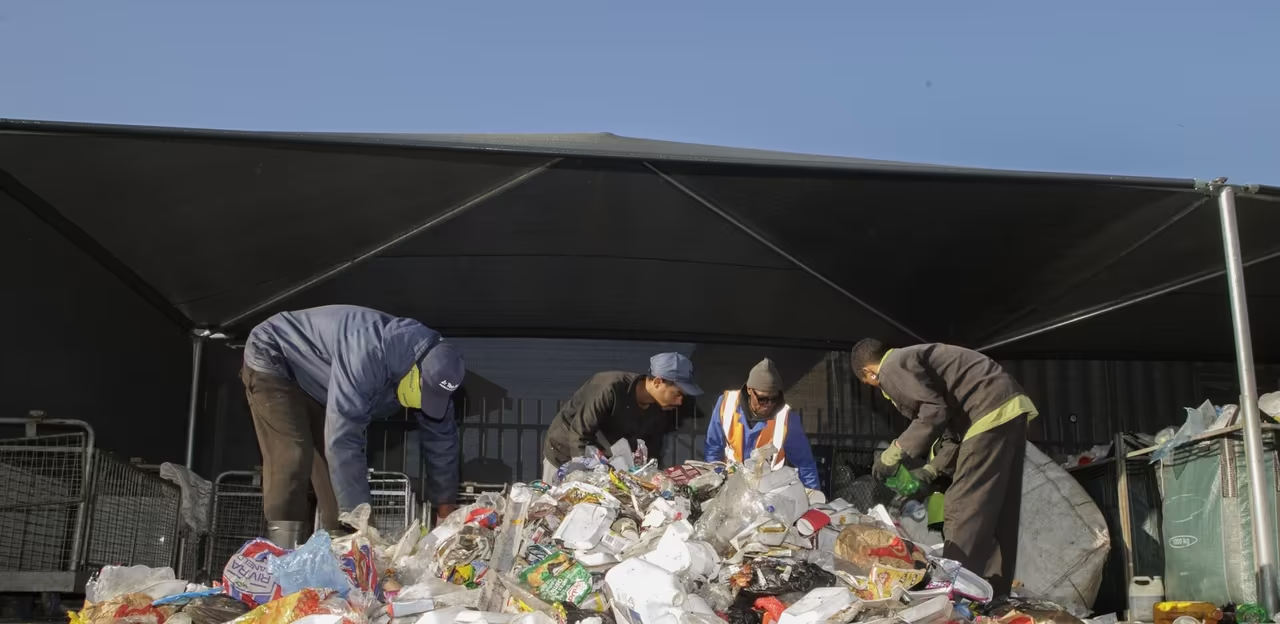
The well-designed Buy-Back Centre in Belville is ensuring people who were once marginalised are earning a living with dignity. More excitingly, it has been nationally and internationally recognised as a model of urban regeneration, green innovation, and social empowerment.
Cape Town, South Africa (18 February 2026) – The unemployment crisis is a growing issue in our country, with nearly 32% of people remaining unemployed. An initiative in Bellville, Cape Town, is tackling the issue head-on by using recycling to offer homeless and unemployed individuals a safer, more structured path to earning a living.
The Buy-Back Centre by the Greater Tygerberg Partnership (GTP), recently recognised both nationally and internationally, is proving that innovation and inclusion can create real economic and environmental change.
Launched in 2019 as part of the Trolley and Recycling Project, the initiative began as a small-scale effort and has grown into an internationally recognised model of urban regeneration, green innovation, and social empowerment that is now ready to be replicated in other regions across the country.
In South Africa, approximately 80% of post-consumer waste is processed through the informal economy, with thousands of waste pickers collecting recyclables daily for minimal returns.
The GTP model formalises this activity, connecting waste pickers to legal, accessible buy-back centres, providing them with training, stipends, upgraded equipment, and safety-focused trolleys.
The results have been transformative. In the past year alone, the initiative processed over 113,000 kilograms of recyclables and created 23 jobs for previously homeless or unemployed individuals. Each receives daily stipends and access to ongoing training, life skills development, and addiction recovery support through partners like MES Cape Town and Green Cape.
The addition of South Africa’s first electric waste collection vehicles (EVs) in 2024 further boosted efficiency and reduced carbon emissions, while linking waste pickers to formal recycling markets, ensuring they earned more for their collections.
Today, over 180 local businesses and schools in Bellville participate in the recycling network, helping build a cleaner city and a more inclusive economy.
A Scalable Solution with Global Recognition
The project’s success has earned it the PETCO “Kerbside Collection and Sorting Superhero” Award for its community-driven, long-running, and efficient approach to separation-at-source.
Internationally, it received the IDA Downtown Achievement Award of Excellence, placing Bellville alongside leading global cities recognised for innovative urban management and sustainable placemaking.
For Warren Hewitt, CEO of the Greater Tygerberg Partnership, the recognition represents an opportunity to scale impact.
“Bellville faces challenges like poverty, unemployment, and waste overload, which mirror those of many cities across South Africa. This model proves that through collaboration between communities, government, and the private sector, we can turn these challenges into opportunities for growth, dignity, and sustainability,” he says.
Partnerships That Bridge Divides
The Buy-Back Centre’s success is rooted in multi-sector partnerships that bridge divides between informal workers, municipalities, NGOs, and private enterprises. By connecting these networks, the model demonstrates how social justice and environmental sustainability can reinforce each other.
Through collaboration with organisations such as the Voortrekker Road Corridor Improvement District, MES Cape Town, Green Cape, and eWASA, the GTP has built a model that is financially viable, socially inclusive, and environmentally restorative. It integrates informal waste collectors into a circular economy, while reducing municipal waste burdens and improving urban cleanliness.
“What makes this model remarkable is its adaptability. It works just as effectively in a dense urban centre like Bellville as it would in smaller towns or rural districts. Its low-cost electric collection vehicles, community partnerships, and skills development framework make it scalable without the need for large municipal budgets,” adds Hewitt.
It is also replicable across regions looking to tackle unemployment and waste simultaneously, creating a pathway to sustainable livelihoods, cleaner cities, and stronger communities.
In a nation grappling with unemployment and inequality, Bellville’s Buy-Back Centre offers a glimpse of what’s possible when innovation meets compassion. It’s a story of people once marginalised, now earning with dignity, and a revolution in urban renewal, rooted in community, and ready to scale nationwide.
Sources: Supplied
Don’t ever miss the Good Things. Download the Good Things Guy App now on Apple or Google.
Do you have something to add to this story? Please share it in the comments or follow GoodThingsGuy on Facebook and Twitter to keep up to date with good news as it happens, or share your good news with us by clicking here or click the link below to listen to the Good Things Guy Podcast with Brent Lindeque – South Africa’s very own Good Things Guy. He’s on a mission to change what the world pays attention to, and he truly believes there’s good news around us. In the Good Things Guy podcast, you’ll meet these everyday heroes and hear their incredible stories:
Or catch an episode of Good Things with Brent Lindeque or our Weekly Top 5 below. The videos here are always changing, updated with the latest episodes from these two shows. Both are part of Good Things TV, created to bring South Africans balance at a time when the news can feel overwhelmingly negative. Our goal is simple: to remind you that there are still so many good things happening in our country – and to leave you feeling a little more proudly South African.