The Retreating Left
Medium | 12.01.2026 14:28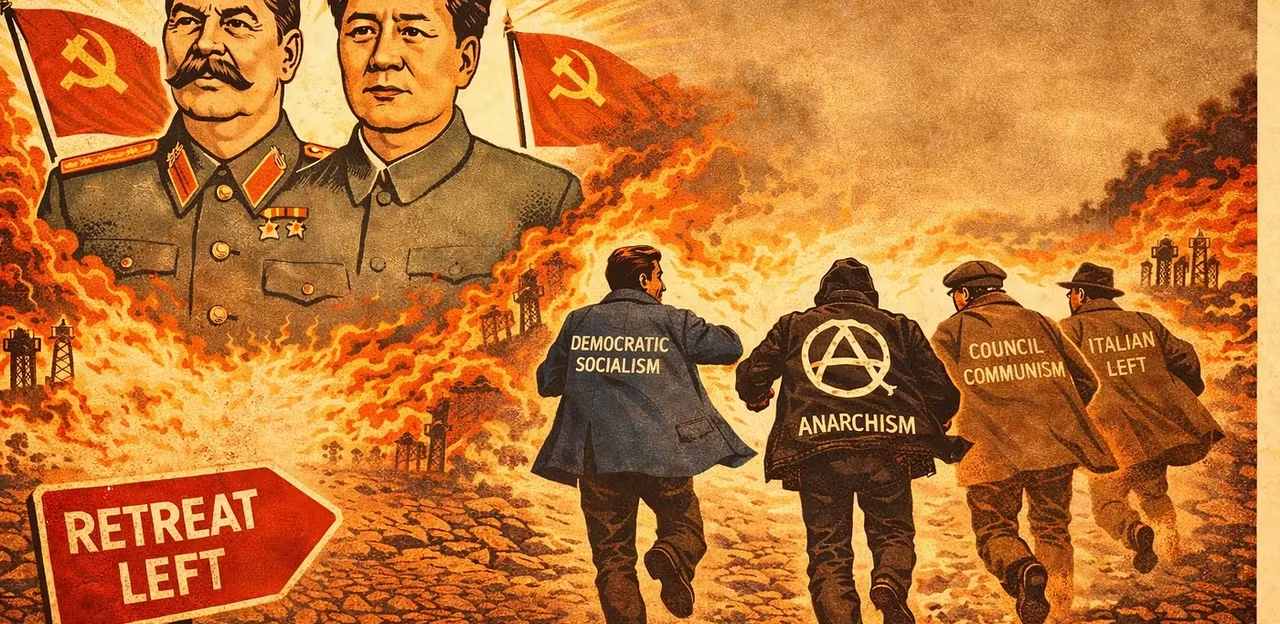
The Retreating Left
6 min read
·
Just now
--
Listen
Share
Democratic Socialism, Anarchism, and Left Communism are variations of the same failure. Each represents a retreat from the inherited legacy of Communism and the revolutionary Left. Trotskyism is unworthy of serious engagement; its absence here mirrors its real-world irrelevance.
The Cold War cast a long shadow over the Western Left. Red Scare repression, censorship, and surveillance forced many who wished to survive politically to disavow socialist states such as the USSR and China. For some, this disavowal became total. Democratic Socialism, Anarchism, and Left Communism emerged in this context as different strategies of retreat—positions I once inhabited but no longer do.
I first entered the Left through Democratic Socialism. There is little value in endlessly critiquing it. Lenin did so in State and Revolution; Rosa Luxemburg did so in Reform or Revolution. They did it more clearly and more forcefully than I ever could. I will therefore engage Democratic Socialism only as it appeared to me: as a politics of retreat.
My first sustained engagement with Democratic Socialism came through the Bernie Sanders campaign in 2016. At the time, low-wage retail work paid $7.25 an hour while the cost of living continued to rise. Liberal promises of “hope and change” rang hollow. The future appeared to offer nothing but endless, degrading work. Sanders spoke openly about billionaires, imperial wars, and inequality. He appeared as an outsider opposing the neoliberal Democratic Party machine.
That moment of hope was quickly crushed when the Democratic Party intervened to sabotage Sanders’s campaign and force his endorsement of Hillary Clinton—an act repeated again in 2020. What might be dismissed as folly if it occurred once became structural certainty when it happened twice.
Historically, electoral socialism has produced limited reforms, but these gains were never gifts from the ballot box. They were concessions forced by mass struggle in the streets. Democratic Socialism ultimately dissolves into social democracy: competent administration of capitalism, managed decline rather than confrontation. It promises socialism but endlessly defers it. Social democrats are not neutral administrators; they are capitalist imperialists who stabilize the system in moments of crisis.
The appeal of Democratic Socialism lies in its reassurance. It claims to be socialist, but not “authoritarian”; democratic, unlike the USSR or China. It insists on rights and freedoms, as though such things cannot exist under socialism. It runs from revolutionary history in exchange for acceptance. It offers socialism without struggle and power without rupture. Yet socialism has never come to power through elections and survived. You cannot overthrow the bourgeoisie using institutions designed to preserve bourgeois rule.
In 2018, I worked for the Super PAC NextGen America. I went from retail work to earning $1,000 a week. That experience stripped away any remaining illusions. Politics was not about persuasion or consciousness—it was about turnout metrics, data points, and managed enthusiasm. The hours were erratic, travel was unpaid, and during a special election we worked 72 hours in four days. Even progressive causes exploited labor. Electoralism revealed itself not as transformation, but as professionalized containment.
Disillusioned with electoral politics, I turned elsewhere. At the time, I accepted the dominant right-wing framing of the USSR as authoritarian and failed. I mistakenly equated socialism in power with fascism—a category error that collapses opposing class forces into moral equivalence. Fascism is death; socialism is life. They are antagonistic systems.
Believing socialism had failed, I sought a “third way”: anti-state communism, anarchism.
I am not referring here to lifestyle anarchism or right-wing individualist deviations. I mean anarcho-communism—left libertarianism as a serious revolutionary tradition. Anarchism appealed to me because it recognized the necessity of rupture and struggle. It rejected reformism. It imagined workers directly controlling production rather than the state.
I studied anarchism seriously. Alexander Berkman’s What Is Anarchism? remains one of the most emotionally compelling critiques of injustice I have read. Its plain language felt human in ways many Marxist texts did not. I read Daniel Guérin, Peter Kropotkin’s The Conquest of Bread, and Post-Scarcity Anarchism.
Yet fundamental questions remained unanswered: Where does anarchism stand on imperialism? On colonial violence? On racism and national oppression? How does it organize to confront these realities? The answers were vague or absent.
Anarchism is rhetorically moral but structurally liberal. Without hierarchy, organization collapses. In practice, anarchism becomes episodic revolt, individual action, or subcultural politics. The IWW still existed, but in a diminished form—bureaucratic, fragmented, and unserious compared to its revolutionary peak. Outside of Spain—if Catalonia can even be considered a successful revolution—anarchism never seized or sustained power.
Through the IWW, I became involved with the Incarcerated Workers Organizing Committee, which was materially engaged in organizing imprisoned workers—many of them Black and brown. There I encountered Marxists who identified as Left Communists. Like anarchists, they argued that the USSR was state capitalist and not socialist.
Through collective study, I encountered Anton Pannekoek’s Workers’ Councils, which seemed to bridge anarchism and Marxism. I then read Paul Mattick and works associated with anti-Bolshevik communism. Eventually, I discovered Amadeo Bordiga and the Italian Communist Left.
I engaged with the International Communist Current, the International Communist Tendency, and ultimately the International Communist Party. In 2018–2019, I corresponded with the party center and wrote analyses of U.S. and global politics, including the Trump regime. I revisited Lenin’s State and Revolution and Imperialism, as well as Marx’s 1844 manuscripts.
Yet as crises intensified—COVID, economic collapse, social unrest—the ICP remained frozen. It observed and translated theory while the world burned. I published an article during the height of the pandemic in March 2020, Coronavirus vs. Capitalism. But the party’s activity amounted to commentary and archival preservation. Selling newspapers while history accelerated exposed the limits of abstentionism.
The George Floyd Rebellion marked a decisive rupture. As capitalism entered open crisis, reaction intensified.
January 6, 2021, was a turning point. Fascism no longer appeared marginal. By 2022, reaction escalated: “Don’t Say Gay” laws, open attacks on trans existence, the overturning of Roe v. Wade, and threats to contraception and marriage equality. Abstention became impossible when my own existence was threatened.
I returned to lessons from my time organizing with Students for a Democratic Society. Through campaigns around racism, immigration, and budget cuts, I learned the practical meaning of the mass line: not abstract correctness, but assessing the actual level of mass consciousness. Class contradictions—budget cuts, material conditions—were where collective action could form.
The final rupture came with the national question. I had previously rejected Black nationalism by falsely equating it with white nationalism. I failed to understand that one is the nationalism of an oppressor, the other of liberation. This misunderstanding unified the failures of Democratic Socialism, Anarchism, and Left Communism. Each retreated from socialism in power by disavowing national liberation and colonial struggle.
Claiming that socialism “hadn’t really been tried” became an easy escape. It was intellectual laziness—utopian socialism disguised as critique. Socialism is not an idea; it is a historical process we inherit. Disavowing that history does not free us—it guarantees defeat.
Much of the Communist Left’s dismissal of Stalin, Mao, and Black nationalism rests on a failure to understand colonialism and settler colonialism. These ideologies remain Eurocentric, fixated on white industrial workers while ignoring oppressed nations. I had to overcome my own settler consciousness to grasp national liberation as the resolution to imperialism.
After years of contradiction, I returned to the ground I had once abandoned. At 26—the same age I was when I met my mentor—I no longer approached communist history with fear or embarrassment, but with responsibility. I arrived at Marxism-Leninism: revolutionary science forged in struggle, not abstraction.
I revisited Stalin not as a caricature, but as the leader who defeated fascism and advanced global liberation. I understood Mao as a revolutionary force who inspired decolonial struggle. My politics had always carried a national liberation impulse—from Ward Churchill to the Black Panther Party, one of the most advanced revolutionary formations in U.S. history precisely because it embraced Marxism-Leninism.
I have returned to Marxism-Leninism and to the revolutionary organization I once left: the Freedom Road Socialist Organization. FRSO is materially the most advanced Marxist-Leninist organization in the United States, actively organizing toward revolution rather than retreating from history.