An American in Palestine
Medium | 18.12.2025 01:58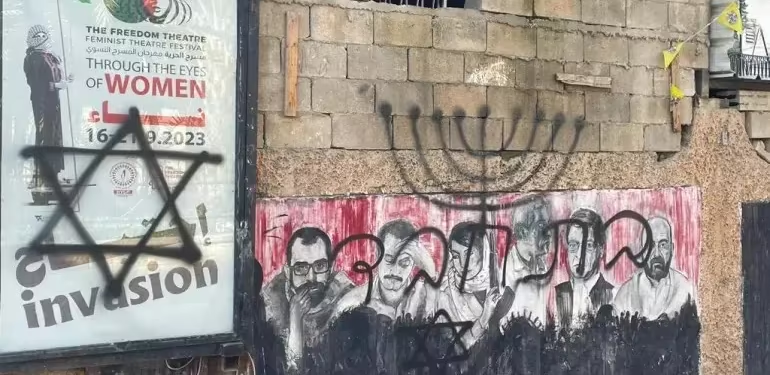
The author had read about living under a brutal occupation. But he wanted to see the situation with his own eyes. The chapters in this series reveal what he found.
“Let me be the king. I know how to do the job!” Ashraf proclaims in Arabic while playing a character on stage in the Jenin refugee camp.
Later, away from the bright lights and the audience’s applause, he says candidly, “On stage, I feel strong, alive, proud.”
He is less than 10 years old. About six years later, he will be killed by the Israel Defense Forces while defending his village, family, and neighbors. The inscription on his body bag will read in in his native tongue, “The Martyr Ashraf Abu Al-Hija.”
Yet Ashraf lives on through celluloid, because these scenes are captured in the film that won the 2004 Tribeca Film Festival award for best documentary, Arna’s Children.
Ashraf and the other youngsters featured in the movie, several of whom also met their demise when they later took up arms, were part of a theatre troupe in the 1990s. The performance group, first dubbed The Stone Theatre, was founded by Arna Mer-Khamis, an Israeli-Jewish woman who fought for the IDF during the 1948 Arab-Israeli War yet eventually recognized, with compassion, the brutalities that had been inflicted on the Palestinians and the occupation they continued to live under. In response to this epiphany, she began to direct her attention toward educating Palestinian children, culminating in the establishment of The Stone Theatre, which would eventually be renamed the Freedom Theatre.
Today, the Freedom Theatre still breathes and has expanded its programming to include adults. Yet its actors no longer have a building in which to share their talents. In December 2023, shortly after Hamas’s horrific attack and the beginning of Israel’s genocidal retaliation, IDF soldiers severely damaged the space, graffitied its walls with obscenities and the Star of David, and arrested its artistic director, general manager¹, and a performer under the guise of “administrative detention.”
During my short stay in Jenin, I had the opportunity to meet and interview the head of both the children’s and women’s programs, Ranin Odeh.
With tightly drawn black hair, a distinctive face, and a radiant smile, Ranin is petite in stature yet conveys the presence and power of a person twice her size. When she speaks, she exudes passion and moral conviction. Within five minutes of meeting her, I couldn’t help but already admire her.
“I grew up in the city of Jenin but my work has been in the camp,” Ranin said through Ismail, who, though still working on his proficiency in English, sufficiently served as our translator.
“When was the first time you visited the camp?” I asked.
“I went when I was young. The first time I visited was to watch a performance at the Freedom Theatre. I had never seen a play before.”
“And what did you think of the show?”
“I was really moved. I decided at that point that I wanted to become a performer,” she stated.
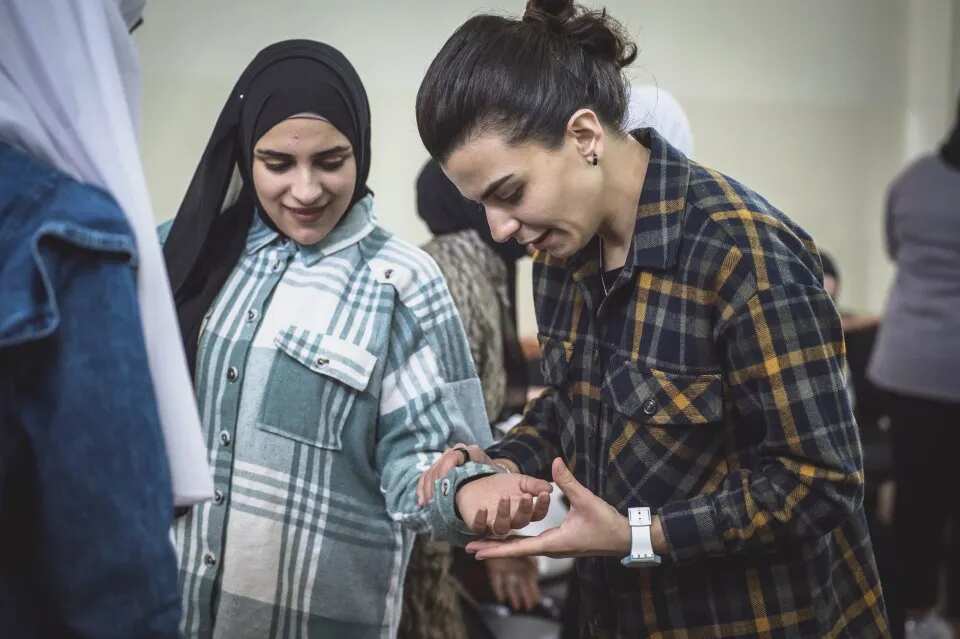
When Ranin first took up her craft, she acted in a space outside the camp. Later, however, she was recruited to join the Freedom Theatre by other girls from the group as well as one of its leaders. By the time she came aboard in 2009, Arna Mer-Khamis, the original theatre’s founder, had passed away. Several years after her death, in 2002, Israeli soldiers destroyed the initial theatre space during the Battle of Jenin, the very war that would claim the life of Ashraf Abu Al-Hija. The theatre was dormant for several years, until Arna’s son, Juliano Mer-Khamis, who had earlier co-directed Arna’s Children, co-founded a resurrected configuration of the playhouse in 2006 under the new banner of the Freedom Theatre.
“When I came to the Freedom Theatre, Juliano Mer-Khamis was heading up the company,” Ranin explained. “But two years later, he was dead.”
On April 4, 2011, Mer-Khamas was murdered by a masked shooter near the reestablished theatre he himself had co-founded. Though the murder remains unsolved, there is suspicion that the killer was actually a Palestinian who, like other residents of Jenin holding more conservative outlooks, felt Mer-Khamas was a corrupting influence on young people because of the liberal views he supposedly espoused through his artistic work.
“I left the theatre after we lost Mer-Khamas,” Ranin noted. “But I came back in 2014 and have stayed until today.”
“So what is the main purpose of the theatre?” I asked.
“For the kids, it’s a way for them to express themselves and get a break from their everyday struggles,” she replied.
But it’s much more than that.
“The primary aim, or goal of the Freedom Theatre is how to turn art into resistance,” Ranin asserted. “This is what, also, in terms of changing the behavior and mentality of the people — of the local community. How to change the ideology, the way people think.”
The recent damage to the current building housing the theatre has limited the children’s opportunities to perform. Yet Ranin finds ways to keep them active in fun and meaningful activities.
“Sometimes the children and adults in the women’s program go to visit and creatively interact with people displaced from the camp.”
“Are the children still acting in plays?”
“Now, no, because we can’t go to the Freedom Theatre, and working on the stage,” Ranin revealed via Ismael’s translation in his emerging English. “But,” she added, “we thinking how we can building performance in the streets.”
It would seem that, just like the resilient Palestinian people themselves, the theatre will survive. No matter how many times the IDF demolishes its venues or what the Israeli military might do to break the troupe’s spirit, the show must go on.
“Our link in this land is a form of resistance,” Ranin declared. “And the work is resistance. And our attempt of changing the others around also is a form of resistance.”
“So what would you like me to say to students when I go back home?” I asked Ranin, repeating the same question I had posed to many others throughout my time in the West Bank.
“Why do you, why are you pro-Israeli if you don’t really know what we Palestinians experience?” she began. “We live in a small, geographical spot and that is not familiar to you as an outsider. You [should] come here, see, how we are, somehow powerless, and there’s like a powerful country [Israel] with all nuclear, military things. And why should we be called terrorists?”
Ranin made it clear that, to her, the Palestinians whom the Western world typically labels as terrorists are simply everyday people who, in response to the endless occupation and other abominations exacted on them by the IDF, have been driven to defend their land and their lives.
“Who is [sic] the terrorists?” she exclaimed. “Even the resistance,” she continued, “it didn’t come out of nothing. No, they [the resisters] have certain reasons. They have been through losses. Each member of families like the wounded, martyred, ended up being handicapped, or somehow, lost something.”
As the traditional, yet modernized Arabic music continued to sound in the background and the chatter carried on at tables around us in the café, my conversation with Ranin soon came to an abrupt halt.
“I’m sorry but I must excuse myself,” Ranin politely announced in English without Ismail’s translation. “It has been a pleasure, but I must hurry home before the Israeli soldiers start wandering the streets.”
Several weeks later, after screening Arna’s Children in the safety of my own New York apartment, Ranin’s vivid appeal for what I should tell students whose tax dollars provide support for all the horrors she alluded to rapidly came to mind. How did Ashraf, the sweet and handsome boy who once felt so alive on the stage in the Jenin refugee camp decide to enter a theatre of war and end up so dead at such a young age?
Or what about Yussef, another energetic boy featured in the documentary? “If I bring the sun into the palace, then I’ll be the king,” he once said in character in the same play Ashraf performed in. Five years after that expression of light he and a friend fell into a very dark state to become suicide bombers, killing not only themselves but also several Israeli civilians. Yussef left behind a closing script that began: “To my brothers, my family and all my loved ones. I greet you and say goodbye.”

Yet as Ranin had said, “it didn’t come out of nothing. No, they have certain reasons.” What would anybody expect to happen, I thought, when a five-year-old boy sees his father’s body reduced to a corpse at the hands of an IDF soldier and kicked aside in the dirt as rubbish by the same invader’s feet? How would any person able to generate even an ounce of empathy expect a nine-year-old girl to behave after witnessing an Israeli fighter ramming her pregnant mother in the abdomen with the butt of a rifle in the name of “defending his nation’s right to exist,” resulting in the miscarriage of what would have been the youngster’s baby brother or sister? What should a people do when their ancestors were violently expelled from their houses during the Nakba that began over 75 years ago and, in a sense, still continues; when their sons and daughters might not return home in the evening because they’ve been placed in “administrative detention” only to be tortured by prison guards; when their friends can’t travel to drop in on relatives because 19-year-old lads and young women with rifles won’t allow them to pass through checkpoints; when, in Gaza, neighborhood landscapes are reduced to rubble, Palestinian parents hold the bloody, unbreathing bodies of their emaciated children, and victims with missing limbs lie on the soiled floors of bombed-out hospitals? As Ranin had asked in a second language, “who is the terrorists?”
After Ismail and I left the café, we were greeted, once again, by his cousin Suhuib, who was sitting behind the wheel, ready to take us to our next destination.
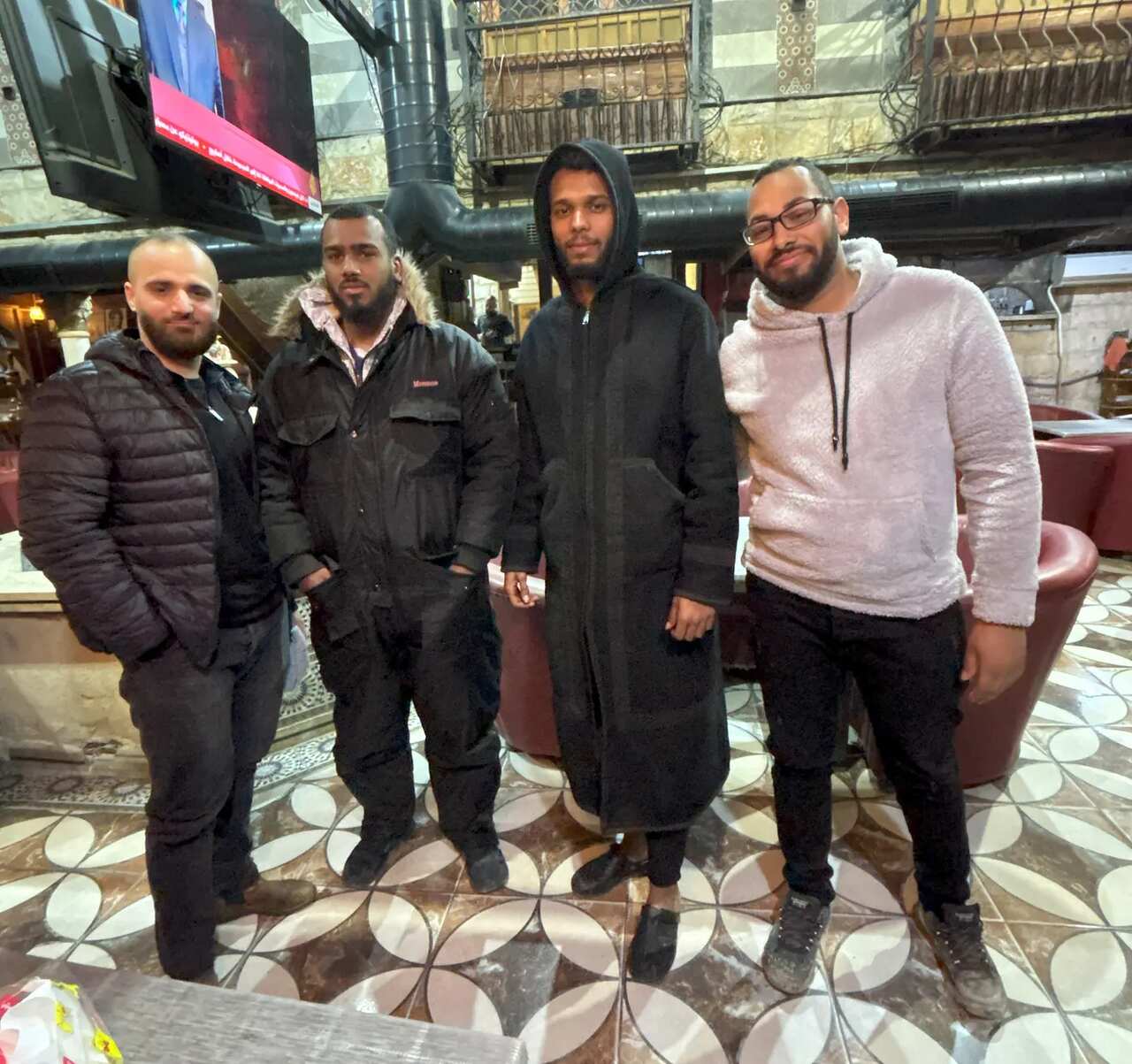
As we entered the lounge he had parked near, we were joined for non-alcoholic drinks by two others, including Baraa, a dear friend of Ismail’s and a professor at a local university, whom I had met the day before. Given our mutual academic positions and interests, I especially enjoyed the lively banter he and I shared. Indeed, it was Baraa who told me about and recommend I view Arna’s Children to gain a fuller understanding of Jenin and its refugee camp.
Talking and laughing with four amiable gentlemen over, what I would say at home, “mocktails,” was the perfect way for me to decompress as I approached my second night at the hotel before leaving the next day. Being on the ground in Jenin and observing the persistent hardships of its population for not even 48 hours had left me depleted. Yet this quartet of courageous young men had lived it every day since they were born. I wanted so much to say, “Hey, please visit me in New York — you’ve got a place to stay and I’ll show you all around the City.” But I knew that possibility was as remote as me traveling to Saturn. I felt ashamed by my ability to roam the globe at will, while these fellow human beings, through no fault of their own, are confined to a small territory that they can’t escape even for a weekend retreat.² Nonetheless, they will always inhabit a very large space in the banks of my memory.
The next morning, I was able to eat my breakfast in peace, with no sound of gunfire in the distance this time. Afterward, Suhuib drove me to the Servee³ station and, minutes later, I was on the road back to Hebron. Wistfully staring out the window along the way, I reflected on everything I had experienced during my near month in Palestine. At the same time, I knew that in less than a week I would be flying back home. Passing through the Tel Aviv airport en route to the West Bank had been the first adventure on my voyage. I wondered what twists and turns my return trip would have in store.
[1]. The General Manager, Mostafa Sheta, was finally released from prison roughly 15 months later, at the end of March 2025, just days after I had returned home from the West Bank.
[2]. It turns out that, since I left the West Bank, Ismail has almost miraculously received his ticket to Saturn. Besides serving as the Minister of Religious Affairs for the Palestinian Authority, he has also worked on films, including State of Rage, which was the winner of the 2025 BAFTA TV Award for Best Current Affairs. Shortly after receiving the honor, Ismail applied for a working visa to live in England as a creative professional. I realize that the glowing recommendation I wrote for him in support of his application was an infinitesimally small factor in him ultimately being granted the visa — he earned it through his sheer talent. But it still brightens my soul to know that I was able to make a tiny contribution to his life in thanks for the enormous one he has made to mine. I am so happy for Ismail and hope to see him, as they say, “on the other side of the pond,” someday soon.
[3]. A shared taxi running a fixed route that allows riders to pay a substantially reduced fare.
![Popular Hyundai Grand i10 receives zero stars for safety in crash test [VIDEO]](https://cdn.thefuse.co.za/images2/1/5/8/f/9/158f9842-0425-3675-aec4-08e4cb10d4eb-1280x720.jpg)