Surname Bigger Than Name: The Unfair Burden of Inherited Identity
Medium | 25.12.2025 18:55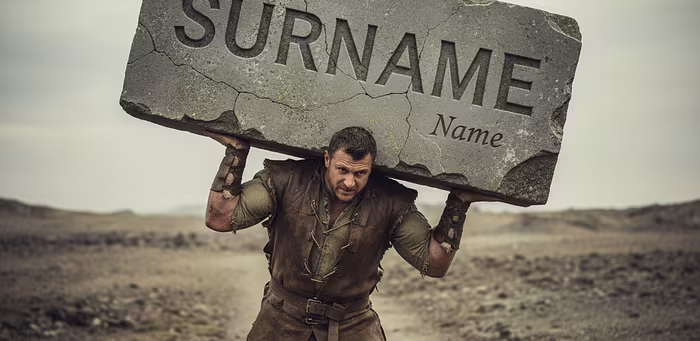
Surname Bigger Than Name: The Unfair Burden of Inherited Identity
1. The Unchosen Label: Birth vs. Individual Choice
When a child is born, their surname is already decided; only the name requires thought and effort. Parents may consult an astrologer for a name, but never for a surname. The reason is simple: the surname is inherited from a clan, caste, or community. It is an unavoidable consequence of birth, not an individual choice. This distinction reveals a deeper societal truth: we are often branded before we even have a chance to speak.
2. The Sensory Roots of Inequality: From Craft to Caste
Surnames originally came from the occupations people adopted in ancient times, such as tailoring, pottery, metalwork, trading, preaching, shoemaking, cleaning, masonry, farming, and wood moulding. However, over time, this occupational work solidified and took on an ancestral character.
This occupational distinction subsequently hardened into a social hierarchy. These occupational titles became fixed as caste names, where some castes were labelled superior and others inferior based on the nature of the work. Specifically, work related to mental effort was called superior, and work related to skilled labour or helping professions was called inferior.
There were further subcategories within skilled labour: those performing sanitation work were deemed the most inferior, while those performing odourless or hygienic work were considered less inferior. Essentially, work perceived as agreeable to the senses was viewed as better and superior, while sanitation or perceived ‘unclean’ work was deemed inferior.
Sensory perception played a main role in this division of work and the resulting caste complexity. The mind became thoughtless, failing to recognise that all work has value and that no person or profession is inherently superior or inferior. Sadly, this legacy persists today, continuing to promote discrimination and sometimes untouchability.
3. The Modern Surname: The Social Proxy for Caste
Surnames in India generally fall into two categories: family/lineage surname and caste/occupational surname. Over time, the second one has become popular, and most people are using it. Many surnames have gained such popularity that people immediately recognise them as caste identifiers. Somewhere, family/lineage names also become popular as caste identifiers.
This is where the core problem lies: society’s reaction to a person — whether it is respect, acceptance, or rejection — is too often predetermined simply by their surname. A surname, which should merely symbolise family identity, has instead become a social label that determines one’s intrinsic worth and place in the social order.
4. The Psychological Cage of Inherited Status
In the past, people used to write only their first name. But now, surnames have gained greater importance. People now refer to individuals with only a surname by using the suffix ‘Ji’ or ‘Saheb’; the surname is printed on the house nameplate and in the branding of shops, offices and businesses. Today, people often take more pride in their surname than in their name. It has deepened social divisions, turning the surname into a marker of privilege or prejudice.
This system means that only those associated with socially ‘favoured’ or ‘powerful’ surnames enjoy certain privileges, while others continue to face systemic bias, neglect, and exclusion. Individuals — whether they carry a ‘respected’ or ‘deprived’ surname — begin to identify themselves solely by that status, accepting the specific rung on the social ladder that society has assigned to them.
When two strangers meet, they introduce themselves with their full name. If someone doesn’t state their surname, the other person often requests the full name or sometimes directly asks for the surname or ‘title name’. Most Indians deeply ingrain this underlying curiosity about the other person’s caste in their minds.
In village areas, people often directly ask the caste of the meeting person, while city people rely on the surname for the same information. The surname serves as a default understanding of how two people will react to each other in society.
Get Kuldeep Kumar’s stories in your inbox
Join Medium for free to get updates from this writer.
Subscribe
Subscribe
5. The Professional Bias: The “Chair and the Surname
This phenomenon extends critically into public and professional life. Those with powerful, socially ‘accepted’ surnames frequently dominate representation in private sector hiring, entrepreneurship, and high-ranking government positions. Conversely, hiring often relegates individuals with marginalised surnames to low-profile or subordinate roles and fewer high-ranking positions. The reality is stark: surnames have become a proxy for caste, and caste remains a primary driver of discrimination.
6. The Power of Group Identity and Social Capital
Matching shared or respected surnames often implants in individuals a profound sense of security, belonging, and unity. These deeds form a group, and the group has power itself. Occasionally this power leads to unconscious bias towards deprived surnames.
Shared or respected surname groups do not feel hesitation and are proud of their surnames or castes while talking or at social gatherings. When we compare the feelings of safety and power experienced by the privileged to the vulnerability and exclusion experienced by the marginalised, the depth of inequality becomes clear.
7. A Roadmap for Reform: Shifting from Birth to Deed
Despite the modernisation of traditional jobs and the freedom to choose any profession, the underlying caste identity still persists. To dissolve these old divisions, we must move beyond the surname system entirely. This requires more than just a change in mindset; it demands deliberate and active involvement. We have a responsibility to intentionally include individuals with marginalised surnames in all spheres of work and authority.
By freeing our minds from the burden of inherited status and approaching every interaction with genuine empathy, we can finally lay the foundation for a truly equitable society. The following steps provide a roadmap to dismantle these ancient barriers and reclaim our shared humanity.
i. Political and educational reform: To achieve a fair society, we need strong political commitment and active public participation to neutralise the complexities tied to surnames. This requires significant effort, but if we work together, it can happen much faster.
Education is our most powerful tool for dismantling prejudice. We must introduce comprehensive, mandatory modules on equality, social justice, and constitutional values from primary school onwards. We must present the history of the caste system, related surnames, and the contributions of caste reformers in a neutral and critical light, fostering empathy instead of guilt or denial.
ii. Social Integration: Breaking down social silos is essential. We must promote inter-caste marriages and create public events that encourage cooperation among different surname groups. These interactions help dismantle prejudice by proving that our shared humanity is more important than our inherited labels.
iii. Professional Equality and Blind Hiring: Equality should not only apply to government jobs but also to jobs in the private sector. We should promote hiring processes that remove caste-identifying information — such as surnames — from initial application reviews. This blind process cuts down on unconscious bias and makes sure that talent is the only measure of success.
iv. Individual and Collective Responsibility: The long-term solution lies in shifting our social metric of respect from birth to deeds. We should encourage individuals from marginalised communities to assert their self-respect and dignity with peace and love to challenge discrimination. We should also encourage individuals from historically privileged communities to acknowledge their advantages and actively combat casteism within their social circles.
8. Conclusion
As long as we value the surname over the individual name, true equality will remain an unreachable horizon. Our genuine identity must be derived from our actions, values, and character — not from inherited labels or the collective history they carry. While a name is given at birth, a reputation must be earned through life.
The time has come to honour individuals based on their deeds, not their birthrights. Until we move beyond the comparisons and rigid hierarchies that surnames impose, society will continue to judge based on the accident of lineage rather than the content of a person’s character. By shifting our focus to ethics and actions, we can finally lift the burden of the surname and replace it with the true value of individual character.
Disclaimer: This article is intended for educational and social awareness purposes. The views expressed are aimed at promoting social equality and human values and are not intended to hurt the sentiments of any individual, community, or religion.