The Psychology of Boycotting and ‘Buycotting’ the United States of America
Medium | 31.12.2025 03:32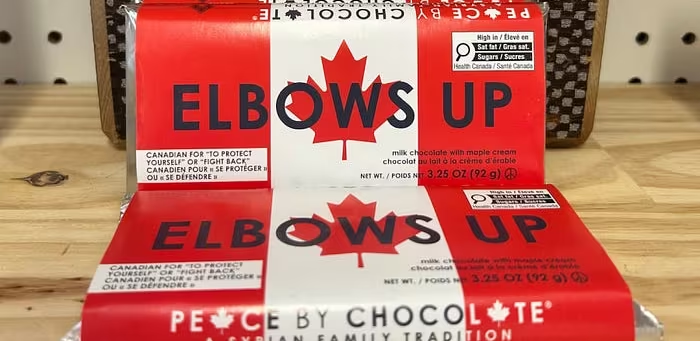
The Psychology of Boycotting and ‘Buycotting’ the United States of America
Follow
4 min read
·
Just now
33
Listen
Share
ON DECEMBER 30, 2025 BY PHOTOMOTOMANIN POLITICAL EDITORIAL
Share This!
There are innumerable reasons to boycott and buycott (a term derived from boycotting) the United States. With respect to Canadians this decision should be normative, and is becoming exactly that.
Trumps extortion threats, his arrogance and his hubrice, combined with his genuine ignorance and narcissism, has led Canadians to not only feel threatened, but has led to a genuine dislike, some would go much further and say hate of the man.
And the longer this pervades, the more it entrenches the opinions and actions of Canadians who genuinely no longer trust America and Americans whatsoever.
What Trump has accomplished has galvanized Canadians like never before, save WW2. Canadian nationalism is on the rise and political protests, retaliation and identity expression have become the response that Trump’s actions have created.
Canadian sovereignty and a desire to support domestic goods and services is expanding. The Canadian government is using this animus of America, created by America, to amplify participation and peer pressure within Canada to not go to the United States or support the U.S., in any way, particularly buying products.
Political consumerism, where buying choices become moral statements seeking to punish perceived wrongs (US Government actions) now boosts local economies, with strong social identity and collective action by consumers against America.
Retaliation and punishment is now a tool used to punish America’s imposition of tariffs and sovereignty threats.
National Identity and Sovereignty has increased the willingness of Canadians to boycott, making it a powerful socially reinforced action.
Peer pressure has evolved into what can only be called a social norm today.
Government support for these actions legitimizes the boycott and encourages broader participation.
Moral and Expressive Identity creates action based on values and feeling part of a movement that is meaningful, signalling opposition to policies, creating a sense of moral clarity.
The Fear of America and the need for self-preservation as U.S. border hostility is exercised by detaining, photographing, questioning and denying entry for social media opinions is rapidly alienating Canadians, resulting in a permanent willingness to eschew America at every level.
Consumer habits enable a multi-faceted psychological response to what is a perceived threat and injustice. Canadians can ‘see’ that their actions have effects, which only bolsters further application of the boycott and buycott behaviour.
Get Ken McMullen , BA, MPA’s stories in your inbox
Join Medium for free to get updates from this writer.
Subscribe
Subscribe
However, this is not simply a recent or Canadian-only phenomenon.
https://pmc.ncbi.nlm.nih.gov/articles/PMC8041440/
According to the National Library of Medicine’s article;
“What Drives Consumer Activism During Trade Disputes? Experimental Evidence from Canada.”
“Consumer activism has a long history, dating back at least to the free-produce movement, an international boycott of rum and sugar produced by slave labour in the late eighteenth century. With the surge of trade protectionism and disputes around the world today (particularly the tariff regime of the United States of America) consumer activism is also rising in response.
In the summer of 2019, Japan and South Korea were embroiled in a bitter trade dispute triggered by Japan’s export restriction on key chemicals for semiconductor production.
Angry consumers in South Korea destroyed vehicles bearing the logos of Japanese carmakers, poured Japanese beer down the drain, and compelled supermarkets to clear their shelves of foodstuffs from Japan.
Elsewhere, China has also been locked in an escalating trade war with the U.S. since the summer of 2018. A recent survey found that 56 percent of Chinese consumers have boycotted an American product “to show support for China.”
However, nothing has come close to the reaction of Canadians and their recent travel and product boycott’s of American goods.
By 2026, this action will likely have cost small American hotels, tourist resorts, restaurants and retail sellers an enormous amount, particularly vacation hotspots and border cities and towns.
It is now estimated that the broader impacts of Canadians boycotting and buycotting the U.S. will likely exceed 90 billion in GDP by 2027, particularly if Canadian sentiments worsen, which it appears is inevitable.
Canadians are not enamoured with anything from or about America at the present time. Behaviours are hardening and Canadians pay close attention to ‘where’ a product is produced, or whether the product in question is owned by Americans.
Registries in Canada list all products and to what percentage profits or ownership travels to the United States. It only takes seconds to determine the facts and Canadians are more than willing to change their purchasing behaviour or travel plans as America continues to attack the Canadian economy.
This extends into Canada’s foreign policy, procurement, both Provincially and Federally with new mandates requiring government’s to ‘buy Canadian’ or from partners offshore that are trusted and that respect Canadian sovereignty.
It is increasingly affecting how Canada’s military procures its weapons, aircraft, submarines, electronic suites, OTH Radar systems, etc., etc. Canadian are joining new partnerships and organizations designed specifically to protect against American aggression.
In reality, these actions are long overdue. Canada has been supplying America with its needs for far too long, and far too cheaply.
In the future, this will no longer be the case.