Justice Delayed Didn’t Just Hurt One Person
Medium | 25.01.2026 05:11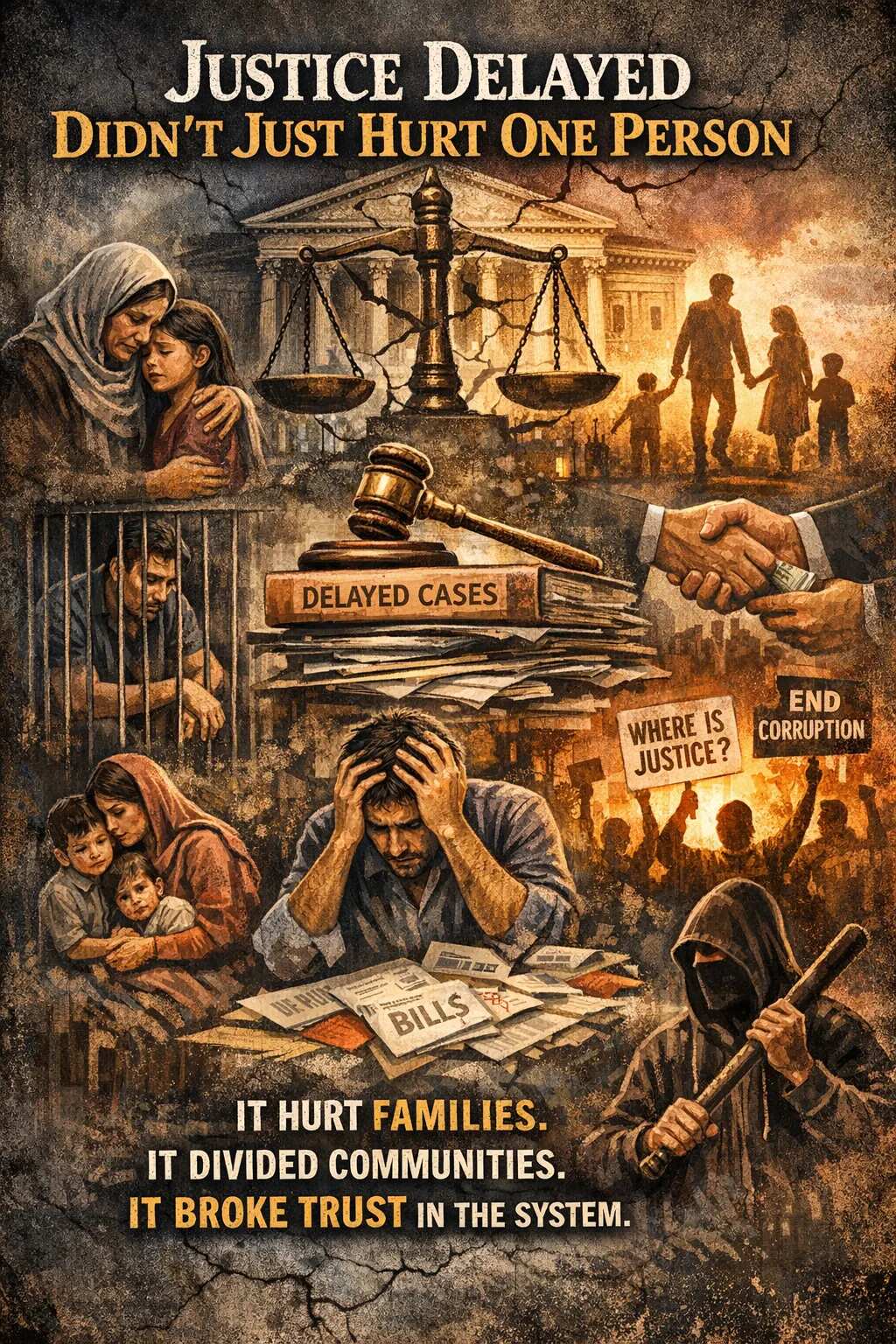
Justice Delayed Didn’t Just Hurt One Person
5 min read
·
1 hour ago
--
Listen
Share
Justice is often described as the backbone of any civilized society, the mechanism through which fairness is upheld, wrongs are corrected, and the rule of law is maintained. Yet, when justice is delayed, it ceases to fulfill this promise. Justice delayed is justice denied—and the impact is rarely limited to a single individual. It spreads through families, communities, and society, corroding trust in institutions and shaking the foundation of governance itself.
In many countries, including Pakistan, delayed justice has become a systemic problem. Courts are burdened with an overwhelming backlog of cases, procedural inefficiencies are rampant, and resources are often insufficient. These systemic flaws trap ordinary citizens in prolonged legal battles. A civil dispute over property can last decades; a criminal case can drag on for years, leaving victims and their families in a constant state of uncertainty. The emotional, financial, and social costs of these delays are immense.
Take, for instance, a case of domestic abuse or custody dispute. While the law may recognize the victim’s rights, delayed hearings prolong the risk and stress. Each adjournment or procedural complication intensifies anxiety, leaving victims and children exposed to trauma and uncertainty. In such situations, the delay itself becomes a form of harm, sometimes as severe as the original injustice. Families may be forced to live in instability, while the victims’ mental health and social well-being deteriorate.
Justice delayed also perpetuates inequality. Those with financial means or social influence may manipulate or navigate slow judicial systems more effectively. They can afford multiple lawyers, pay bribes in corrupt settings, or leverage connections to expedite cases. Meanwhile, ordinary citizens without such resources suffer silently, trapped in a system that is meant to be blind but often favors privilege. This unequal access deepens social divides, undermining the notion of fairness that justice is supposed to guarantee.
Moreover, the societal consequences are profound. When individuals perceive that justice is slow or inaccessible, faith in institutions declines. People begin to doubt whether the system serves their interests or simply exists to maintain bureaucracy. This erosion of trust has ripple effects: citizens may resort to extra-legal measures, vigilantism, or corruption to obtain the remedies they are legally entitled to. Prolonged legal delays weaken the social fabric and challenge the very concept of the rule of law.
The psychological toll of delayed justice cannot be overstated. Victims often endure anxiety, depression, or post-traumatic stress while waiting for their cases to be resolved. The uncertainty undermines their ability to work, pursue personal goals, or maintain healthy relationships. In criminal cases, the accused also suffer. While the principle of presumption of innocence remains central, the shadow of unresolved charges can disrupt lives, tarnish reputations, and fracture families. Delayed justice, therefore, affects both victims and the accused, demonstrating that its consequences are universal.
Financial consequences further exacerbate the harm. Legal battles, particularly prolonged ones, drain economic resources. Individuals spend years on legal fees, lose income due to repeated court appearances, or face the risk of losing property or contracts. These personal economic losses can compound over time, affecting families and communities. Additionally, systemic delays can discourage investment and business operations in areas where contracts are difficult to enforce or legal resolutions are unpredictable. Justice delayed is not only a moral and social issue—it is an economic one.
Addressing delayed justice requires a multi-pronged approach. Courts must be adequately staffed and resourced to handle increasing caseloads. Procedural reforms should reduce unnecessary adjournments and streamline case management. Technology can play a transformative role, from tracking case progress to enabling virtual hearings that save time and resources. Alternative dispute resolution mechanisms should be promoted to resolve non-critical cases quickly. Above all, reforms must prioritize accessibility, ensuring that justice is available equitably, not just to those who can afford to navigate delays.
The moral and societal imperative is clear: justice must be timely. A verdict delivered after decades may be legally correct, but it rarely remedies the full extent of harm caused by delays. Relationships may have been strained or broken, financial losses incurred, and mental well-being compromised. Justice is not merely the issuance of a judgment; it is the restoration of balance, rights, and confidence in the system. Delays compromise this very essence.
When justice is delayed, the harm extends beyond the courtroom. Families experience instability, communities witness the erosion of trust, and society questions the legitimacy of its governing institutions. Each case postponed is not just a personal grievance—it is a reflection of a system struggling to fulfill its promise. The consequences are cumulative: a generation may grow cynical about the law, perceiving it as distant, inaccessible, or ineffective.
Reforms to reduce delays must combine structural, procedural, and cultural change. Structural reforms include increasing judicial capacity and modernizing infrastructure. Procedural reforms involve stricter timelines, case prioritization, and reducing frivolous adjournments. Cultural reforms require fostering a mindset of accountability and efficiency within the judiciary. Technology can act as an enabler, while policy interventions can ensure that reforms are implemented transparently and equitably.
Ultimately, justice delayed is justice denied—not just to an individual but to society as a whole. It diminishes trust, weakens institutions, and erodes the social contract between the state and its citizens. Efficient, timely justice is not a luxury; it is a necessity for societal stability, personal dignity, and national development.
The human cost is also undeniable. Lives disrupted, families fractured, and communities disillusioned—these are the real consequences of a legal system that moves too slowly. Each adjourned hearing, each bureaucratic delay, carries a weight that no verdict can fully reverse. For justice to serve its true purpose, it must be accessible, fair, and timely. Without it, the law becomes a source of frustration rather than relief, a promise unfulfilled rather than a safeguard guaranteed.
Justice delayed didn’t just hurt one person—it hurt families, communities, and the moral fabric of society. Recognizing this, governments, institutions, and citizens alike must demand reforms that make justice swift, transparent, and fair. In doing so, the promise of law becomes more than an abstract ideal—it becomes a lived reality for everyone it is meant to protect.








![[Watch] Enhle Mbali CONFIRMS customary marriage in old clip](https://cdn.thefuse.co.za/images2/e/d/8/9/f/ed89f592-7fb8-30db-9ea1-dbb627f743fd-1200x675.jpg)