Families Slam Mbeki and Zuma Over TRC Delays as Ramaphosa Pledges Action
iReport South Africa | 16.03.2026 18:59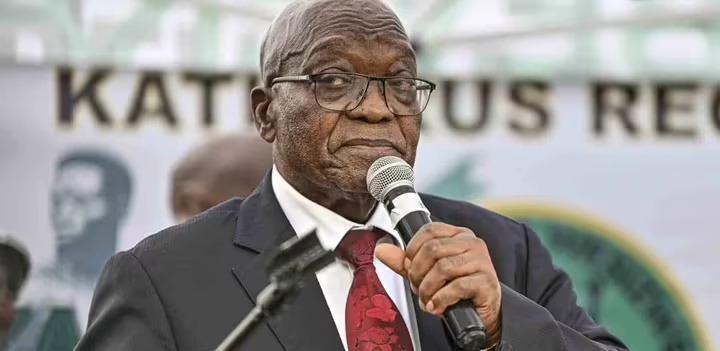
President Cyril Ramaphosa has reaffirmed his commitment to seeking justice for victims of apartheid-era crimes, stating that their cry for justice cannot be swept under the carpet .
This follows strong criticism from families of apartheid-era victims directed at former presidents Thabo Mbeki and Jacob Zuma over stalled prosecutions of cases identified in the Truth and Reconciliation Commission (TRC) report .
TRC Hearings Underway
A total of 25 families and survivors of apartheid-era atrocities are participating in the Khampepe Commission, which is probing delayed investigations and prosecutions of TRC cases. The inquiry began its work in December following the appointment in May of Sisi Khampepe, a former Constitutional Court justice .
Ramaphosa’s spokesperson, Vincent Magwenya, said while the president is committed to seeking justice for the victims, a court application in the Gauteng High Court in Johannesburg for Khampepe to recuse herself from the commission needs to be concluded first .
Court Battles Continue
In February, Zuma and Mbeki failed in their attempt to have Khampepe recuse herself from chairing the commission. In their court papers, the duo argued that Khampepe previously served on the TRC Amnesty Committee and later as Deputy National Director of Public Prosecutions under then-NDPP Bulelani Ngcuka. They contend these roles give rise to a “material and disqualifying conflict of interest” regarding the commission’s subject matter and mandate .
The matter is currently before a full bench of the High Court in Johannesburg, with Zuma’s counsel Advocate Dali Mpofu accusing Khampepe of gross misconduct and alleging that she coached evidence leaders on how to respond to recusal applications .
Ramaphosa Will Act
Magwenya said Ramaphosa would act swiftly after the court decision to ensure the commission gets down to business. “The President has been deeply concerned by the current review applications that could be detrimental to the interests of the victims who want closure and accountability from the government regarding their family members,” he said .
He emphasised that these applications have the potential to defeat the main objective for the establishment of the Commission. “Thus, the president believes the court is best placed to make a determination on the matter. This does not constitute a desire to collapse the Commission and its work” .
Families Demand Truth and Justice
Thembi Simelane, sister of anti-apartheid activist Nokuthula Simelane, spoke at a media briefing held by the Foundation for Human Rights on Sunday. She said the families deserve truth and justice for their loved ones who were killed during apartheid .
“In our view, the actions of former presidents Thabo Mbeki and Jacob Zuma, together with the support of our current President Cyril Ramaphosa, have failed to hold the commissioner properly accountable, given the testimony heard so far about political interference,” Simelane said .
She noted that families have taken the government to court 23 times over what it should do correctly in relation to the TRC. “They argue that these actions form part of a broader strategy to divert efforts away from uncovering the truth and addressing the suppression of the TRC cases” .
Simelane highlighted that the families claim there has been a “closing of ranks” among current and former state officials, a direct quote from the affidavit responding to President Ramaphosa’s explanatory affidavit .
Covering Tracks Alleged
Last month, Lukhanyo Calata, son of late United Democratic Front activist Fort Calata, accused Mbeki and Zuma of trying to stop the Khampepe inquiry to ensure the matter is forgotten. Fort Calata was one of the Cradock Four—Matthew Goniwe, Sparrow Mkhonto and Sicelo Mhlauli—who were abducted and murdered by security forces in 1985 at the height of anti-apartheid struggle .
The Khampepe Commission was established following a court application by families who sued for damages over decades of delays in prosecuting apartheid-era cri