Real Politics: Ramaphosa’s empty war on crime
Scrolla | 28.09.2026 15:10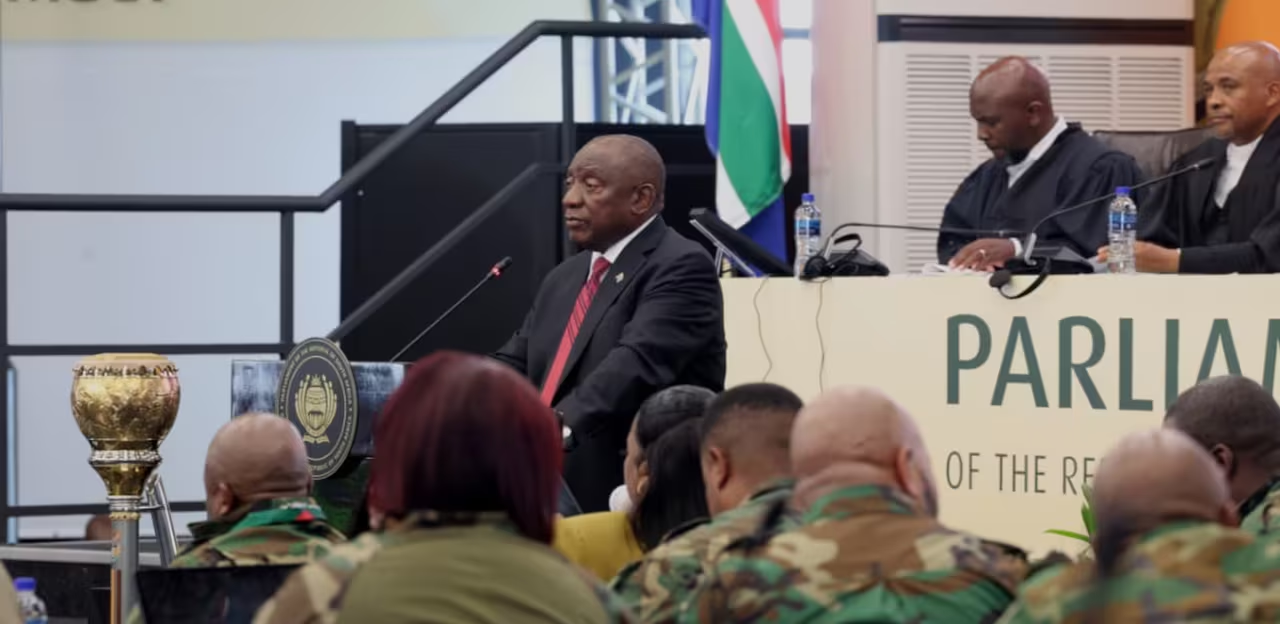
South Africa is spending billions and deploying soldiers against crime, but the real measure is whether fewer people are being murdered and more criminal networks are being dismantled, writes Zukile Majova in Real Politics.
South Africa is living through a crisis of public safety.
27 people were killed in two mass shootings in a single weekend. Eleven more were killed in KwaMakhutha, KwaZulu Natal, days earlier. In Ekurhuleni, 11 women’s bodies have been discovered over two months while police investigate killings that have left communities fearful.
Even after a 5.9% year on year drop in the latest SAPS crime statistics, the country recorded 5,427 murders between April and June 2026. That is almost 60 murders every day.
Yet the government has a strategy, a budget and growing assistance from the military. President Cyril Ramaphosa has promised additional police officers, intelligence led operations, the dismantling of criminal syndicates and a renewed fight against gender based violence.
The question is no longer what the president intends to do. It is what the country has received in return for years of promises, billions of rands in public spending and repeated declarations of war against crime.
In March, Ramaphosa authorised the deployment of 2,200 soldiers to support the police at an estimated cost of R823 million. Operation Prosper targets illegal mining and gangsterism in the Eastern Cape, Free State, Gauteng, North West and Western Cape. The deployment is scheduled to continue until March 2027.
The strategy uses the military’s logistical and operational capacity to support police in crime hotspots.
In July, police and the military reported that the operation had produced 1,149 arrests during June, along with the seizure of illegal firearms and mining equipment.
How many arrests have resulted in convictions? How much money has been recovered from criminal syndicates? What measurable reduction in violent crime can be attributed to the deployment?
The latest massacres raise uncomfortable questions about the reach of the operation. The military cannot be deployed to every violent crime hotspot and soldiers cannot be expected to prevent every shooting. But the government should explain how its targeted deployments are coordinated with police intelligence and local crime prevention operations.
It must also demonstrate that these deployments are confronting the criminal networks and conditions they were designed to address.
The official statistics may show a decline in some offences. That does not erase the severity of a murder rate that remains extraordinarily high, nor does it necessarily reflect how safe people feel in their neighbourhoods.
Ramaphosa must move beyond national totals and demonstrate improvement in the communities most affected by violent crime.
How many murder investigations result in arrests, prosecutions and convictions? How many illegal firearms are traced to criminal networks? Are repeat shootings declining in identified hotspots?
Perhaps the most troubling question concerns the ability of the police to anticipate and prevent organised violence.
Ramaphosa’s 2026 State of the Nation Address promised to consolidate intelligence, identify priority syndicates and establish teams across different agencies to dismantle criminal networks.
But intelligence led policing requires trusted informants, competent investigators, effective information sharing and leadership that has not been compromised by corruption.
The allegations involving senior police officials make this an urgent institutional concern.
The Madlanga Commission was established after KwaZulu Natal police commissioner Nhlanhla Mkhwanazi alleged that criminal syndicates had infiltrated parts of the criminal justice system. Its hearings and referrals have raised serious questions about criminality, political interference and accountability within law enforcement.
The government must establish whether the police have the leadership, resources and institutional integrity to confront increasingly sophisticated criminal networks.
Large drug seizures and regular operations may demonstrate activity. They do not necessarily reveal who finances the trade, controls distribution or profits from it.
The same applies to illegal mining, kidnapping, human trafficking and extortion. Arresting individual perpetrators is not the same as dismantling the networks behind them.
The economic consequences of this insecurity are substantial.
Businesses must pay for private security, insurance and protective infrastructure while also worrying about the safety of employees and customers.
In struggling central business districts, crime can discourage investment, reduce foot traffic and undermine efforts to revive evening economies. Restaurants, retailers and entertainment venues lose valuable trading hours when customers and staff are afraid to travel after dark.
Tourism is also exposed. The sector contributed an estimated R361.7 billion directly to the economy and supported about 954,000 jobs in 2024, according to the Organisation for Economic Co operation and Development.
South Africa welcomed more than 10.5 million tourists in 2025, surpassing levels recorded before the pandemic. That success demonstrates the sector’s resilience, but continued growth depends partly on visitor confidence and safe destinations.
Crime does not deter every tourist. But insecurity imposes costs on operators, shapes visitor choices and threatens the country’s ability to realise its full tourism potential.
Domestic tourism matters too. South Africans should be able to enjoy their own cities, visit attractions and support local businesses without constantly worrying about their safety.
The same insecurity undermines government plans to attract investment and regenerate urban centres. Investors considering commercial property, hospitality or retail developments need confidence that employees, customers and infrastructure will be protected.
A city that empties after dark because of fear is a city losing economic opportunities.
The crisis of violence against women exposes another gap between government commitments and lived experience.
Ramaphosa has repeatedly described gender based violence as a national crisis and pledged decisive action. Yet the discovery of 11 women’s bodies in Ekurhuleni over two months has renewed concern about the protection of women and the effectiveness of prevention and investigation.
The government has a National Strategic Plan on Gender Based Violence and Femicide, but the public deserves a transparent account of its implementation.
How much has been allocated and spent? Which organisations receive funding? How much reaches shelters, victim support services, prevention programmes and forensic investigations? What independent monitoring shows whether these interventions are working?
Presidential condemnations and strategic plans matter. But women need functioning police services, accessible protection, effective investigations and a justice system that holds perpetrators accountable.
The state must demonstrate that its commitments are producing safer homes, workplaces, streets and public spaces.
Ramaphosa’s record since taking office in 2018 should therefore be assessed against outcomes, not announcements.
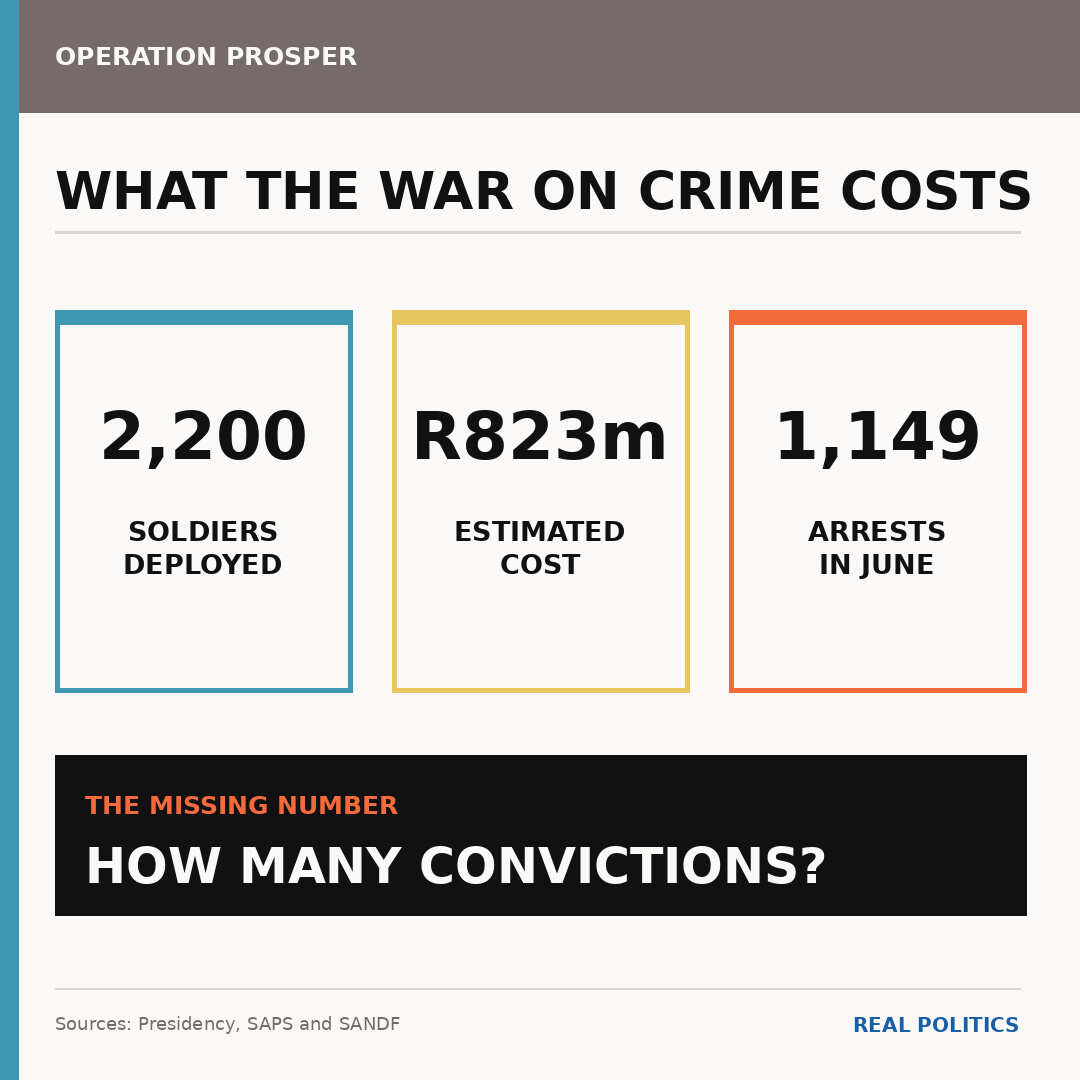
Police recruitment, military deployments, arrests and budget allocations are inputs. The real measures are fewer murders, successful prosecutions, dismantled criminal networks, reduced violence against women and greater public confidence in the state.
There is no simple solution to South Africa’s entrenched crime problem. Poverty, inequality, unemployment, illegal firearms, organised criminal economies and institutional weakness all contribute to it.
Nor can the president personally prevent every act of violence. But he is responsible for ensuring that the government has a coherent strategy, competent leadership and systems that deliver results.
The latest massacres should prompt more than another round of outrage and promises of decisive action.
They should trigger an honest assessment of what the government has spent, what its operations have achieved and where its approach must change.
South Africa cannot build thriving cities, attract sustained investment or expand its tourism economy while millions of people live with the fear of violence. Nor can it claim meaningful progress against gender based violence while women continue to face grave threats to their safety.
Eight years into Ramaphosa’s presidency, the country needs an honest accounting of the war on crime.
The question is not how many operations have been announced or how many arrests have been made. It is whether the state is becoming more capable of protecting its people.
Until the government can prove that it is, its war on crime will remain a campaign of activity without enough evidence of victory.
Subscribe free