Men vs Women
Medium | 23.01.2026 20:49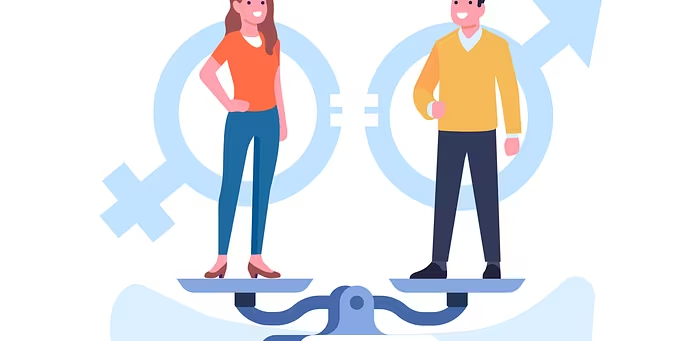
Men vs Women
Follow
2 min read
·
1 hour ago
Listen
Share
Women and men are two biological pillars of human civilisation. A building is stable when the work done is equally distributed among its components or pillars; in our case, it’s the same. But when it’s about the rewards, it’s not the same.
Women’s contribution
A mother who gave birth to a child after 9 months. A mother is the first teacher of her child.
A wife who creates millions of good memories of her husband. A sister who is the best sibling.
And they have trillions of other contributions to us, to our memories. The contribution of a lady cannot be summed up in these lines.
Even after this, a lady remained unrecognised. Because most of its work is unpaid.
A lady does most of her work without a wage. They do that only for us, for our happiness, for our comfort.
Men vs Women (in terms of hours)
A man does work for himself and his family; for most of the work he does, he gets paid.
Get The Aware Age’s stories in your inbox
Join Medium for free to get updates from this writer.
Subscribe
Subscribe
If we talk in terms of stats, women work 1 hour more compared to men. The working hours differ from continent to continent, country to country, region to region, and family to family. But the difference of 1 hour is almost constant.
In the case of women, almost 50% of their work is unpaid, whereas for men it’s only 10–15%.
In terms of money, women get paid less than men for the same work.
This applies to all countries of the world; in the developed nations, the condition is slightly better, but not ideal. This is the subject that exists only on paper, not in reality, because ultimately no one wants to lose the powers that history created (by physical capabilities), not earned.
What now?
Change should arise from the individual level. All the ladies around us — we should respect them and appreciate their efforts.
In the last 100 years, we can clearly observe the change, first in developed nations, and then followed by developing nations.