Lukhona Mnguni defends Rise Mzansi mayoral bid
Explain | 02.06.2026 23:13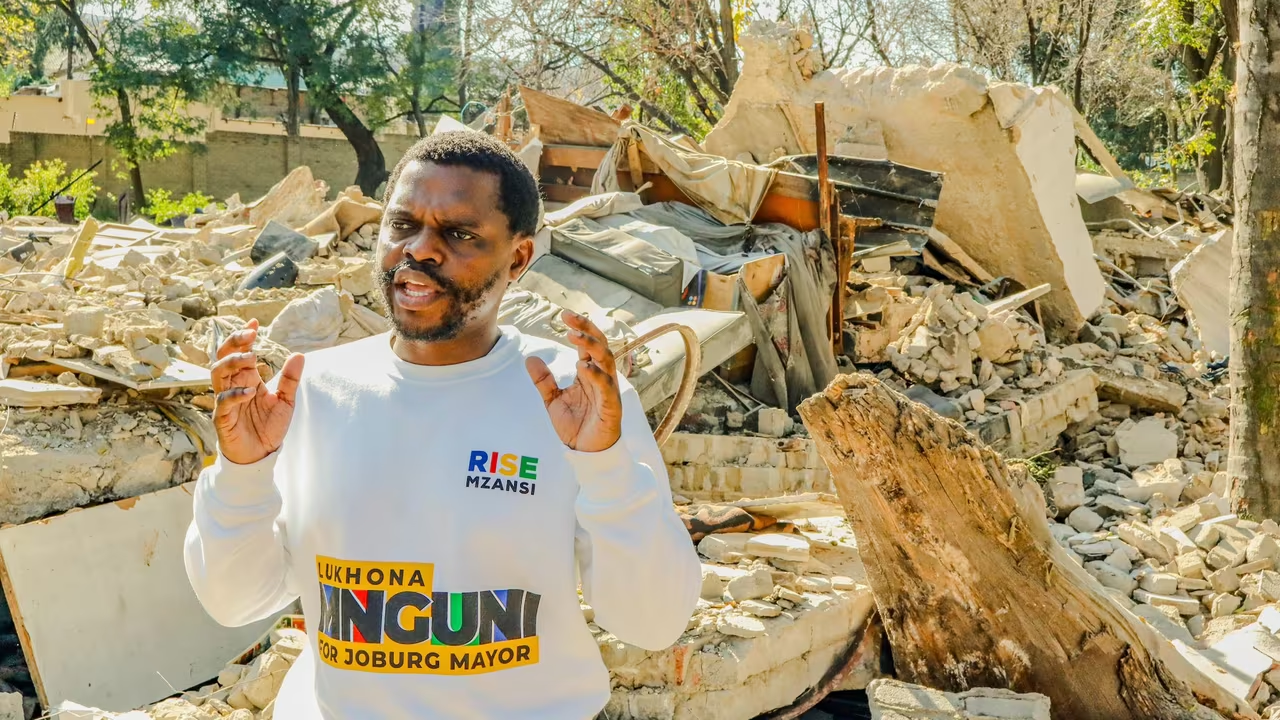
Lukhona Mnguni has spent years telling South Africans what politicians are doing wrong. Now he wants a crack at fixing it himself.
The 36-year-old political commentator has officially swapped analysis for action, becoming Rise Mzansi’s candidate for mayor of Johannesburg ahead of the 2026 local government elections.
Critics have questioned his move from independent commentator to politician, arguing that analysts are meant to observe politics, not engage on the frontlines. But Mnguni told /explain/ watching from the sidelines was no longer enough for him.
Mnguni is no stranger to politics. Before entering the race, he was a co-founder of the Rivonia Circle think-tank, alongside Rise Mzansi leader Songezo Zibi. Think-tanks are organisations that research public policy and propose solutions to social and political problems.
Mnguni also built a public profile as a columnist and political analyst, regularly appearing in the media to unpack South Africa’s often chaotic political landscape.
In Mnguni’s view, the gap between analyst and politician is smaller than many people think. He describes himself first and foremost as an activist, saying he has spent much of his life campaigning for change and taking part in civic action.
From that perspective, running for office is less a career change and more the next step of the same journey.
Whether voters buy that argument remains to be seen. But Mnguni’s message is clear: after years of diagnosing Johannesburg’s problems, he now wants the chance to help to solve them.
Mnguni says this is not his first time moving from the sidelines into the action.
At university, he joined protests against fee increases despite having a bursary himself. The issue, he says, was the students who did not have National Student Financial Aid Scheme funding or families who could afford fees.
“From an activist point of view, I had this fire burning because an injustice was being done to those students,” he said.
He also campaigned for the Congress of the People (Cope) after the ANC’s bruising 2007 Polokwane conference, where Jacob Zuma beat Thabo Mbeki for the party presidency.
Mnguni says he wanted to help to stop a Zuma-led ANC from winning a two-thirds majority, which potentially allows for parts of the Constitution to be changed.
He describes the ANC’s instability at the time as “a tragedy in South African politics”.
For him, running for Johannesburg mayor is not a random career pivot. It is a return to politics at a moment he sees as urgent. “This re-entry into politics is by no means an accident,” he said. “Johannesburg is on the verge of collapse.”
When Mnguni decided to enter party politics, he says Rise Mzansi was the obvious choice.
The party fits his politics as a social democrat – broadly, someone who supports a market economy, but with the government stepping in to reduce inequality and protect people through services and social support.
That, he says, made Rise Mzansi a better fit for him than a “broad church” party like the ANC, where many different ideologies sit under one roof. Sometimes peacefully. Sometimes… less so.
Mnguni also says relationships mattered. He is friends with some of Rise Mzansi’s leaders and believes politics works better when you trust the people next to you.
“In politics, it is important to work with people you feel are your comrades,” he said.
He believes his profile and experience can help to grow Rise Mzansi from Johannesburg’s seventh-largest party into one of its top five.
Mnguni’s announcement did not exactly receive a standing ovation.
The backlash was fast, with critics questioning whether his past political analysis had really been objective. Deputy Minister in the Presidency Nonceba Mhlauli led the charge on X, saying she was happy Mnguni was now openly “the politician we’ve always known him to be”.
Mnguni called her reaction “weird”, saying they had spoken before and he considered her a friend.
“But I suppose I’m a politician, and she’s a politician, so sparring is inevitable,” he said. “I’m sure if I had chosen her political party, she would not be making noise.”
He rejects the idea that his move proves his analysis was biased. Objectivity, he argues, does not mean pretending all sides are equally right. It means following the evidence and reaching a clear conclusion.
Now, he says, he is moving from political thought leadership to political leadership – and he is not apologising for it.
“I became frustrated as the more I analysed, the more my country died,” he said.
For Mnguni, the decision comes down to conscience. He says he could no longer “sit back” while Johannesburg’s problems worsened and believes stepping into politics is his way of helping to “halt the rot and corruption” in the city.
Mnguni says he is the best candidate because he understands local government from years spent analysing it up close.
“I represent the future,” he said, adding that his work as an analyst, broadcaster, and writer has put him in rooms with mayors, municipal managers, and speakers. From one perspective, the system is not new to him.
Mnguni’s campaign is not only about fixing Joburg’s obvious problems: corruption, broken roads, dead traffic lights, crime, and unreliable water and electricity. He says the city also needs a new economic identity.
Joburg was built on gold. That gold rush is long over. Mnguni argues the next version of the city should be built around its people, neighbourhoods and small businesses.
He wants urban villages revived and protected from malls that push out family-owned businesses. He also wants Joburg to build a safer, more vibrant nightlife, but says that can happen only if people are able to move around the city safely and easily.
Mnguni says he will release a detailed plan after speaking to residents. “You cannot, as a candidate, go into communities with sweeping plans,” he said.
His argument is simple: Joburg does not just need potholes filled. It needs a vision. Mnguni’s contention is, until he entered the race, that was missing.
Local government elections will take place on 4 November. In the lead-up,/explain/ will interview as many mayoral candidates as possible to help South Africans to gain a better sense of the people vying to become the city of gold’s first resident.
Prashalan Govender is a journalist who was shortlisted for the Vodacom Young Journalist of the Year Award twice. He is focused on reporting the stories that shape everyday life in South Africa, with a particular interest in politics, economics, and social issues.
/explain/ is independent, easy-to-understand news for busy South Africans. Sign up for our award-winning weekly Wrap of the news here. Check out our Weekly Roundup section for our Wrap archive.
Click here to make /explain/ a preferred source in Google Search, or .






![Long-term review: Chery Tiggo 7 CSH Plug-in hybrid [Intro]](https://cdn.thefuse.co.za/images2/2/f/4/9/8/2f4980f5-9728-38f0-ac2b-2c084dee1a78-1200x675.jpg)