Africa has World Cup talent. So why does money still win?
Explain | 18.07.2026 14:38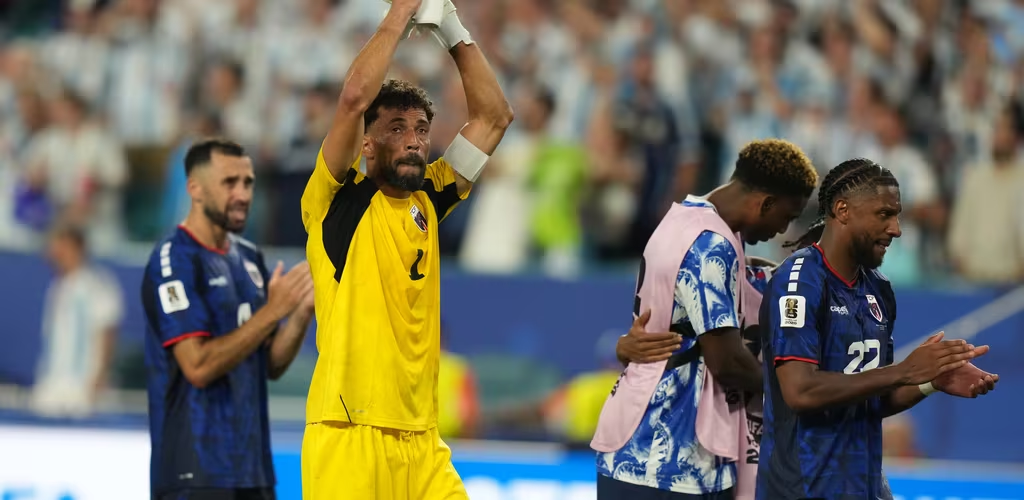
OPINION
France and England meet in the 2026 World Cup third-place play-off on Saturday night, with two of football’s wealthiest and best-supported national teams competing for a place on the podium. Their match offers a useful reminder of what money buys in international football: elite academies, experienced coaches, sports scientists, scouting networks, quality facilities and enough top-level players to replace an injured star without the entire plan collapsing.
African teams have shown throughout this World Cup that they can compete with those systems. Cape Verde pushed defending champions Argentina to the limit, while Morocco reached the quarter-finals. But competing in one match and building a team that can survive an entire tournament are different challenges. Only one of the 10 African teams that qualified reached the quarter-finals. And that raises an important question: what do African teams need to compete consistently with football’s biggest nations? One thing is clear for sure, African teams have the talent. The real challenge is having the resources to match it.
Cape Verde’s World Cup campaign was one of the tournament’s biggest surprises. On their World Cup debut, the small island nation reached the Round of 32 and pushed defending champions Argentina all the way before narrowly losing 3-2. Much of that fight came from veteran goalkeeper Vozinha, whose outstanding performance produced a string of crucial saves and frustrated one of football’s greatest attacking teams.
But that match also highlighted something bigger than football: money. Argentina arrived at the tournament with a squad valued at €807.5 million, while Cape Verde’s squad was worth just €54.5 million. On paper, it looked like a mismatch. On the pitch, it certainly didn’t. The gap in market value reflects the quality, experience, and depth of players available to each team, and, in the end, Argentina’s quality helped them edge past Cape Verde. But for 90 minutes, Cape Verde showed that talent, organisation and determination can close even the biggest financial gaps.
The contrast was just as striking at an individual level. Lionel Messi’s market value is around €15 million, while 40-year-old Cape Verdean goalkeeper Vozinha is valued at €50,000. Yet those numbers meant very little during the match. Vozinha, who plays in Portugal’s second division, earned $53,000 last year. In comparison, Messi made more than that every five minutes he played for Inter Miami. Vozinha repeatedly denied Argentina with a series of impressive saves, proving that market value may measure a player’s worth in the transfer market, but it doesn’t always predict who will have the biggest impact on the pitch.
Cape Verde is not the only African nation competing with a much lower squad value. Many African teams go into major tournaments with far fewer financial resources than their European and South American rivals. The difference is not always talent. More often, it is the environment where that talent is developed and the support available to help players reach their full potential. Look at the investment many European football nations have made in player development. They have built world-class academies and training facilities that identify and develop talent from a young age.
A talented young player in Europe often has access to opportunities that many young African players can only dream of. That does not mean African players are less talented. I don’t think so. Africa has produced some of the greatest footballers the game has ever seen. The real question is: why do so many African players have to overcome bigger challenges to reach the top?
I believe the answer often comes down to resources. Money does not create talent, but it creates the environment where talent can grow. Take FC Barcelona’s famous La Masia academy, which developed players like Lionel Messi, Xavi Hernández and Andrés Iniesta. Sporting CP helped produce Cristiano Ronaldo and Bruno Fernandes. In France, the Clairefontaine National Football Institute played a major role in developing stars such as Kylian Mbappé and Thierry Henry.
Now look at Morocco. They reached the semi-finals of the 2022 FIFA World Cup, becoming the first African nation to do so. That success was not a surprise. It was the result of years of investment in football, especially in youth development and infrastructure. The Mohammed VI Football Academy has become one of Africa’s leading football academies, producing players who have gone on to succeed in Europe’s top leagues. Those players return to represent Morocco, having gained experience competing against some of the world’s best footballers every week. If you ask me whether talent alone is enough, my answer is no. Talent is only part of the equation.
Morocco has also made recruiting dual-national players a key part of its strategy. By identifying talented players with Moroccan heritage in Europe and presenting them with a clear football vision, the country has convinced stars like Achraf Hakimi, Hakim Ziyech and Noussair Mazraoui to represent Morocco. Now let’s bring the conversation home. South Africa has the largest economy in Africa and more financial resources than most countries on the continent. So why haven’t we followed a similar path?
Do we not want to compete with the best in the world? Of course we do. And it is possible. The talent is here. What is needed is the same commitment from our leaders to developing young players, investing in football infrastructure and building a clear plan for the future. If Morocco can do it, there is no reason South Africa cannot aim for the same heights.
Kamogelo is a journalist who graduated in Journalism from the University of the Free State. He’s just a simple guy who’s really into sport, like, more than anything else. He basically lives and breathes it because that’s where he feels happiest. He’s into all kinds of sports, but football and cricket are his absolute favourites.