Lost track of the Madlanga Commission? Here’s what matters
Explain | 12.08.2026 18:28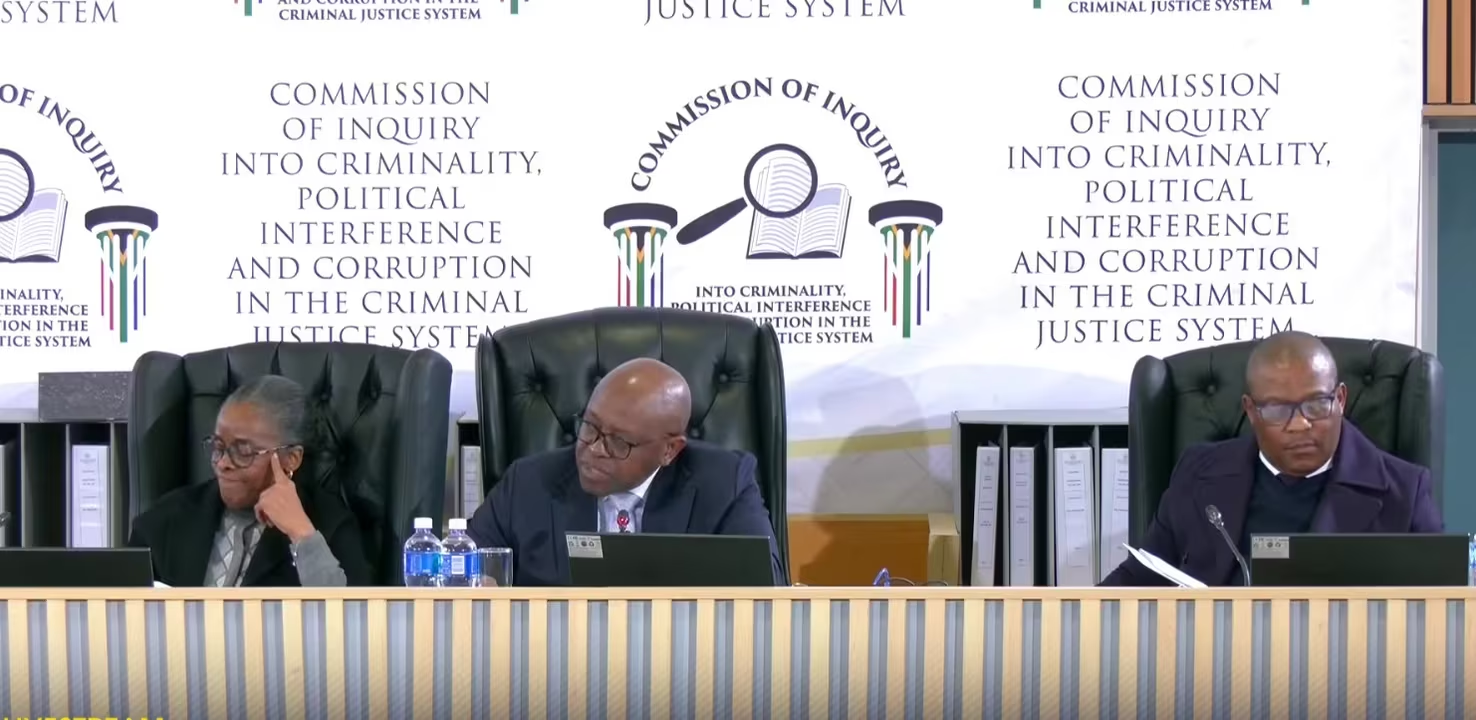
If you’ve lost track of the Madlanga Commission, you’re forgiven. For nearly a year, South Africans have watched senior police officers, prosecutors, politicians, and alleged criminal figures become entangled in one sprawling inquiry into whether organised crime has wormed its way into the very institutions meant to stop it.
There’ve been explosive allegations, bruising testimony, resignations, arrests, memes, and enough acronyms to make even the most dedicated news reader close the tab. So, with the commission heading towards its final stretch, here’s what actually matters.
Why does this commission exist?
It all began in July 2025, when KwaZulu-Natal police commissioner Lieutenant-General Nhlanhla Mkhwanazi held a dramatic media briefing and made allegations that shook the country.
Among them: that suspended Police Minister Senzo Mchunu had interfered in sensitive police investigations, that powerful businesspeople had influenced policing decisions, and that a criminal syndicate had infiltrated parts of the police, prosecution service, prisons, and even the judiciary.
President Cyril Ramaphosa announced a judicial commission of inquiry soon afterwards. Its full name is the Judicial Commission of Inquiry into Criminality, Political Interference, and Corruption in the Criminal Justice System. It became known as the Madlanga Commission, after its chair, Justice Mbuyiseli Madlanga.
Its job is to investigate whether Mkhwanazi’s allegations are true, how far any criminal influence extends, who enabled it, who failed to stop it, and what should happen next.
That means examining institutions including the South African Police Service, Crime Intelligence, the National Prosecuting Authority, the State Security Agency, metro police departments, correctional services, and parts of the judiciary.
Why has it taken so long?
The commission was initially expected to submit its final report on 31 August, but its evidence deadline has been extended to 2 October, with the final report now due on 16 November. Ramaphosa said the extension was necessary because the commission still had areas of evidence and testimony to complete.
“Without an extension, the commission will have to leave large parts of its work unfinished,” he said.
The original allegations were earth-shattering, and when witnesses began testifying, the commission began uncovering new relationships, decisions and disputes that required further investigation.
Why are the commissioners internet famous?
The commission’s chairperson, Madlanga, and commissioners advocate Sesi Baloyi and advocate Sandile Khumalo have developed an online following because of how they question witnesses.
They interrupt when answers are vague. They return to contradictions. They comb through witness statements in detail and ask follow-up questions when something doesn’t add up.
The commission’s evidence leaders have also become part of the spectacle. An evidence leader’s role is to gather, organise, and present material before the commission, question witnesses, and help to establish the facts.
Who has appeared before the commission?
A long list of senior figures have already testified. They include Mkhwanazi, suspended Police Minister Senzo Mchunu, National Police Commissioner Fannie Masemola, suspended Deputy National Police Commissioner for Crime Detection Lieutenant-General Shadrack Sibiya, and former Investigating Directorate Against Corruption (Idac) head Andrea Johnson.
What have we actually learned?
We asked Corruption Watch spokesperson Janine Erasmus which revelations stood out most. The first, she said, was that Mkhwanazi’s original allegations have become part of a much wider picture. When he appeared before the commission, Mkhwanazi doubled down on his claims and implicated several figures in alleged wrongdoing.
Those included political fixer Brown Mogotsi, suspended Ekurhuleni Metropolitan Police Department official Julius Mkhwanazi, and Sibiya. The commission has also spent significant time examining alleged relationships between police officials, politicians, and businessman Vusimuzi “Cat” Matlala.
Matlala has repeatedly surfaced in testimony. He has been accused of using gifts, loans, and personal relationships to build influence with police officials and secure access to state business. Many of the allegations involving Matlala remain untested, but Erasmus said the relationships exposed through testimony had been an “eye-opener”.
“These stand out for us because they show the scope of the corruption, through all ranks and especially in the senior levels,” Erasmus told /explain/. The interference which extends from street-level policing right up to ministerial level, with businessmen firmly embedded,” she said.
And then there is Idac
One of the biggest surprises has been the damage to Idac’s reputation. Idac is a permanent anti-corruption unit inside the National Prosecuting Authority. Its job is to investigate and prosecute complex corruption, including cases linked to state capture.
Former Idac head Johnson was the subject of intense scrutiny during her testimony. Erasmus said Johnson’s evidence raised concerns about how investigations had been handled and whether sufficient checks had been done before important decisions were taken.
Johnson also faced criticism for appearing to shift responsibility to junior officials. Erasmus argued that, as the head of the unit, Johnson had a responsibility to verify information before acting on it. “This is unprecedented for a national flagship anti-corruption unit,” Erasmus said.
Has anyone faced any consequences?
This is where the Madlanga Commission differs from some previous inquiries. A case of alleged tender-rigging and another, the alleged unlawful possession of and dealing in precious metals, involving some of the people who have been accused of wrongdoing at the commission, are before courts at the moment.
Notably, law enforcement has insisted that such cases were not enrolled because of the commission, but from prior investigations; however, it is hard to see the timing as merely a coincidence.
In contrast, previous commissions of inquiry have produced mountains of evidence, but very little action. Take the Zondo Commission, which investigated state capture, corruption, and fraud in the public sector from 2018 to 2022. It produced a massive body of evidence and detailed recommendations. Years later, many South Africans remain frustrated by the relatively limited number of successful prosecutions linked to its findings.
Erasmus stressed this was not necessarily a failure of the commission itself. A commission investigates, establishes facts, and recommends action. Police, prosecutors, and courts must then follow up. That is where the system often slows down.
She said the Madlanga Commission offers at least one reason for cautious optimism: investigations are under way while evidence is still fresh instead of waiting until the entire inquiry is finished.
“That is an important structural difference from the way commissions have been run previously,” Erasmus said.
A case being opened does not guarantee that anyone will go to prison. South Africans saw plenty of dramatic arrests after the Zondo Commission, only for some cases to collapse or drag on.
For example, former minister of sports, arts, and culture and prominent ANC member Zizi Kodwa was charged with accepting bribes in influencing the awarding of lucrative contracts to information technology company EOH Holdings. The NPA recently reinstated that case after it was dropped in November 2024 when prospects of a successful prosecution had diminished.
Then there is the Free State asbestos-removal case involving former Free State premier and ANC secretary-general Ace Magashule. That matter concerns a R200-million-plus project to remove asbestos roofing from poor homes across the province. Instead, this money was allegedly irregularly channelled to a joint venture involving Edwin Sodi’s Blackhead Consulting in 2014, with government officials receiving kickbacks. That case has been going on for nearly six years.
For Erasmus, the real test of the Madlanga Commission will be whether high-profile prosecutions eventually result in convictions and whether the institutions in the crosshairs are actually reformed.
What happens when people stop trusting the police?
The commission has repeatedly heard allegations involving the very institutions South Africans rely on to investigate crime, prosecute offenders, and protect the public.
Erasmus said public confidence in law enforcement was already low before the inquiry began. This means people may become less willing to report crime. Whistle-blowers may hesitate to come forward. Communities may stop believing that reporting corruption will lead anywhere.
If businesses start to believe that criminal networks can influence police or state institutions, that can also affect investment. But Erasmus argues that exposing the problems is still necessary. You cannot repair an institution if nobody is willing to acknowledge what is broken, she said.
Will the commission actually change anything?
The Madlanga Commission has already put extraordinary information into the public record. It has forced powerful officials to answer uncomfortable questions. It has exposed alleged relationships between senior officials, businesspeople, and criminal networks. It has also triggered investigations while hearings are still under way.
But South Africa has been here before. The real test begins after the microphones are switched off. Will cases be won in court? Will implicated officials face consequences? Will damaged institutions be repaired? Will the people responsible for oversight change systems that allowed alleged wrongdoing to take place? Or Will South Africans end up with another lengthy report sitting on a government website while everyone involved simply moves on?
For now, the commission is still asking questions. Whether the country gets meaningful answers will depend on what happens after it concludes.
This article is the first in a series aimed at helping audiences who may have lost track of the expansive and time-consuming, but critically important Madlanga Commission to better understand its proceedings and significance.
In our next piece, we will look at the people who have dominated the headlines because of the commission’s work.