“You Are Not Being Truthful” – Madlanga Commission Confronts Sgt Fannie Nkosi
iReport South Africa | 20.03.2026 18:25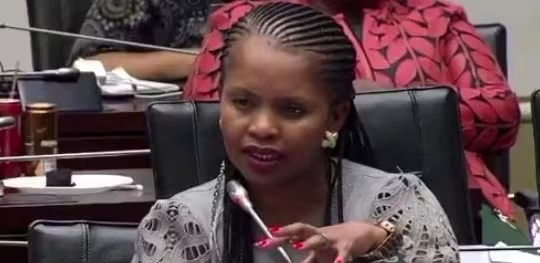
Tensions flared at the Madlanga Commission of Inquiry when commissioners openly questioned the reliability of testimony given by Sergeant Fannie Nkosi, telling him during proceedings that they did not believe he was being honest.
The confrontation took place while Nkosi was being questioned about incidents linked to ongoing investigations before the commission, which is examining allegations of corruption, political interference, and potential abuse of power.
As the session unfolded, commissioners raised concerns over inconsistencies in Nkosi’s statements, noting that some of his responses conflicted with earlier testimony and existing evidence presented to the panel.
The situation intensified when a commissioner interrupted Nkosi and bluntly told him he was not telling the truth, marking a sharp escalation in the tone of the hearing.
Observers pointed out that such direct accusations are uncommon but can happen when commissioners suspect a witness may be withholding key information or providing misleading answers.
In recent weeks, the commission has heard from a range of witnesses, including police officers, government officials, and others connected to the matters under review.
Since commissions of inquiry depend heavily on sworn testimony to piece together events and assess possible wrongdoing, the credibility of witnesses is essential. Legal experts note that when commissioners openly doubt a witness’s honesty, it often suggests a mismatch between their statements and other available evidence.
During the exchange, Nkosi tried to clarify his responses, but commissioners continued to press him for more precise answers, focusing on whether he had fully disclosed his role in the incidents under investigation.
Public attention on the inquiry has been steadily increasing as more details surface about alleged networks involving law enforcement and external actors.
Many South Africans are closely following the hearings, hoping they will bring clarity to the serious allegations and strengthen accountability and transparency.
The commission is still in the process of collecting testimony and reviewing evidence before delivering its final conclusions and recommendations.
It remains uncertain whether Nkosi will be called back for further questioning, but the moment when commissioners directly challenged his honesty has already become one of the most notable episodes of the inquiry so far.
President Cyril Ramaphosa has denied authorizing the disbandment of the Public Key Task Team (PKTT), stating that he was only formally informed of the decision in February 2025. His clarification was made in written submissions to an ad hoc committee investigating the circumstances surrounding the controversial move in Johannesburg.
In his submission, Ramaphosa placed responsibility on Police Minister Senzo Mchunu, accusing him of acting outside his authority by unilaterally dissolving the unit. The President stressed that a decision of such magnitude required proper consultation and approval at the highest levels of government, which, according to him, did not take place.
Ramaphosa made it clear that his office neither approved nor endorsed the disbandment, underscoring the importance of adherence to established governance processes. His remarks come amid growing political pressure and public concern over the implications of the decision.
The PKTT, regarded as a key structure within South Africa’s security and intelligence framework, has been central to debates about national safety and operational continuity. Critics, including opposition parties and civil society groups, have argued that its abrupt dissolution may have weakened critical law enforcement capabilities.
Political analysts believe Ramaphosa’s distancing from the decision may be aimed at reinforcing accountability and restoring confidence in government institutions. At the same time, attention has shifted to whether Mchunu could face consequences for allegedly bypassing required procedures.
The parliamentary committee is expected to continue its inquiry, with further engagements planned to establish the full sequence of events and assess the broader impact on the country’s security structures.