Why Trump Says the United States Needs to “Own” Greenland
Medium | 10.01.2026 10:00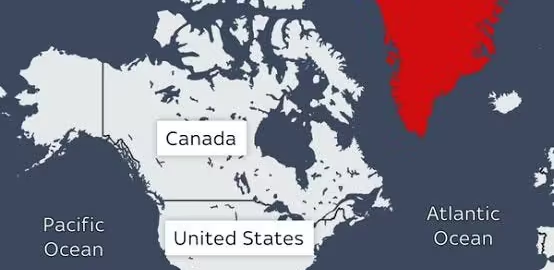
Why Trump Says the United States Needs to “Own” Greenland
Geopolitics, Arctic Power, and the Rising Russia–China Challenge
Introduction: A Statement That Shocked the World
When Donald Trump declared that the United States needs to “own” Greenland to prevent Russia and China from taking control of it, the statement immediately triggered global debate, ridicule in some quarters, alarm in others, and renewed attention on the Arctic as a strategic battleground. While the phrasing sounded blunt—even crude—the underlying logic reflected a growing geopolitical reality: the Arctic is becoming one of the most important strategic regions of the 21st century.
Greenland, the world’s largest island, sits at the crossroads of North America, Europe, and the Arctic Ocean. For decades it was considered remote, frozen, and geopolitically marginal. Today, climate change, melting ice, new shipping routes, vast untapped natural resources, and rising great-power competition have transformed Greenland into a key piece on the global chessboard.
Trump’s statement was not made in a vacuum. It was rooted in long-standing U.S. strategic thinking, renewed fears of Russian militarization of the Arctic, China’s growing ambitions as a self-declared “near-Arctic state,” and concerns that American influence in the region could erode if decisive action is not taken.
This article examines why Greenland matters, what Trump really meant by “owning” it, how Russia and China fit into the picture, how Denmark and Greenland themselves responded, and what this controversy reveals about the future of global power politics.
1. Greenland: Geography That Shapes Global Power
A Colossal Island in a Strategic Location
Greenland is massive—larger than Mexico—yet home to fewer than 60,000 people. Its importance lies not in population, but in location.
Greenland sits between:
North America (Canada and the U.S.)
Europe (via Iceland and Scandinavia)
The Arctic Ocean and North Atlantic sea lanes
This makes Greenland a natural strategic gateway. Any military or economic power operating in the Arctic must consider Greenland.
Control of Air and Sea Routes
During the Cold War, the U.S. recognized Greenland’s importance as an early-warning outpost against Soviet nuclear missiles. That logic still holds today.
Missiles, submarines, and aircraft traveling between Eurasia and North America often pass through Arctic corridors. Greenland offers surveillance, radar coverage, and basing opportunities that are crucial for missile defense and global security.
Trump’s concern, therefore, was not abstract. It was deeply tied to defense geography.
2. The U.S. and Greenland: A Long History
Not a New Idea
Trump’s comments were widely portrayed as bizarre or unprecedented. In reality, the U.S. has considered acquiring Greenland multiple times:
1867: After buying Alaska, U.S. officials explored the idea of acquiring Greenland.
1946: The U.S. formally offered Denmark $100 million in gold to purchase Greenland.
Cold War era: The U.S. established Thule Air Base, a critical military installation that still operates today.
Thus, Trump was reviving an old strategic conversation rather than inventing a new one.
Thule Air Base and U.S. Presence
Thule Air Base (now called Pituffik Space Base) is one of America’s most important overseas military facilities. It plays a role in:
Missile warning systems
Space surveillance
Arctic defense operations
For Washington, Greenland is already essential to national security. Trump’s statement simply made this reality explicit—and politically explosive.
3. Why Russia Is a Central Concern
Russia’s Arctic Militarization
Russia has invested heavily in the Arctic over the past decade. Its actions include:
Reopening Soviet-era military bases
Deploying advanced missile systems
Expanding its nuclear submarine fleet
Increasing Arctic patrols and exercises
Russia views the Arctic as a core national interest. Much of its coastline, energy reserves, and naval power lie in the region.
From a U.S. perspective, losing influence in Greenland would weaken America’s ability to monitor and counter Russian activity.
The Northern Sea Route
As ice melts, Russia is promoting the Northern Sea Route as a major shipping lane connecting Asia and Europe. Control of Arctic chokepoints could translate into economic and strategic leverage.
Trump’s warning reflects fear that Russia could dominate Arctic routes and reshape global trade flows—with Greenland playing a key role in surveillance and counterbalance.
4. China’s Quiet but Persistent Arctic Ambitions
China as a “Near-Arctic State”
China has no Arctic territory, yet it has declared itself a “near-Arctic state.” This concept has alarmed Western policymakers.
China’s interests include:
Access to rare earth minerals
Scientific research (with military dual-use potential)
Arctic shipping routes as part of the Belt and Road Initiative
Strategic footholds through infrastructure investment
Chinese Investment Attempts in Greenland
China has shown interest in:
Mining projects
Airport construction
Infrastructure development
Although many projects were blocked or scaled back due to Danish and U.S. pressure, Washington remains wary. Economic influence can become political and strategic influence over time.
Trump’s statement reflected fear that if the U.S. does not act, China might gain leverage through investment rather than invasion.
5. What Trump Meant by “Own”
Literal Ownership vs Strategic Control
Trump’s phrasing—“own Greenland”—was widely criticized as colonial and outdated. However, analysts argue he likely meant:
Permanent strategic control
Exclusive military and security dominance
Preventing rival powers from gaining influence
In Trump’s worldview, clarity and bluntness are virtues. What diplomats say indirectly, Trump says directly.
A Transactional View of Geopolitics
Trump approaches international relations like business deals:
Assets matter
Control matters
Rivals must be blocked
From this perspective, Greenland is not just land—it is a strategic asset. Allowing Russia or China to gain influence there would be, in Trump’s logic, a catastrophic failure.
6. Denmark and Greenland Respond
Danish Rejection
Denmark, which governs Greenland as an autonomous territory, firmly rejected the idea of selling it. Danish leaders called the suggestion “absurd” and emphasized that Greenland is not for sale.
The reaction highlighted the tension between:
Get Wasif Ali’s stories in your inbox
Join Medium for free to get updates from this writer.
Subscribe
Subscribe
U.S. strategic thinking
European norms of sovereignty and diplomacy
Greenlandic Voices
Greenlanders themselves were largely sidelined in the global debate. Many expressed frustration at being treated as an object rather than a people.
Greenland has its own parliament and increasing autonomy. While some Greenlanders welcome U.S. investment and protection, most oppose any idea of forced ownership or external control.
This raises a deeper question: Can 21st-century geopolitics coexist with self-determination?
7. Climate Change: The Game Changer
Melting Ice, New Opportunities
Climate change is rapidly transforming the Arctic:
Ice coverage is shrinking
Shipping seasons are lengthening
Resource extraction is becoming feasible
Greenland holds vast reserves of:
Rare earth minerals
Uranium
Oil and gas
Freshwater locked in ice
Whoever influences Greenland could shape the future of resource competition.
Security Risks
Melting ice also increases military vulnerability. New routes mean new threats. Early-warning systems in Greenland become even more vital.
Trump’s statement reflected the belief that climate change is accelerating geopolitical urgency, not reducing it.
8. NATO, Allies, and Strategic Friction
Greenland and NATO
Denmark is a NATO member, and Greenland is covered by NATO’s collective defense framework. In theory, this should reassure the U.S.
However, Trump has often expressed skepticism toward alliances, arguing that they:
Move too slowly
Depend too much on U.S. protection
Fail to respond decisively to threats
From this viewpoint, “owning” Greenland removes uncertainty and guarantees American control.
European Unease
European leaders worry that Trump’s rhetoric:
Undermines international law
Encourages power politics
Weakens alliance trust
Yet many quietly share U.S. concerns about Russia and China—if not Trump’s blunt methods.
9. Media Reaction and Public Perception
Mockery vs Substance
Much media coverage focused on the novelty of the idea rather than its strategic logic. Late-night jokes overshadowed serious analysis.
This created a divide:
Critics saw imperial nostalgia
Supporters saw strategic realism
Over time, more analysts acknowledged that while Trump’s language was provocative, the Arctic security issue he raised was real and urgent.
10. What This Reveals About the Future World Order
Return of Great-Power Competition
Trump’s statement reflects a broader shift away from:
Globalization optimism
Post-Cold War cooperation
Toward:
Power politics
Strategic territories
Zero-sum thinking
Greenland symbolizes how geography is reclaiming importance in a digital age.
From Soft Power to Hard Control
The controversy highlights a global trend:
Economic investment becomes strategic leverage
Infrastructure becomes influence
Science becomes security
In such a world, symbolic ownership matters less than effective control.
11. Is U.S. Ownership Realistic—or Necessary?
Legal and Political Barriers
Actual U.S. ownership of Greenland is highly unlikely:
Denmark will not sell
Greenlanders oppose it
International norms forbid coercion
However, ownership may not be necessary.
Alternative Paths
The U.S. can:
Expand military cooperation
Increase investment
Strengthen diplomatic ties
Block hostile foreign influence
In practice, this may achieve Trump’s goal without formal ownership.
Conclusion: Blunt Words, Strategic Reality
Donald Trump’s claim that the United States needs to “own” Greenland to prevent Russia and China from taking it was controversial, undiplomatic, and widely mocked. Yet beneath the rhetoric lay a serious strategic warning.
The Arctic is no longer a frozen backwater. It is a frontline of global competition. Russia is militarizing it. China is investing in it. Climate change is opening it. And Greenland sits at its center.
Trump’s language shocked the world, but it forced attention onto a question policymakers can no longer ignore: Who will shape the Arctic’s future—and at what cost?
Whether through ownership, alliance, or partnership, the struggle for Greenland reflects a larger truth of the 21st century: power, geography, and security are returning to the heart of global politics.
And Greenland, once forgotten under ice, is now impossible to ignore.