REAL POLITICS: Unity government faces test on empowerment reform
Scrolla | 20.03.2026 21:14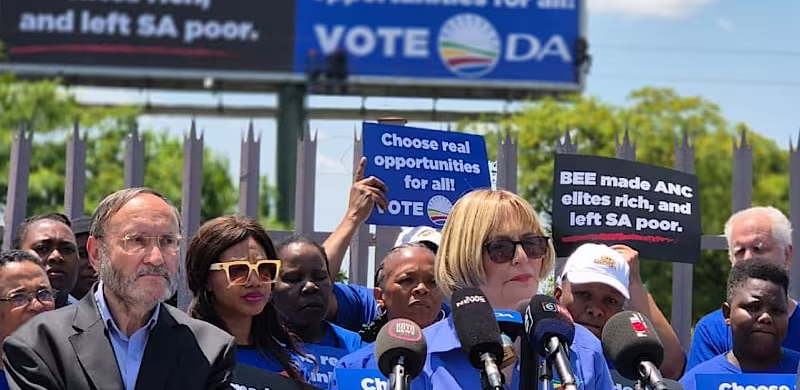
South Africa is finally having an honest conversation about Broad-Based Black Economic Empowerment. And it is long overdue, writes Zukile Majova in Real Politics.
For years, any criticism of B-BBEE was dismissed as resistance from opposition parties or business interests. That is no longer true. The loudest frustration now comes from black South Africans themselves, especially those who feel locked out of real economic progress.
The government of national unity has opened the door to a review of B-BBEE. That matters. But a cautious, technical review will not be enough. What is needed is a deeper rethink of how empowerment actually works in practice.
Deputy President Paul Mashatile has made it clear that the government does not want to scrap B-BBEE. He has called it the backbone of transformation and insists it must be improved rather than replaced. The planned two-phase review will look first at regulations and codes, then at the law itself.
That sounds reasonable. But it avoids a harder question. Has B-BBEE, in its current form, delivered broad-based empowerment, or has it mainly benefited a small, connected elite?
There is no denying that B-BBEE has created a class of successful black professionals and business owners. That is an important achievement in a country shaped by apartheid exclusion. But it is also true that millions of poor South Africans have seen little direct benefit.
Unemployment remains high. Inequality remains among the worst in the world. Economic participation is still out of reach for many.
This gap between policy and reality is where the real problem lies.
One of the biggest criticisms is that B-BBEE has become too closely tied to government tenders and procurement. Instead of driving broad economic inclusion, it often rewards those who are best positioned to access state contracts.
This creates a system where political connections can matter as much as, or more than, innovation and hard work.
The controversy around the R49 million Tembisa hospital tender linked to Mashatile’s children shows how damaging this perception can be. Even if every rule was followed, the public is left questioning whether the system is fair.
That doubt erodes trust. And without trust, no empowerment policy can succeed.
There is also a growing argument that race alone is no longer an adequate measure of disadvantage. South Africa remains deeply unequal, but poverty cuts across communities in complex ways.
A young black graduate without connections may struggle just as much as someone from another background who faces economic hardship.
This is why some have proposed shifting the focus towards poverty, job creation and skills development, rather than relying mainly on racial targets.
The DA taken this further by proposing a complete replacement of B-BBEE with a race-neutral system. That proposal has gained attention, but it also raises concerns about ignoring the historical injustice that B-BBEE was designed to address.
South Africa cannot pretend that race no longer matters. It does. But it cannot be the only factor either.
The real challenge is to design a system that recognises past injustice while delivering real opportunity in the present.
Another key issue is implementation. Even the best policies can fail if they are poorly enforced.
Fronting, where companies pretend to meet empowerment requirements, remains a problem. So does corruption in procurement. Strengthening oversight and accountability should be a priority in any review.
At the same time, government should look beyond tenders as the main tool of empowerment.
Local municipalities, for example, could be given more capacity to carry out basic services without relying on slow and often contested tender processes. This would not only improve service delivery but also create more direct employment.
Empowerment should be visible in everyday life. It should mean working infrastructure, functioning local economies and real jobs.
The debate around B-BBEE has become polarised. On one side are those who defend it as essential and untouchable. On the other are those who see it as a failed policy that must be scrapped.
Both positions miss the point.
B-BBEE is neither a complete success nor a complete failure. It is a policy that has achieved some of its goals while falling short in others.
That is exactly why it needs to be reviewed seriously.
The government of national unity has a chance to move this debate forward. The involvement of different parties has already forced a shift in tone. There is more openness now to questioning what has worked and what has not.
But real reform will require political courage.
It will mean admitting that parts of the system have been abused. It will mean challenging vested interests that benefit from the current model. And it will mean being honest about what empowerment should look like in 2026, not 2003.
South Africans are not asking for the end of transformation. They are asking for it to work.
If the review of B-BBEE is limited to minor adjustments, it will be a missed opportunity. If it leads to meaningful change, it could help rebuild trust and unlock broader economic participation.
The choice facing the government is clear: fix B-BBEE or keep failing the majority.
Pictured above: Democratic Alliance Federal Chair Helen Zille addressing party supporters during a protest against BEE policies in October 2025.
Image source: Democratic Alliance