South Africa has a political assassination problem. Who’s ordering them?
Explain | 01.07.2026 22:45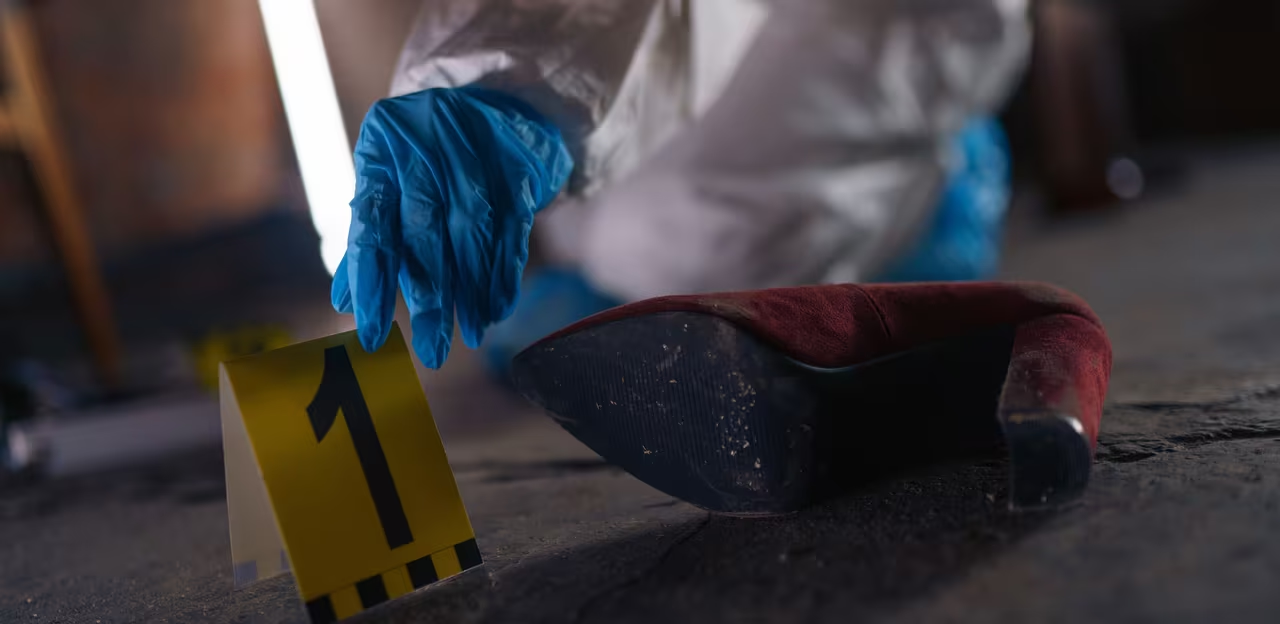
On the weekend of 20 June, four politically linked people were killed in separate shootings across three provinces. All four were attacked around voter registration activities, just months before the 4 November 2026 local government elections.
In Dunoon, Cape Town, Sinovuyo Dyokwe (48), a Democratic Alliance ward 104 by-election candidate and community activist, was shot dead while reportedly making her way home from a voter registration station. The DA has offered a R50 000 reward for information. According to reports, Dyokwe had previously raised concerns about alleged extortion threats.
That same night, in Bekkersdal on the West Rand, two MK Party members, Mozwakhile Zungu and Siyabonga Mabaso, were shot and killed after leaving a voter-registration site. And, in Nelson Mandela Bay, ANC ward 27 councillor Sicelo Mleve was shot dead during a meeting at his office. Police said armed men entered the office, demanded cellphones, and then shot the 45-year-old councillor several times.
The Political Killings Task Team has been brought in to assist with the investigations. But police say no motive has been ruled out.
The stats are bad. The gaps are worse.
In 2024, the Global Initiative Against Transnational Organised Crime said targeted killings in South Africa have risen 108% over the past decade. In 2023, it recorded 131 targeted killings, including 31 political assassinations, or almost 24% of the total. The group says this is almost certainly an undercount because its database relies on publicly available information, such as media reports, court records, and official statements.
Political-violence monitor Mary de Haas told /explain/ it is “almost impossible” to get accurate statistics. She has tracked killings for decades, particularly in KwaZulu-Natal, but says some cases never make it into media reports at all.
She said the pattern has also changed. In the 1980s and 1990s, many killings were linked to conflict between the UDF/ANC and the IFP. Over the past 20 years, she said, intra-party killings have become far more common.
Political-analyst Professor Bhekithemba Mngomezulu agrees. He told /explain/ the recent killings are not isolated.
“The killings are part of the culture in our politics,” he said. “Each time the country prepares for an election, more politicians are killed.”
Why local politics is deadly
Mngomezulu said councillors and local political leaders are vulnerable because local elections are closest to communities. Winning a ward can mean influence, access, and momentum for bigger political battles. “Not all politicians are killed by their political rivalries with other political parties,” he said. “Some are killed by their own comrades as they fight for inclusion in the candidates’ lists.”
The Moerane Commission of Inquiry, which investigated political killings in KwaZulu-Natal, reached a similar conclusion in 2018. It linked some killings to unfair council selection processes, municipal deployments, tender competition, and power struggles inside political organisations.
TANC acting national spokesperson Nonceba Mhlauli told /explain/ political violence cannot be pinned on one cause. She said it can involve “criminality, competition over resources and opportunities, local disputes, factionalism, and wider socioeconomic pressures”.
De Haas warned that motives are difficult to prove until evidence is tested in court. A killing may look political because the victim held office. But it may be linked to a tender, taxi interests, private security, a personal dispute, corruption, or someone trying to silence a whistleblower.
Mngomezulu said this is exactly why the true number of political killings is probably higher than recorded. Some cases are treated as ordinary murders. Others may never reveal who ordered them.
“It is difficult to know the masterminds behind these killings because some of them are high-profile politicians,” he said. The real horror is that South Africa sometimes catches the gunman but rarely the person who paid for the gun.
The ANC says preventing political violence requires government, law enforcement, political parties, and communities to work together. It says police must investigate threats and attacks quickly, political parties must promote tolerance, and communities must reject violence as a way to settle disputes.
The bloody voter-registration weekend gave South Africa another set of numbers. Four people killed. Three provinces. One election season. But the data still can’t answer the most important question: Who wanted them dead, and why?