SA’s SALT Telescope Joins One of the Most Ambitious Sky Surveys Ever!
Good Things Guy | 26.02.2026 19:00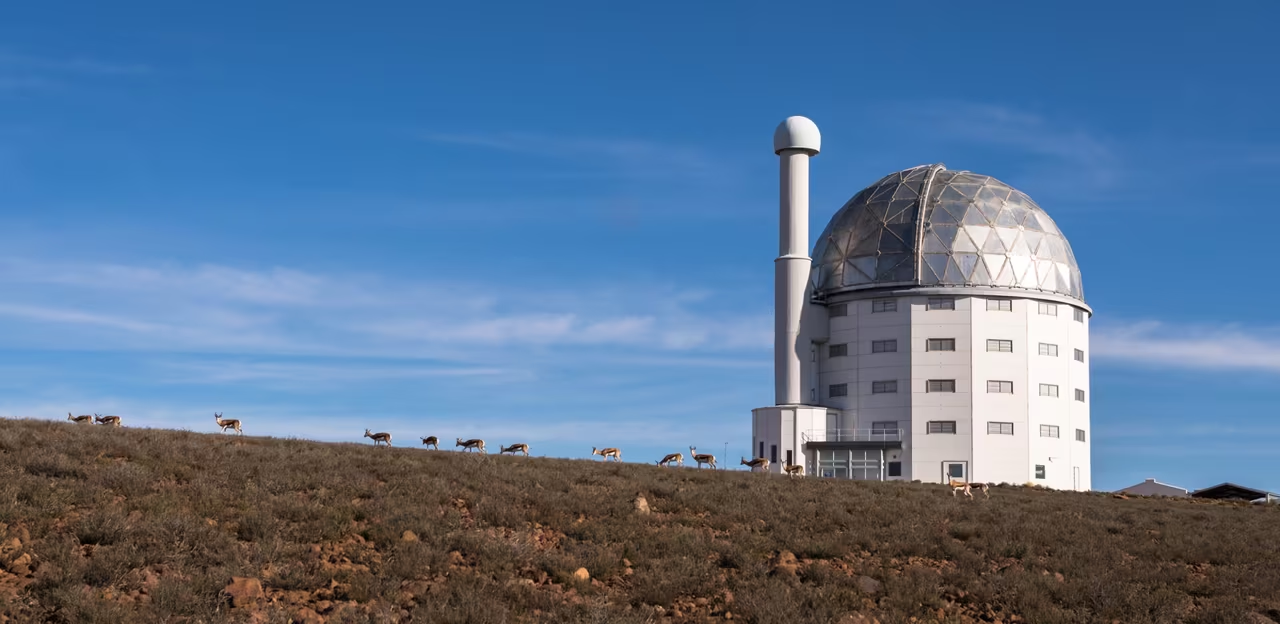
South Africa is stepping into a new era of time-domain astronomy by investigating new alerts picked up by the Rubin Observatory in Chile!
Northern Cape, South Africa (27 February 2026) – The Rubin Observatory in Chile is conducting one of the most ambitious sky surveys ever.
The observatory uses the largest digital camera ever built – the Legacy Survey of Space and Time camera – to photograph the sky every 40 seconds. Its software automatically spots anything that’s changed since the last time it looked, whether that’s a star that suddenly brightened, a new explosion in a distant galaxy, or a rock moving through our solar system.
When it spots something unusual like an exploding star (supernova), a flaring black hole, or a new asteroid, it sends out a global ‘alert.’
The observatory released the first of those alerts this week. In one single night, it issued 800,000 alerts calling scientists’ attention to new asteroids, exploding stars, and other changes in the night sky. Eventually, the system is expected to produce up to seven million alerts per night!
While the Rubin Observatory is great at finding these events, South Africa has the ‘detective’ needed to solve the mystery.
Sutherland is the home of the largest single optical telescope in the Southern Hemisphere, the Southern African Large Telescope (SALT). Its job is to take that alert, point its massive 11-metre mirror at the object, and perform ‘spectroscopy’ – which is basically analysing the light to figure out exactly what the object is made of and how far away it is.
In space things happen fast. An exploding star might only stay bright for a few days or even hours. Because South Africa shares the same southern sky as Chile, we are perfectly positioned to jump into action the moment an alert is triggered.
But SALT isn’t working alone! We also have the Lesedi telescope, a fully automated ‘robotic’ telescope in the Northern Cape. It’s part of the Intelligent Observatory program, meaning it can respond almost instantly to an alert, providing the first crucial bits of data before the giant SALT telescope takes over for heavy lifting.
“This is an exciting moment for South African astronomy,” said Prof Rosalind Skelton, Managing Director of the National Research Foundation’s South African Astronomical Observatory. “Rubin Observatory is transforming how we discover dynamic events in the Universe, and SALT is ideally equipped to investigate them in detail, building on an existing highly successful transient programme. Our ability to respond quickly to these alerts ensures that South Africa will play a leading role in the scientific return from this global endeavour.”
The partnership puts South African scientists and students at the absolute forefront of international astronomy that will, over time, reshape how humans understand the universe!
Sources: Linked above.
Don’t ever miss the Good Things. Download the Good Things Guy App now on Apple or Google.
Do you have something to add to this story? Please share it in the comments or follow GoodThingsGuy on Facebook and Twitter to keep up to date with good news as it happens, or share your good news with us by clicking here or click the link below to listen to the Good Things Guy Podcast with Brent Lindeque – South Africa’s very own Good Things Guy. He’s on a mission to change what the world pays attention to, and he truly believes there’s good news around us. In the Good Things Guy podcast, you’ll meet these everyday heroes and hear their incredible stories:
Or catch an episode of Good Things with Brent Lindeque or our Weekly Top 5 below. The videos here are always changing, updated with the latest episodes from these two shows. Both are part of Good Things TV, created to bring South Africans balance at a time when the news can feel overwhelmingly negative. Our goal is simple: to remind you that there are still so many good things happening in our country – and to leave you feeling a little more proudly South African.