Who will tell Fatima?
Medium | 30.01.2026 13:41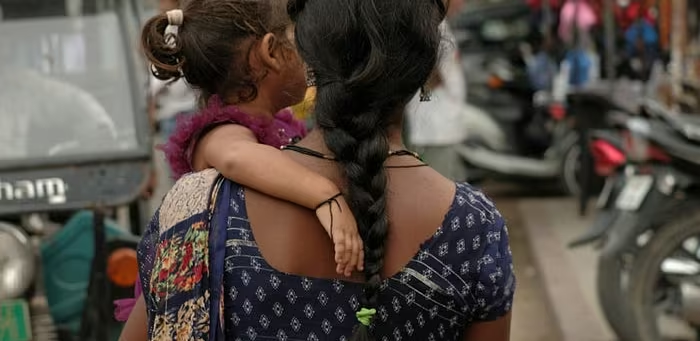
Who will tell Fatima?
Vinati Sukhdev DCI Stanford fellow & author
5 min read
·
Just now
--
Listen
Share
Air pollution stories from smog-ridden Delhi
Fatima is a 26 year old mother of two who comes to our Delhi flat to clean and dust and mop everyday. She lives in a shanty town nearby and cycles in to work from about two kilometers away. Her daily cleaning ritual takes her about two hours and then she goes to work in another apartment in the building. She returns home at about 1 pm and takes over from her mother-in- law who has looked after the children all morning. It is one of the cruel ironies of our inequitable times that the top 10% don’t know how the rest of the world lives. Fatima’s makeshift home probably resembles a lurid art installation in a London gallery. Blue tarpaulin to keep out the rain, some corrugated iron sheets to make up the walls, some basic bedding on the floor for the family of five and thin ropes running criss-cross across the dwelling thus created to hang all the family’s clothes. The children play out in the open all day inhaling air that indices routinely rate as hazardous. Fatima’s husband works as a security guard in a nearby building. He is exposed to the toxicity of Delhi’s polluted air for a full 12 hours a day.
Pradushan? She has trouble understanding the word, even in Hindi. ‘Dirty air’ is the best I can offer in terms of simplification. ‘Oh that,’ she says blithely, ‘it is winter, that is why the air is so dirty. I wear my dupatta over my nose and mouth so I can avoid the dust.’ No, she has not fallen ill, nor have her children.’ What about other children in the neighbourhood?’ She looks at me puzzled and gives a definitive answer. ‘No, I haven’t seen any child fall ill because of the dirty air.’
Like many Indians, Fatima is not aware of the impact of hazardous air quality on health. Yet.
Get Vinati Sukhdev DCI Stanford fellow & author’s stories in your inbox
Join Medium for free to get updates from this writer.
Subscribe
Subscribe
The Times of India has quoted the Institute for Health Metrics and Evaluation (IHME) as reporting that one in seven deaths in Delhi or 15% of deaths are due to polluted air. Data from the Centre for Research on Energy and Clean Air ( CREA) says ambient particulate matter pollution remains the single largest risk factor of deaths in Delhi which number a staggering 17,200 annually already. One estimate by CREA estimates that 490000 years of healthy life are lost in Delhi alone due to air pollution. Gita Gopinath, former chief economist at the IMF and currently a professor of Economics at Harvard University startled the CEO fraternity at Davos recently by warning that India’s air pollution will cause more harm to the economy than global tariffs. She warned that India posed an investment risk despite an enviable GDP growth rate of 8.2 %. Environmental economist Vimalendu Jha backs Gopinath and says that the loss due to air pollution could be as high as 9% of GDP. Gopinath was trolled in the Indian media by people who claim the link between air pollution and health risks is tenuous.
Fatima does not understand GDP or economics. Or politics for that matter.
The other apartment where Fatima works is on the same floor as our flat. It is occupied by a young professional couple. Both are in their 30's and work in strategic consulting for global companies. They have one child, a five year old boy who darts in and out of their apartment and ours, bringing delight and joy wherever he goes. His parents have just bought a villa in a gated community in the coastal state of Goa. The Air Quality index there is helped by sea breezes and less traffic, industrialisation and construction generally. They drop in to tell us that from next year they will be spending four months in Goa. ‘ We want to protect our child,’ says Manish. ‘ We have been trying to move for the last five years but could never find the right place.’ He doesn’t expect things to improve anytime soon and his reaction is not knee jerk or drastic. It is born of weary cynicism that is part-Hindu ( this is our destiny) and part lived- experience.
‘Even 79 years after independence, the Indian government has failed to provide a stable electricity grid or clean drinking water in the taps. Why should we expect clean air?’ says Manish with a cynical laugh. ‘I have to make my own arrangements.’ Like most well-to-do Indians, Manish lives in a private condominium with its own generator which switches on automatically every time there is disruption in the electricity supply. His kitchen has a state of the art water filter that works on reverse osmosis technology and provides safe drinking water. His living room now has a comprehensive air filter that combines conventional ventilation with advanced filtration technology to create a safe and clean air haven. What Manish is most relieved about is that his filter effectively eliminates PM2.5. – the microscopic atmospheric particulate matter with a diameter of less than 2.5 micrometers, about 30 times smaller than a human hair. It penetrates the lungs and enters the bloodstream, causing serious long-term health risks such as respiratory infections, cardiovascular disease and reduced life expectancy
Fatima has never heard of PM2.5 and does not own any kind of air filter, water filter or generator.
Manish’s cynicism is not shared by many others in Delhi who turned up last November at India Gate to protest government inaction on the issue of pollution.People who feel those in power are not doing enough. As protests in India go, it was small. Only about 1000 people in a city of 22 million took part. Whether it was fear or cynicism or plain ignorance, it is hard to tell but at least it was a start. With two million lives in India cut short each year by this scourge and many more under threat, it is time to put the government under pressure to spell out and implement its pollution control strategies. On paper the government seems to be doing more than it did a few years ago. The position of the Indian government until recently was stubborn refusal to give up fossil fuel usage because it was cheaper. At international forums India would point to the western developed nations and say ‘ you did it with fossil fuels, now it’s our turn,’ or ‘ our greenhouse gas emissions per capita are still much lower than yours.’ But the game has changed since then. Delhi’s air pollution problem has made the government realise that we are all in this together. They have come up with an emergency Graded Response Action Plan (GRAP) depending on the severity of the pollution. It bans vehicular traffic and closes down schools in the worst case and puts a halt on industrial and construction activity to improve air quality. It also deploys cloud seeding, anti-smog guns and water sprinklers as alleviation measures. Over 400 km of new roads are being built to reduce dust in the atmosphere. On the positive side, there is a move to transition to a fleet of 10500 electric buses in Delhi and a move to plant trees to replace lost green cover. In the long term, these measures, many of them highly unpopular, require political will. It is a question of who will vote for cleaner air and whether their votes are more than those of the people who own cars and run factories.
Fatima has a voting card. But who will tell Fatima what power it wields?