Why Feminism
Medium | 26.12.2025 22:03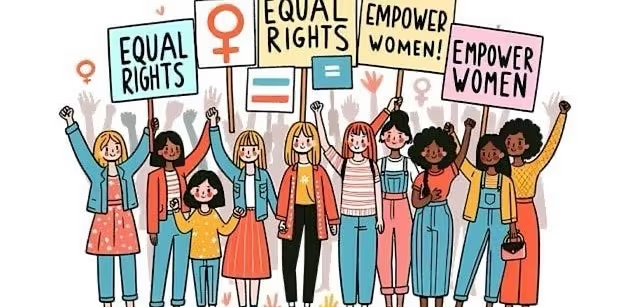
Why Feminism
The Conversation That Proved Why It Still Matters.
Follow
4 min read
·
Just now
Listen
Share
A man asked me, “Why feminism? Why do women make such a big deal out of equality? Don’t they already get treated fairly? Why do women today need to propagate feminism?” He said it casually, almost jokingly, the way society often does, dismissing centuries of imbalance with a smirk. And for the longest time these words stayed somewhere in the background of my life. But today, those words came back like a warped vinyl looping endlessly. Because today I witnessed the very reason why feminism still exists, still matters and still needs to be spoken about – loudly.
Earlier this morning I overheard a conversation, not an argument, not a fight, but a quiet, routine family discussion. The kind that happens in Indian households all the time. My parents and sibling were talking about inheritance. I wasn’t supposed to be part of that conversation, after all daughters rarely are. Yet in just a few sentences, I heard enough to understand exactly where I stood. A future was being planned where my brother naturally received a major portion of what my parents owned, while I was assigned a smaller piece, not based on need, effort, contribution or character, but simply gender. They talked about it with such ease, as if this was the most normal, logical thing in the world. And that is what hurt the most, not the numbers but the comfort with which my worth was reduced.
It’s strange how sometimes patriarchy rarely screams. It whispers. It hides behind smiles, behind tradition, behind what it calls family understanding. It convinces itself it is being fair, that this is how things have always been done, that daughters have their “own future homes,” that sons have “responsibilities.” It is dressed up in logic, but beneath it sits a deep, fragile insecurity- “If a daughter is given equal rights, what remains that makes the son special?” And so families come up with creative tactics like wills drafted early, verbal agreements made behind closed doors, emotional manipulation, silent expectations – all constructed to quietly dodge the very laws designed to protect women.
Because if they didn’t dodge them, daughters would have exactly the same inheritance rights as sons. And that reality, for many is unbearable.

It’s a strange kind of heartbreak to realize that people who claim to love you can still reduce you to a category. That no matter how educated or modern a household looks on the outside, inside its walls women’s rights can be treated as optional, flexible, negotiable. I am an adult woman standing on my own feet, contributing financially, supporting whenever needed, taking responsibility for myself. Yet when the moment comes to acknowledge that independence, that effort, that existence, suddenly I am “less eligible” simply because I was born a daughter.
Get Shivani Chougula’s stories in your inbox
Join Medium for free to get updates from this writer.
Subscribe
Subscribe
This is the part people overlook when they ask, “Why feminism?”
They don’t see the quiet rooms where decisions are made about our lives without us. They don’t see the invisible calculations of what daughters deserve. They don’t see the laws bent and twisted so that patriarchy can stay comfortable.
This is why feminism is still not just relevant but necessary.
Because equality on paper means nothing when inequality at home is still the default. Because daughters are still expected to be grateful for crumbs. Because a woman standing up for her rights is still seen as “overreacting.”
Feminism exists for moments like today, moments that reveal how fragile a woman’s privileges truly are in a society that is always searching for ways to subtract from her share. It exists to remind us that we are not asking for more than men – we are simply refusing to accept less. It exists so that young women know they are not alone when they feel betrayed by their own families. And it exists so that one day, perhaps, no girl will have to overhear decisions about her future and forced to quietly accept them.
And if anyone ever asks me again, “Why feminism?” I’ll point to this very day, to the calculations, the justifications, the quiet misogyny hidden in plain sight.
This is why.
This is exactly why I’m a feminist.