Morro da Providência: Spatial Sociology of the Cable Car Gaze over Gamboa’s Barracões Culturais
Medium | 08.01.2026 16:49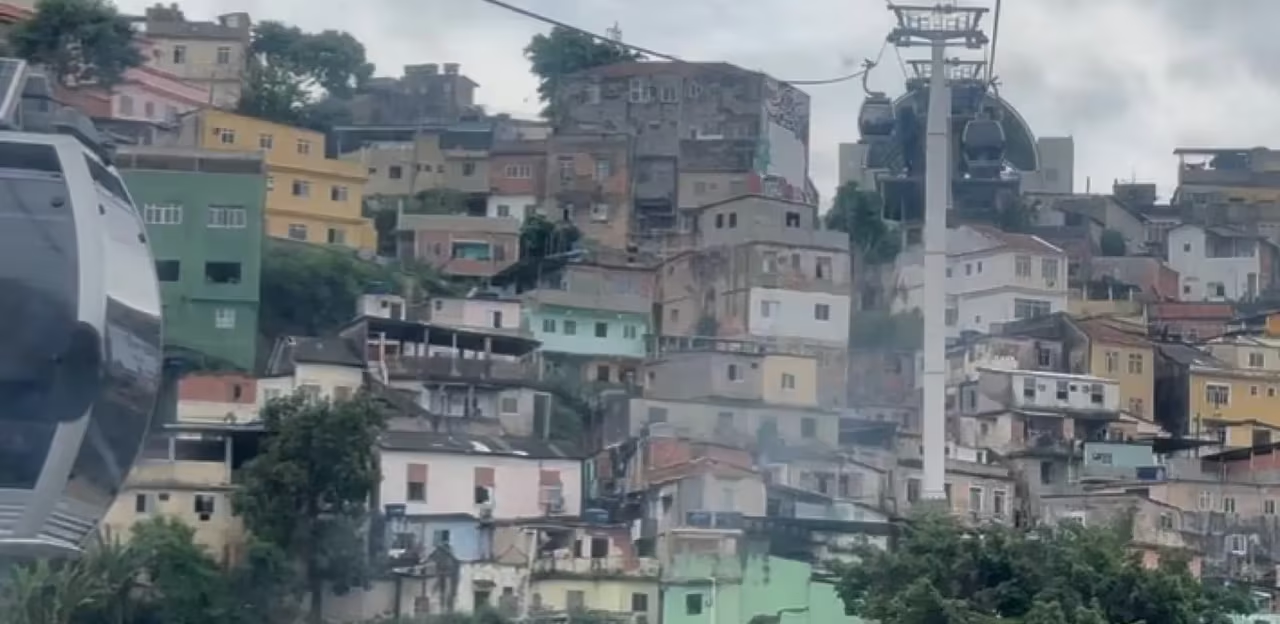
Morro da Providência: Spatial Sociology of the Cable Car Gaze over Gamboa’s Barracões Culturais
4 min read
·
Just now
--
Listen
Share
As a visitor, my experience of Brazil was marked by warmth and pure joy!!! ❤️ Attending my first bloco in Rio was a powerful reminder of Carnival’s collective spirit and it was so magical. My reflections are not intended as an attack on Rio, but as an attempt to think carefully about how joy, labour, and visibility intersect within the city.
I recently took the Teleférico da Providência cable car up to the Morro da Providência, Brazil’s oldest favela. And it came with a strange emotion. Being brought into a vehicle of surveillance that was loaded with meaning, a vantage point between the visible and hidden city whilst under the guise of tourism.
I questioned, does this cable car exist largely for tourism, or does it exist for urban logic, to organise visibility, control, and distance under the guise of leisure, on a deeper level?
Tourists, (if they come), board this cable car like distant observers, in panopticon – style, above the residents’ homes but not so close to them. I found that power play jarring. I wondered what it must have signalled to those simply wanting to get on with their lives here but constantly seeing an engineered surveillance of cable cars with people and tourists constantly watching over their homes, I wondered what it must be like as a resident to endure this engineered gaze each time they take the cable car themselves or leave their homes. I think the cable car is more than just transport, it felt like a gaze made infrastructure.
As you sit in the cable car, the Copacabana beach is behind you in the distance, a big attraction, where festivities occur, but where you’re heading, in front of you, being the Providência, brings you initially to a rooftop where you can see the favela from above. Here, from below the gaze, and then in front of you, are the hidden away ports, homes and the Barracão Cultural. Out of sight from the rest of the city, attractions, and dominant narratives.
I asked my Brazilian friend Gustavo, (with his permission to be mentioned here), what was the purpose of the Barracão Cultural and he told me this is where people work, where artisans create production for the professional carnival. Like hand-stitched costumes, samba props, and monumental floats.
“Rio de Janeiro’s old port […] always served as a utilitarian space, a backstage service area attending to the needs of the city center while conveniently keeping activities of a potentially offensive nature out of sight” (Broudehoux 2017)
The Barracão Cultural
(and neighbouring industrial complexes).
I found it strange that the place (and heart) responsible for so much of the crafting of the costumes, and objects, that the wider public celebrates with at the (professional) carnival, is geographically distanced from the city.
Why does the glamour and joy circulate freely but the work carried out in the port (that made it possible), is spatially and symbolically obscured?
Why is there an invisible backstage to carnival?
To dig deeper this refusal signals racial othering. The port literally becomes a place to pass over…in this way the city consumes Black Brazilian cultural production while engaging less with the communities that sustain it. I do not claim to know what this gaze means for residents, and I am still learning the deeper historical implications, but witnessing it led me to question the city from a perspective of spatial sociology.
Rio’s port area could therefore be characterized as a refuse space, a space of otherness, alterity, and marginality, where the city’s excluded could be readily exploited while being kept invisible” (Broudehoux 2017, citing Wright 1997).
As white cultural learner navigating Providência’s teleférico, I probe spatial unease not as an expert, but as a student deeply curious about the divides I witness and the role spatial sociology and arrangement of a city plays, that thus makes me compelled to question privilege’s blind spots without any intention of overriding communidade voices. I hope this will be received with the sensitivity in which I have written it. And I hope to keep deepening my understanding of learning about the world through travel enthnography.
“Some of the richest contributions to Brazilian culture came from the port’s black population. […] Rio de Janeiro’s port is known as the birthplace of both samba and capoeira. It is also the cradle of the first ranchos, which would later give birth to the city’s famous carnival” (Broudehoux 2017, citing Moura 1995). ⭐️
P.s: A photo I took at my first Bloco.
Grateful. Grassroots joy.❤️
At Providência’s summit, rethinking elevated gazes, which inequities persist unseen?
Yours faithfully,