Father Reaches Funding Goal to Create AI That Detects ‘Invisible Epilepsy’
Good Things Guy | 05.02.2026 21:30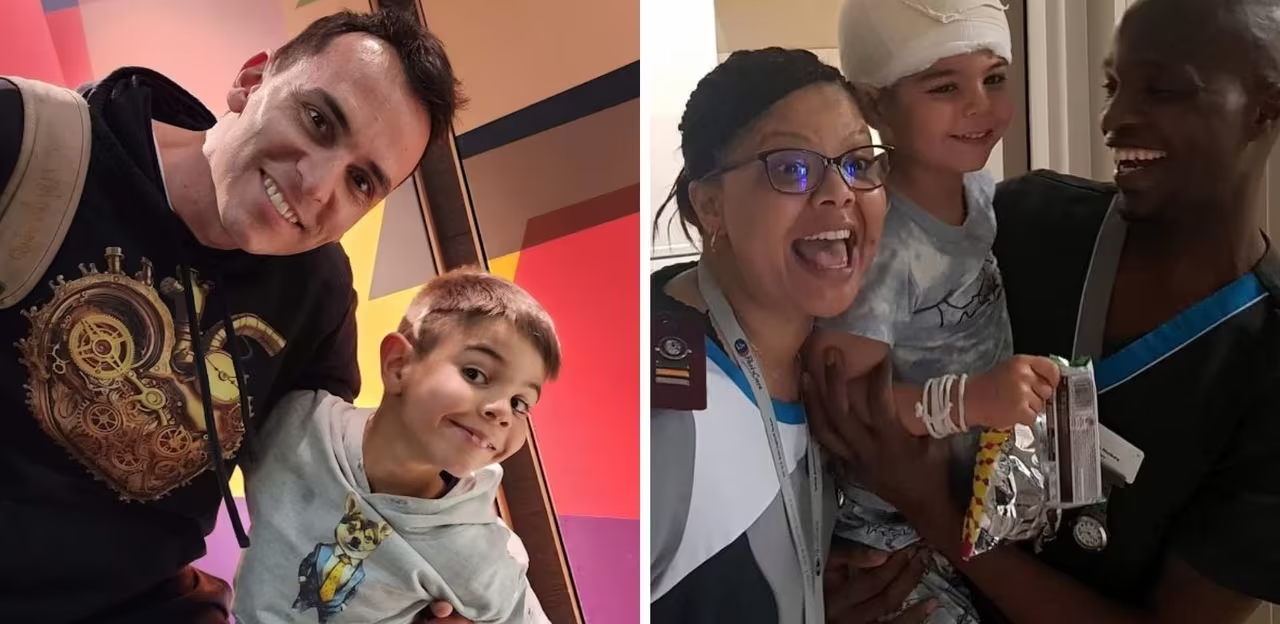
After years of being told his son’s scans were ‘normal’, Matthew turned to an experimental initiative abroad, hoping for answers. The results changed everything. Now he’s building an AI supercomputer to help people who suffer from refractory epilepsy!
Alberton, South Africa (05 February 2026) – For Matthew Sanan, the words ‘the scan is normal’ became a phrase he learned to fear.
“For thousands of families in South Africa, a ‘normal’ MRI report doesn’t mean their child is healthy. It means the doctors cannot see the problem. It means the seizures continue,” shares Matthew. “This is the reality of Focal Cortical Dysplasia [FCD]…tiny, subtle brain malformations that are the leading cause of drug-resistant epilepsy in children. They are invisible to the naked eye in up to 50% of standard scans.”
His son Declan lived with FCD for years without anyone knowing. He suffered years of seizures, sometimes up to 50 a day, while results kept coming back clear.
Eventually, Matthew sent Declan’s scans to the MELD Project, an international research initiative using artificial intelligence to detect FCD. Where human eyes saw healthy tissue, the AI flagged a problem area in Declan’s brain.
That moment changed everything.
For the first time, Matthew had proof that Declan’s seizures weren’t random or untreatable. The cause had been hiding in plain sight. The AI had done what years of conventional imaging couldn’t. That breakthrough eventually helped reopen conversations with specialists, and after months of further review and expert input, the word ‘inoperable’ was finally taken off the table.
But Matthew couldn’t shake a bigger thought. If this technology could help his son, how many other children were still being told their scans were ‘normal’ while seizures continued? How many families were stuck in the same loop?
Matthew wanted to bring the remarkable capability that saved his son’s life home.
With his background in technology, he’s launched Project Unseen.
It’s a research initiative that explores how full 3D brain analysis (rather than traditional 2D image slices) could help uncover subtle anomalies and generate heatmaps that guide surgeons directly to affected areas.
“Inspired by the incredible success of the MELD project, I am launching a personal research initiative specifically for South Africa.” shares Matthew. “While standard clinical diagnosis relies on 2D images, my goal is to explore how analyzing the complex 3D geometry and ‘wiring’ of the brain can help us detect the subtle anomalies that remain invisible even to current advanced tools.”
To make this possible, Matthew turned to online crowdfunding with a R175,000 goal to build a dedicated deep-learning workstation powerful enough to train the model on thousands of 3D brain scans.
In just over a week, the fundraiser crossed the 25% mark.
“I am honestly lost for words. In just over a week, our community has rallied to raise R47,300 for Project Unseen. We now have enough funding to secure the core chassis, motherboard, and power supply. The ‘idea’ is about to become physical hardware…THANK YOU to the 31 amazing donors who have brought us this far. You are helping us make the ‘invisible’ visible'” shared Matthew.
Just a week later, the campaign passed its target!
At the time of writing, more than R202,000 has been raised – 116% of the original goal – thanks to 39 donors who believed in the idea and the family behind it. A couple from The States made an incredibly generous donation of $9000 (around R140,000).
Matthew wants to pay it all forward. He says the hardware will become a shared resource that will bring access to advanced diagnostics to families who might otherwise never reach it.
“This hardware is a community asset. Once the model is operational, I commit to dedicating a portion of the machine’s computing capacity to process urgent scans for state patients and NPO partners at no cost, as resources allow.”
If you’d like to know more about the project, follow this link!
Sources: Linked above.
Don’t ever miss the Good Things. Download the Good Things Guy App now on Apple or Google.
Do you have something to add to this story? Please share it in the comments or follow GoodThingsGuy on Facebook and Twitter to keep up to date with good news as it happens, or share your good news with us by clicking here or click the link below to listen to the Good Things Guy Podcast with Brent Lindeque – South Africa’s very own Good Things Guy. He’s on a mission to change what the world pays attention to, and he truly believes there’s good news around us. In the Good Things Guy podcast, you’ll meet these everyday heroes and hear their incredible stories:
Or catch an episode of Good Things with Brent Lindeque or our Weekly Top 5 below. The videos here are always changing, updated with the latest episodes from these two shows. Both are part of Good Things TV, created to bring South Africans balance at a time when the news can feel overwhelmingly negative. Our goal is simple: to remind you that there are still so many good things happening in our country – and to leave you feeling a little more proudly South African.