REAL POLITICS: Hill-Lewis may be the reset the DA needs
Scrolla | 27.02.2026 22:16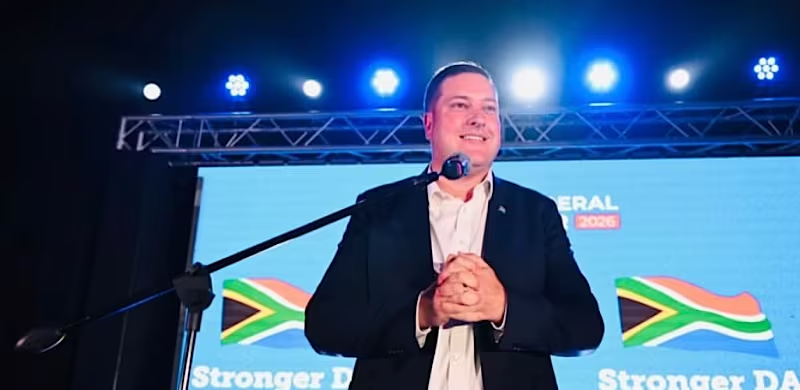
All signs point to Cape Town mayor Geordin Hill-Lewis emerging as the next leader of the Democratic Alliance in April. If that happens, it could mark a turning point for South Africa’s second biggest party at a critical moment in its history, writes Zukile Majova in Real Politics.
The timing could not be better. The local government elections are around the corner, and the DA needs fresh energy, a unifying message and a leader who can broaden its appeal beyond its traditional base.
Outgoing leader John Steenhuisen leaves behind a mixed legacy. His failure to strongly address farm killings angered many hardcore supporters, especially in the Afrikaner farming community. For them, the issue is not just crime statistics. It is about vulnerability. Farmers often live far from towns and police stations. Many feel exposed and unheard.
By framing farm killings as no different from other murders, Steenhuisen appeared out of touch with a constituency that has long backed the party. That perception has hurt the DA at a time when it can least afford internal fractures.
As minister of agriculture, Steenhuisen also faced criticism over the government’s response to the Foot and Mouth disease outbreak. More than 129,000 cattle have been lost and another 297,000 animals affected. Although one million vaccines have now been secured, many farmers believe the response was too slow. In an election year, that dissatisfaction carries political risk.
A new leader will have to decide whether to keep Steenhuisen in the agriculture portfolio. That decision alone will send a strong signal about the party’s direction and priorities.
Hill-Lewis offers something different. At 38, he represents a generational shift. But youth alone is not his main selling point. His record in Cape Town gives him credibility.
Under his leadership, the city has maintained relatively low unemployment compared to the national average. He has overseen major capital investment, including a reported R9.7 billion infrastructure push in a single year. Roads have been upgraded. Water systems strengthened. The city has moved to build energy resilience by allowing households and businesses to sell excess solar power back into the grid.
Cape Town has also attracted international attention. The city won the Bloomberg Mayors Challenge 2025 and secured a $1 million prize for innovative projects, including turning cow dung into energy saving rooftop paint and using artificial intelligence to redirect surplus food to struggling families. These are practical, measurable achievements.
Hill-Lewis has made it clear that he wants to build a party that is home to all races. His slogan, A Stronger DA, A Stronger SA, signals a desire to move beyond the narrow identity battles that have limited the party’s growth.
For years, critics have argued that the DA has struggled to shake off the shadow of its late 1990s politics, when fear of ANC dominance shaped much of its messaging. Whether fair or not, that perception has made it harder for the party to win the trust of black voters in large numbers.
Hill-Lewis appears determined to change that. He speaks about honest government, real service delivery and putting people first. He frames the leadership race as a chance to renew and expand, not retreat.
He also has support from younger leaders in the party, including former Tshwane mayor Cilliers Brink and Basic Education Minister Siviwe Gwarube. That matters. A divided party cannot grow.
Money will also play a role in the months ahead. The DA recently declared more than R31 million in donations in one quarter alone. A long and intense local government campaign could cost up to R1 billion. A leader with a strong governance record may attract even more financial backing.
Meanwhile, Helen Zille’s campaign to become mayor of Johannesburg is already under way. If she succeeds, she will be fully occupied with fixing that city. That would leave the national leader with more space to shape the party’s long term strategy.
If Hill-Lewis wins in April and secures two terms, he could lead the party from 2026 to 2032. That would include two municipal elections and a national election in 2029. It is a long runway.
The DA stands at a crossroads. It can cling to old battles and shrinking constituencies, or it can reposition itself as a credible national alternative focused on growth, jobs and clean government.
Hill-Lewis is not yet a national figure in every province. But his record in Cape Town speaks loudly. For a party that campaigns on governance, performance matters.
In politics, timing is everything. For the DA, this may be the moment to turn the page.
Image source: DA