Cape Town’s mayoral race is heating up. Here are the candidates.
Explain | 24.06.2026 18:40
Cape Town is often sold as South Africa’s best-run city: clean audits, blue skies, mountain views, and functioning robots. Joburg residents can only dream…
But it’s also a city of brutal inequality defined by unaffordable housing, spatial injustice, gang violence, and drug abuse.
South Africa’s local government elections will take place on 4 November 2026, and Cape Town is becoming one of the most closely watched metros.
The DA remains the party to beat, but, for the first time in years, an outright DA majority is no longer guaranteed.
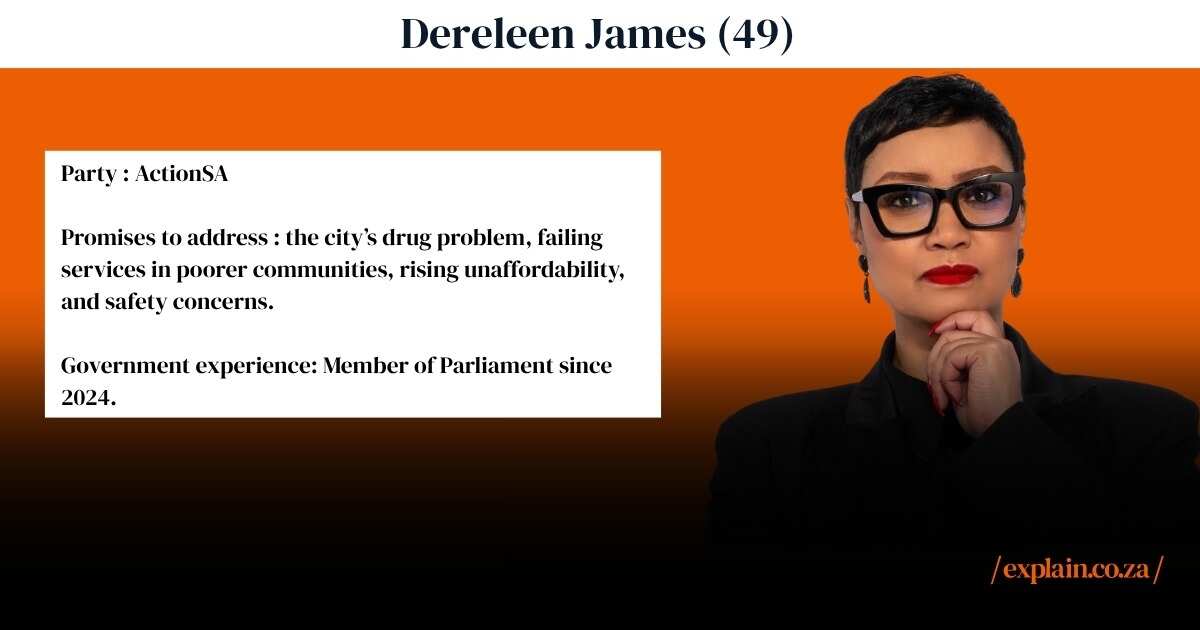
The DA has put forward the current mayor and party leader, Geordin Hill-Lewis, who is seeking another term. ActionSA has named MP Dereleen James as its candidate. The GoodParty has backed Brett Herron, who is also the Rise Mzansi candidate under the two parties’ partnership. And the Patriotic Alliance has named Councillor Cheslyn Daniels.
Geordin Hill-Lewis: The incumbent with the target on his back
Hill-Lewis enters the race with the obvious advantage: he’s already mayor. He can campaign on the DA’s record in Cape Town, which the party frames as proof of good governance and delivery.
Hill-Lewis will likely campaign on service delivery, infrastructure, safety, and keeping Cape Town working. His challenge is convincing voters that the city is working for everyone, not only for people who live close to the mountain, the beach, or a good coffee shop with backup power.
Dereleen James: ActionSA’s crime-and-accountability candidate
Since entering Parliament in 2024, James has built a reputation for blunt interventions on crime and socioeconomic issues. She has also gained visibility through the ad hoc committee probing allegations made by KwaZulu-Natal police commissioner Lieutenant-General Nhlanhla Mkhwanazi.
ActionSA unveiled James as its Cape Town mayoral candidate in Hanover Park, a choice that was clearly meant to signal where the party wants to make an impact: on crime, safety, working-class communities, and the Cape Flats.
Her pitch is likely to land with voters who feel Cape Town’s government talks smoothly about safety, but has not done enough to protect vulnerable communities.
Brett Herron: The inequality candidate
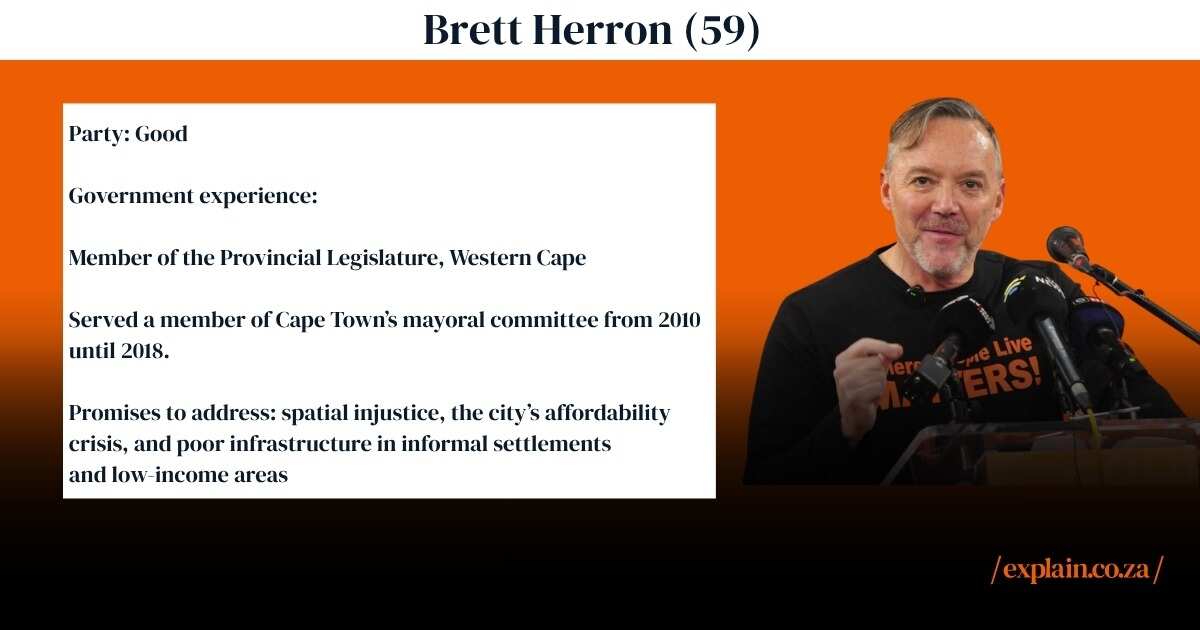
Herron isn’t new to Cape Town politics. He previously served as the city’s mayoral committee member for transport and urban development, before leaving the DA with Patricia de Lille in 2018. He also ran as Good’s mayoral candidate in 2021.
This time, he is running as the Good Party’s mayoral candidate, with a campaign focused heavily on inequality, affordability, and apartheid spatial planning. At his launch, Herron argued that where people live in Cape Town still shapes all areas of their lives, from transport costs to safety, schooling, and opportunities.
This is a direct challenge to the DA’s Cape Town story. Herron’s argument is basically: The city may function better than many others in Mzansi, but for whom?
Research and graphic: Prashalan Govender. Photo: Good
Cheslyn Daniels: The PA’s grassroots candidate
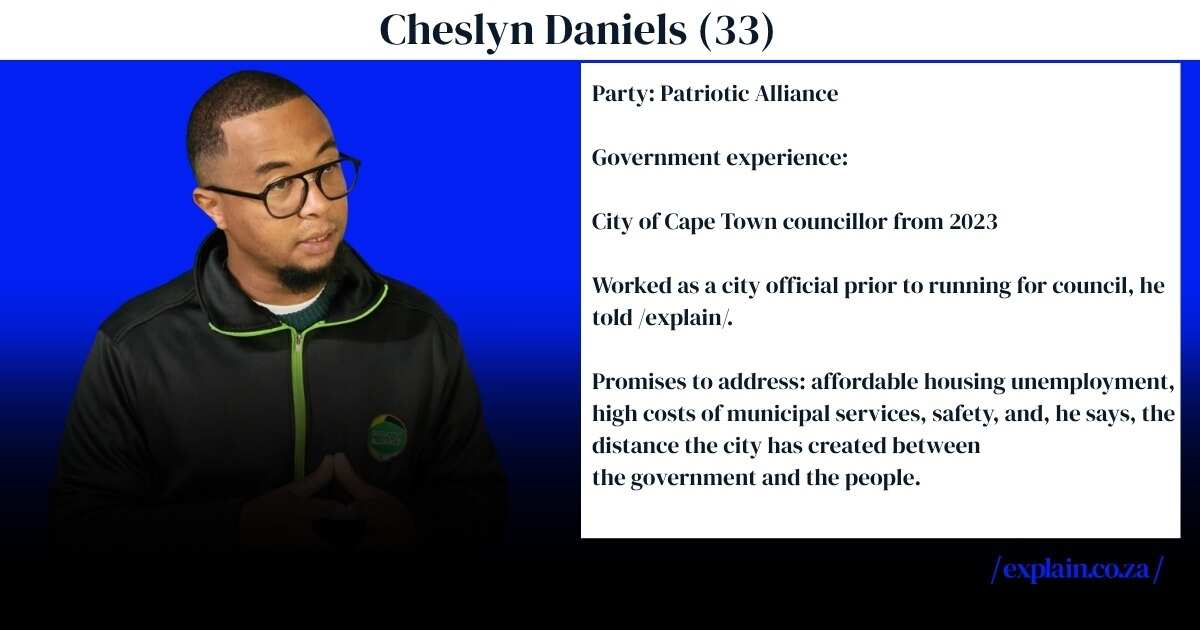
The Patriotic Alliance moved early by naming Councillor Cheslyn Daniels as its Cape Town mayoral candidate. The PA has said it plans to contest all 116 wards in the metro.
The PA has been growing in parts of the Western Cape by leaning into community-level frustrations, particularly around crime, identity, coloured working-class representation, and distrust of established parties.
Daniels’ challenge will be turning that energy into citywide credibility. Cape Town is not one ward meeting. It is a massive metro with complex budgets, water systems, housing backlogs, safety demands, and infrastructure pressures. Voters may like a fighter, but they also need someone who can run the machine.
Nelson Mandela University political analyst Professor Ntsikelelo Breakfast told /explain/ he believes it’s unlikely the DA will lose its majority in Cape Town. But he added the party will have to “break a sweat” to retain its hold on the city.
Breakfast said the DA must tackle several challenges, including internal factionalism and reducing the gap between the haves and have-nots, if it wants to succeed on 4 November.
Cape Town’s election will not only be about who can keep the city clean, functional, and internationally admired. It will be about who can convince voters that the city belongs equally to people in Sea Point, Mitchells Plain, Khayelitsha, Bonteheuwel, Gugulethu, Delft, Camps Bay, and Wesbank.
The ANC is still expected to announce its Cape Town candidate, which could further shake up the race. The ANC opened its 2026 local elections mayoral candidate-nomination process to the public in May, but has yet to announce its selections.
Prashalan Govender is a journalist who was shortlisted for the Vodacom Young Journalist of the Year Award twice. He is focused on reporting the stories that shape everyday life in South Africa, with a particular interest in politics, economics, and social issues.