Lindiwe Zulu says patriarchy never left the ANC
Scrolla | 26.08.2026 21:05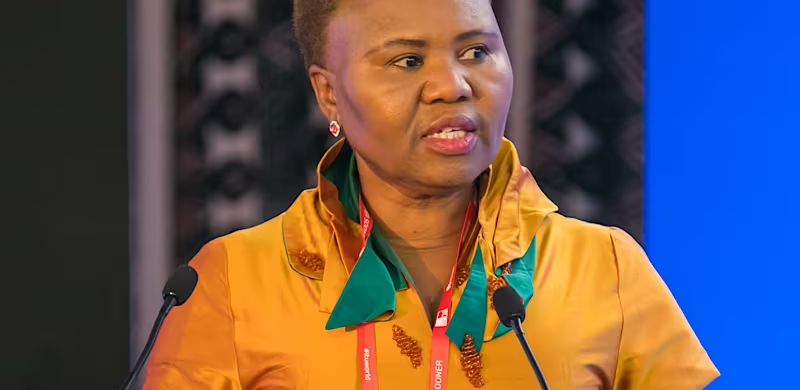
By Celani Sikhakhane
- Lindiwe Zulu says a lack of unity among ANC women, alongside deep-rooted patriarchy, blocked both Winnie Madikizela-Mandela and Dr Nkosazana Dlamini-Zuma from the party’s top job.
- Zulu was herself among 11 ANC Women’s League leaders, including Dlamini-Zuma, who resigned in 1995 in protest of Madikizela-Mandela’s leadership of the League.
ANC National Executive Committee member Lindiwe Zulu says division among women in the party, and patriarchy within its structures, cost Winnie Madikizela-Mandela and later Dr Nkosazana Dlamini-Zuma their chances of becoming ANC president.
Zulu shared her view during an interview with the African Renaissance Podcast this week. She said patriarchy has never left the ANC, and that women in the party have historically struggled to unite behind their own candidates at elective conferences.
She pointed to the ANC’s 1997 elective conference in Mafikeng, North West, where Madikizela-Mandela contested the position of deputy president.
“There was no unity with the women, let’s just start there. Because even if you look at the issue of Dr Nkosazana Dlamini-Zuma, fast forward, if there had been unity and the power that women had in the voting, she would probably have made it. Going back to comrade Madikizela-Mandela, all the other controversies that were used and abused, in some instances there was no unity there and agreement that all of us as women… imagine all of us as women agreed to vote for her as president. Patriarchy never left the African National Congress, it has never lost its sight of that,” Zulu said.
She said a belief that women are not capable of leading persists within the ANC, and that this must end.
Zulu’s own history with this issue runs deeper than commentary. On 11 February 1995, she was one of 11 ANC Women’s League National Executive Committee members who resigned in protest of Madikizela-Mandela’s leadership of the League, citing concerns over her leadership style, a lack of accountability, and unconsulted decisions, including an unapproved tourism venture. The group also included Adelaide Tambo, Nosiviwe Mapisa-Nqakula, Baleka Mbete, Nomvula Mokonyane, and, notably, Dr Nkosazana Dlamini-Zuma herself, the same leader Zulu now says was later let down by a lack of unity among ANC women.
At the 1997 Mafikeng conference itself, ANC Women’s League leaders were divided over Madikizela-Mandela’s candidacy for deputy president. Figures including Mapisa-Nqakula and Tambo again opposed her, saying her leadership style was shameful. Madikizela-Mandela withdrew her candidacy mid-conference, allowing Jacob Zuma to be elected unopposed.
History repeated itself in 2017, when then ANC Women’s League president Angie Motshekga led opposition to Dlamini-Zuma’s own bid for the ANC presidency at Nasrec, Johannesburg. Dlamini-Zuma was defeated by Cyril Ramaphosa, who had significant support from women aligned with Motshekga. At the time, Motshekga faced accusations of leading the Women’s League “from the grave” and undermining her successor, Bathabile Dlamini.
Fellow ANC NEC member Nomvula Mokonyane has echoed similar concerns. Speaking to the Mail & Guardian recently, she described being a woman in ANC politics as “a struggle within a struggle,” saying real progress depends on women achieving economic independence. Mokonyane, who has signalled she would accept a nomination for the ANC presidency in 2027, has also pointed to the party’s leadership history as evidence of the problem, noting it has had “five men and just one woman” at the helm since 1994.
Pictured above: ANC NEC member Lindiwe Zulu, who says patriarchy has never left the ANC.
Image source: Department of Social Development