Sorry, France, the world's best bubbly is British

BBC | 08.12.2025 20:00
Over the past decade, international chefs have swept French culinary competitions with unprecedented frequency.

Travellers wandering through Paris of late may notice that certain boulangeries and charcuteries are plastered with badges designating their baguette or pâté as "le meilleur" (the best). These aren't empty claims. France is home to hundreds of culinary competitions, from the amateur-run AAAAA certification for andouillette to the prestigious Glorieuses de Bresse, whose best-named chicken receives the honour of being served to the French president.

France has long been considered the pinnacle of Western cuisine and is the home of the Michelin guide, so it's perhaps unsurprising that its hosts so many culinary contests. But what's striking is how many of these titles have recently been won by foreigners.

Several months ago, an English fizz became the first non-Champagne to be named the world's top sparkling wine. A few weeks later, an American made history by winning the Mondial du Fromage's Concours du Meilleur Fromager (World's Best Cheesemonger Competition).

In fact, over the past decade international chefs have swept French culinary competitions with unprecedented frequency. The 2024 winner of the Championnat du Monde de Pâté-Croûte (World Championship of Pâté-Croûte) was Japanese Chef Taiki Mano; in 2023, Danish chef Brian Mark Hansen won the prestigious Bocuse d'Or, often dubbed "The Gastronomic Olympics". And many of the most recent winners of Paris' Grand Prix de la Baguette competition have been bakers with non-French roots. According to some experts, this trend shows that despite the rising popularity of global cuisines, the nation retains its storied prestige on the international gastronomic scene.

France has been a culinary hub for centuries, thanks in part to 18th-Century celebrity chefs like Marie-Antoine Carême and Auguste Escoffier, who codified French haute cuisine with military rigour and spread its renown through international courts. Today, French culinary techniques remain "absolutely universal in terms of classic gastronomic cooking", according to Allison Zinder, a culinary educator and gastronomy guide based in Paris. As she put it: "If you know how to cook food with French techniques, you can be a chef anywhere in the world."

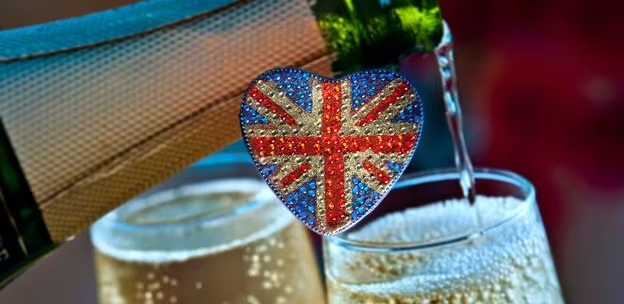
This culinary culture extends beyond the kitchen. France's oenological renown was part of what motivated Cherie Spriggs, Head Winemaker at Nyetimber in West Sussex, to enter the International Wine Challenge, which she dubs "the Oscars of the wine world". When her Blanc de Blancs 2016 Magnum was named top sparkling wine this year, it was the first time in the competition's 34-year history that a non-French wine took the trophy. "This is amazing recognition for Nyetimber and of course England as a whole," she said.

American Emilia D'Albero echoed this sentiment when she and her teammate Courtney Johnson nabbed one of France's top cheese honours in September. "Until this year, an American had never won the gold medal at the Mondial du Fromage," she said, noting that Americans "have traditionally been the underdogs in the international cheese community".

Alamy
The Nyetimber vineyards are located in West Sussex, England (Credit: Alamy)

"It was an honour to hear the judges – specifically the French ones – speak so highly of our work during and after the competition," D'Albero added.

It may seem surprising that the French reception of the Americans' win should be so positive. But while many stereotype the French as closed to international influence, particularly gastronomically, history shows a very different reality. Two of France's most famous baked goods – the baguette and the croissant – have Austro-Hungarian roots. In contemporary Paris, TimeOut's top-five restaurants of 2025 reveal Korean, Japanese, Argentinian, English and Filipino influences, and this year, the Michelin Guide awarded two stars to just two Parisian establishments, both of which are helmed by Japanese chefs.

Japanese chefs boast a certain hegemony over the French gastronomic scene, perhaps thanks to the "sense of precision" for which they are known among their French colleagues, according to Zinder. The proof is in the pudding – or, in this case, the pâté. The Championnat du Monde du Pâté-Croûte, founded in 2009, has since become an international undertaking, with eight selection rounds in regions from Scandinavia to North America before the championship in Lyon. But the award is nowhere as prized as in Japan, which sends "nearly as many applications… as France", according to Championnat co-founder Audrey Merle. To date, six of the 16 world champions have been Japanese.

Alamy
Organisers say nearly as many Japanese chefs compete in France's Championnat du Monde du Pâté-Croûte as French chefs (Credit: Alamy)

"It's the art of the knife," Merle said. "They have that technicity. They're perfectionists. So mastering pâté-croûte was almost normal for them."

But while Zinder says the prestige of winning a French culinary competition is evident to international entrants, she doesn't think this isn't always the case among French chefs.

"I don't get the idea that French chefs really understand how important French cooking techniques are, and that they are the universal reference," she said. On the contrary, some French chefs see such focus on the classics as old-fashioned, according to Christopher Edwards, the Australian chef-owner of Nice's Café des Musiciens and vice-champion of the 2022 Championnat du Monde de L’Oeuf-Mayonnaise (World Egg-Mayonnaise Championship). His interest in perfecting old-school recipes like oeufs en gelée (eggs in aspic) or joining culinary brotherhoods protecting such products is, he said, "very amusing to my French friends and family who recognise something old fashioned and eccentric [about it]".

According to most French culinary pros, it's not interest in these competitions that's lacking: it's the time to train. Participation, Zinder said, requires "an excruciating amount of preparation". She recalled a former culinary school colleague who, in the two-month leadup to a competition, made nearly 30 fish terrines. "It had almost like a basket-woven type of design using leeks," she recalled. "It was just really excruciating, just the amount of effort and repetition."

Judges awarded an American, Emilia D'Albero, as this year's Mondial du Fromage winner (Credit: Alexandre Alloul)

D'Albero cited a similar amount of prep leading up to the Mondial du Fromage. "We personally prepared for almost a year, and our coaches had been gathering resources and assembling a training programme for far longer," she said.

Zinder says many chefs are "too busy working" to devote the time and attention to such contests. "Competitions are not necessarily the most sought-after accolades in the kitchen world and are often seen as a novelty," echoed Edwards. "So, if you are after recognition as a French chef, you are probably working yourself too hard to have the time to compete outside of your already competitive situation."

But for winners, one thing's for certain: life is never quite the same.

Jean and Roxane Sévègnes founded the restaurant Café des Ministères in 2022. Despite Jean's fine-dining background, the French couple always knew they would focus on French classics, like the chou farci (stuffed cabbage) Jean's mother made when he was young. When they were contacted by the organisers of the newly founded Championnat de France du Chou Farci (French Stuffed Cabbage Championship) in 2022, they threw their hats in the ring – and won. Ever since, she said, it's proven impossible to take the dish off the otherwise ever-changing menu. In summer, she recalled, they tried to replace it with seasonal stuffed tomatoes. "We quite quickly realised that people were coming for this dish."

Alamy
Winning the Pâté-Croûte championship helped launch Karen Torosyan's career (Credit: Alamy)

Wins don't just change menus; they change careers. Armenian chef Karen Torosyan was just 18 when he emigrated to Belgium, and he had been cooking at Bozar Brasserie in Brussels for a decade when he won the 2015 Pâté-Croûte championship. In the ensuing year, inspectors from both Gault & Millau and Michelin Guide visited for the first time; Torosyan earned a 17/20 and his first Michelin star.

For Edwards, the egg-mayonnaise award granted him a sense of legitimacy. "My accomplishment confirmed for me that I had reached a certain understanding of French culture," he said. "I could put forward my take on a classic bistro dish and have it not only impress, but belong."

Spriggs says her win has helped cement awareness and appreciation of English sparkling wine. When she joined the vineyard in 2007, she said, "there were many people who didn't know that grapes were grown in this country. Now, people really appreciate what we're doing, which has been helped a lot by award wins."

And despite stereotypes to the contrary, the French continue to celebrate their non-French champions.

"It shows that French gastronomy interests a lot of people and a lot of different nationalities," said Sévègnes. "It doesn't just stay in France, in our little kitchens. It means that there are people who want to brush up against it and discover it. And that's great."