Did Our Mothers & Grandmothers Really Stay at Home, Just Caring For Kids?
Medium | 30.01.2026 21:03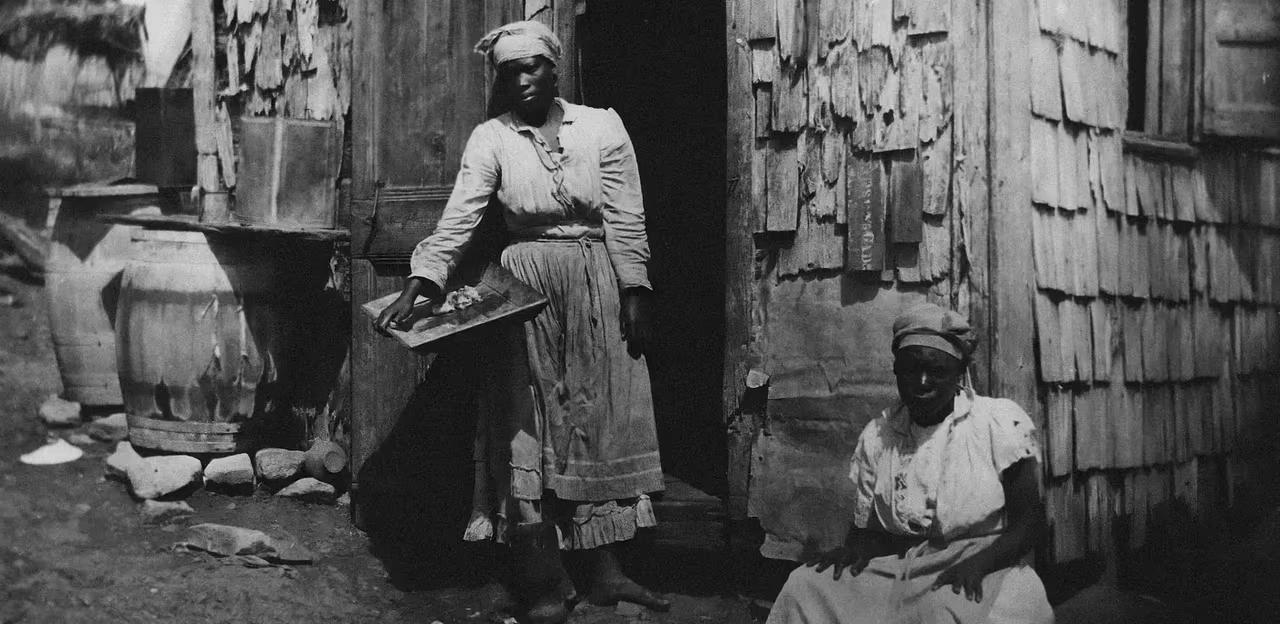
Did Our Mothers & Grandmothers Really Stay at Home, Just Caring For Kids?
6 min read
·
Just now
--
Listen
Share
Were our mothers really fully dependent on their husbands?
Every other day on the internet, I come across comments alluding to how our mothers stayed back at home while the men worked.
People often say this when they want to draw a parallel between the work culture of modern day women and women from older times, ot when they want to defend the call for modern day women to contribute financially, equal to their husbands.
They'd talk about how our mothers and grandmothers were excused from financial contribution because they stayed back home and cared for the kids, while men labored outside the homes for the sustenance of their families.
As a student of history, I’ve always found those assertions dubious, especially when the women referenced were African women. Did African women ever stay back at home knitting sweaters with their pedicured legs placed atop a marble stool, while their men labored outside the homes?
Maybe European women did, but certainly not African women. If you insist that African women too had their own less-glamorous time when they did nothing but birth kids, pray tell, what were they doing at home?
Well, let's look at what is more cohesive with African culture. In the olden days often referred to, most of our African societies were agrarian with respect to the major sources of livelihood, and women were not left behind in the work chain. Women also farmed, which was one of the incentives of polygamy for men, because it meant having more wives and children (more hands) for labor.
While men cleared land and planted staple crops, women weeded, harvested, processed, stored, and sold food. In many regions, women controlled food crops, while men focused on prestigious or cash crops.
Even when women weren't the main actors of certain economic activities like farming or fishing, they controlled post-harvest economic activities and engaged in fringe labor.
For instance, it was women who typically pounded grain into flour, processed cassava into garri, fufu, lafun, extracted palm oil and palm kernel oil, smoked and dried fish, and made shea butter for sale.
These were not “domestic chores.” They were income-generating industries.
Women weaved mats, baskets, raffia, and produced textiles, they made oil to be sold in the market, they engaged in petty trading, they made beads for sale, they did so many other things that helped to balance out the market chain.
My two grandmothers who are both dead now were very hardworking and rich, at least in their time. Women like them were not scarce during their time. Even as a child, I remember all the uneducated mamas who used to sweep compounds, churches and streets for five thousand naira monthly. These are the mothers we now say did not work?
There simply was never a time in African societies when women were sitting at home all day playing dress up and plaiting the hair of dolls while their men went out to work. Women have always worked and at the same time, cared for their children, which is why the 50-50 mad argument will never make sense to me! It will always be unfair to women because even working and contributing women will still carry the heavier load of caring for their homes and children.
Globally, women are estimated to spend 2.5 times more hours per day on unpaid care and domestic tasks than men, and are responsible for 75% of all unpaid care and domestic work.
Now, let's assume the West owns this accusation leveled against African women alike. In the West, women were responsible for taking care of other people's children or homes as governesses or housekeepers. On whom did they spend their earnings, if not their children and families?
Modern day narratives continue to insist on this false belief that men went to work while our mothers didn't, meanwhile, what existed in Africa was a gendered division of labor, and not female idleness.
Nwunye Odogwu, the modern colloquial term for a spoiled wife to a rich man, is a modern concept, because these mothers, grandmothers, and great-grandmothers we talk about, worked hard around their homes and carried the informal economies on their backs.
Of course, because they lacked domestic help as modern women now have access to, a lot of their economic activities were done close to their homes to avail them opportunity to look after their kids, but they weren't at home just watching the sun set!
Out of the 3 main industries of precolonial African economies: the agrarian, the merchantile and the artisanal, women featured heavily in the first two, & only less compared to their male folks in the artisan industry.
Judging women's economic production simply on account of when they began to feature in the formal workforce is lazy and deceitful. When did white-collar work start in Africa?
African societies were built on household production, not wage labor, which is a western concept of judging economic productivity. While the so-called African mothers and grandmothers were “lounging away in their homes doing nothing,” were the men slaving it out in offices?
Now, assuming but not conceding that we indeed had a culture of non-working African mothers who only did domestic chores, are we saying that domestic chores do not count as work, and the only valid contribution to a home is the finance?
This is not only a disingenuous claim, it is false. The economic contribution of housewives and women doing unpaid domestic work is massive, and often amounts to hundreds of thousands of dollars per household over time, and yet, we overlook them because it takes place outside the formal market.
Research has shown that if this labor were to be outsourced- hiring professional cleaners, cooks, and caretakers- the cost would be humongous for many families. For instance, a 2024 analysis by Insure.com estimated the annual economic value of a stay-at-home mother’s labor (as a cook, cleaner, tutor, and manager) to be around $140,315.
Oxfam studies show that the annual value of unpaid care work performed by women is at least $10.9 trillion, which is more than three times the size of the global tech industry.
Our mothers didn’t have paid helps, nannies, or chefs. They did all the domestic work themselves! They took turns caring for each other’s kids.
So, even on the off-chance that they had no jobs outside their homes, I dare say: the economic value of their domestic work is still equivalent to the financial contribution of the men who worked!
History, especially because it has always been told by men and un-countered by women, has only captured the economic activities of men and continues to either go silent on women's real economic activities, or pretend that the domestic work is still unproductive work and has no real impact on the family income.
Modern day men no longer have any hesitation expressing that they want qives who work because having to carry the core expenses of a home alone, and also pay for the services of multiple domestic staff, is a luxury that less than half of the population of African men can afford.
Another interesting angle is, quite a lot of men do not want women who have really busy, active careers such that they are not the ones directly and mainly responsible for domestic activities like cooking and child care.
These men are wary about leaving their kids to the care of household staff, and very few can reasonably afford a chef for the kinds of meals they expect wives to cook. But when women take on these roles full time, they all of a sudden become basic tasks that don't equate to the man's provision, even if he's a low or average income earner?
When we claim that the earliest women “didn’t work,” we're applying a western, wage-based definition of work to societies that didn't operate that way in the first place. African women contributed to their households financially and still took care of their children!
Financial contribution from women is not a modern concept, and even in homes where the women did nothing but care for the kids and keep the house running, she was doing enough!