Steenhuisen’s demotion was dramatic, but it wasn’t shocking
Explain | 19.06.2026 14:15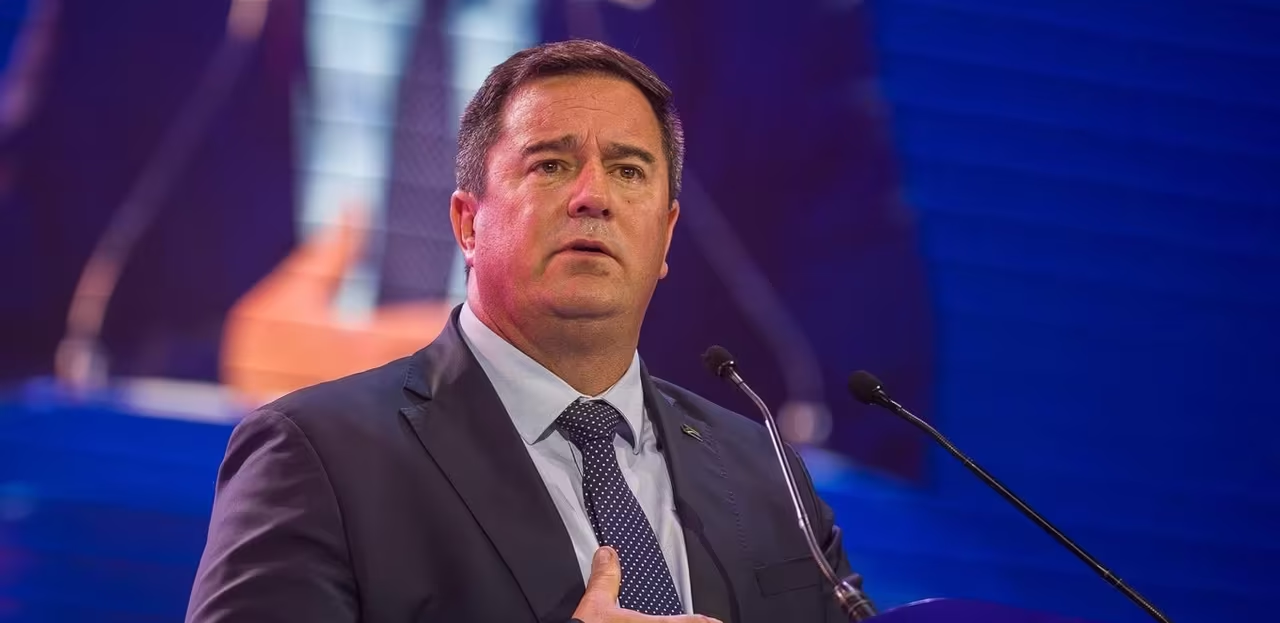
John Steenhuisen’s proposed demotion looks dramatic, but after FMD anger, court setbacks and staff controversies, it is hardly surprising.
OPINION
John Steenhuisen’s time as agriculture minister has been marked by criticism over his handling of foot-and-mouth disease (FMD), tensions with farmers’ organisations, and repeated drama surrounding his chief of staff appointments.
For the Democratic Alliance, a party that sells itself on clean governance, competence, and accountability, the agriculture portfolio had become a serious reputational problem.
On 17 June, DA leader Geordin Hill-Lewis said he had written to President Cyril Ramaphosa requesting changes to the DA’s representatives in the national executive. It’s worth remembering that the appointments are still up to Ramaphosa, because the cabinet remains the president’s constitutional playground, no matter who sends him a wish list.
Hill-Lewis said the changes followed a “careful assessment” of the DA’s team in the Government of National Unity (GNU). His proposed headline move is for Willie Aucamp, currently minister of forestry, fisheries, and the environment, to replace Steenhuisen as minister of agriculture. Steenhuisen would move to deputy minister of trade, industry, and competition, replacing Alexandra Abrahams.
The DA leader said Steenhuisen had expanded market access for South African agricultural products and made progress on the procurement and distribution of FMD vaccines.
But he also gave Aucamp an immediate mandate to resolve ongoing legal proceedings related to FMD, work with the sector, and restore confidence through faster practical steps.
Other proposed changes include moving Abrahams to deputy minister of electricity and energy, replacing Samantha Graham, who would leave the executive. Yusuf Cassim would become deputy minister of higher education, replacing Mimmy Gondwe. Jack Bloom would be appointed deputy minister of water and sanitation, replacing Isaac Seitlholo, and David Maynier would take over as minister of forestry, fisheries, and the environment.
In short: Hill-Lewis is rearranging the DA’s GNU furniture. Steenhuisen is the couch being moved out of the main room.
Steenhuisen’s tenure in agriculture had become politically expensive. Not only because of the FMD crisis, but because the scandals around his office kept giving the DA’s opponents free ammunition.
If there is one thing the DA hates more than ANC cadre deployment, it’s being made to look administratively messy in public.
Soon after becoming agriculture minister, Steenhuisen appointed Roman Cabanac, a controversial podcaster, as his chief of staff. The backlash was immediate. Cabanac’s history of inflammatory online comments became a public headache, and Steenhuisen later asked him to step down.
But Cabanac did not go quietly. That alone was bad optics. A minister who could not quickly remove his own controversial chief of staff was always going to struggle to convince the public that he could bring order to a national agricultural crisis.
Jana Le Roux, Steenhuisen’s chief of staff, apologised after allegedly swearing at an agricultural chief executive during the National Maize Producers Organisation (Nampo) agricultural show. The incident was related to tensions around FMD and the court fight involving agricultural organisations.
There was also the earlier controversy over a formal letter from FMD Response SA, which Le Roux forwarded to officials “for some amusement”.
Tweet
You don’t have to be a farmer to understand that when people are desperate for vaccines, court clarity, and government responsiveness, “for some amusement” is not the tone you want from the minister’s office.
Steenhuisen’s staff problems created a damaging impression: the agriculture ministry was not only struggling with the disease outbreak, but also with basic political judgment.
Foot-and-mouth disease is a highly contagious viral disease that largely affects cattle, causing mouth and hoof blisters and hurting livestock productivity. The outbreak has been described as South Africa’s worst in years, with the government trying to boost local vaccine production while still relying heavily on imports.
In February, farmers’ groups described the response as “fragmented, slow, and structurally incapable of matching the scale and pace of the outbreak”.
This mattered politically because agriculture is not just any portfolio for the DA. Farmers and agribusiness are an important part of its support base. If the DA cannot look competent there, where exactly can it do so?
In May, the Pretoria High Court ruled that farmers could privately procure and administer FMD vaccines without state involvement and blocked the agriculture minister from interfering in private commercial arrangements involving lawful vaccine importers. The case was brought by Sakeliga, Free State Agriculture, and the Southern African Agri Initiative.
That ruling was a major embarrassment. The DA can spin the reshuffle as renewal, performance management, and “the DA difference”, but the court case made clear that the sector had lost patience with the department’s handling of vaccination access.
Aucamp’s new mandate says the quiet part out loud: resolve the FMD legal mess, work with the sector, and restore confidence.
Steenhuisen didn’t underestimate the problem
To be fair, Steenhuisen himself understood that FMD was serious. When he announced in February that he would not seek re-election as DA leader, he said he would focus on agriculture and on defeating what he called the most devastating FMD outbreak South Africa had ever seen.
At the time, agricultural economist Wandile Sihlobo supported a sharper focus on the disease, warning that many producers faced financial disaster.
The issue is not that Steenhuisen ignored FMD completely. It’s that the crisis became the measure of his ministerial performance and he was found wanting. When the DA’s own core constituency started losing confidence, Hill-Lewis had every political reason to act.
This reshuffle request is not only about Steenhuisen. It is also Hill-Lewis’s first major test as DA leader.
He’s trying to show that the DA under him will not simply protect old loyalties. Replacing his predecessor is a blunt message: performance matters, even if your name is John Steenhuisen.
That is politically useful for Hill-Lewis. It allows him to look decisive, reform-minded, and willing to upset powerful people. It also helps him to separate his leadership from Steenhuisen’s without having to openly declare war on him.
But there is also a risk. If Ramaphosa accepts the changes, Hill-Lewis will own the new DA team in cabinet. Aucamp will not have the luxury of blaming Steenhuisen forever. If FMD remains unresolved, farmers will not care that the furniture was rearranged. They will ask whether anything actually works better.
Ramaphosa still has to make the appointments. The proposed changes depend on the president formally acting on them. Business Day reported that Ramaphosa was “positively considering” Hill-Lewis’s request, with a wider reshuffle expected before the end of June.
That means Steenhuisen’s demotion is not technically complete until the president says so. But politically, the message has already landed.
After months of FMD anger, chief-of-staff drama, and court setbacks, it is hard to argue Hill-Lewis had no reason to reach this decision.
Sign up for /The Wrap/
/explain/ is independent, easy-to-understand news for busy South Africans, and you can get a weekly round-up of our best stories in our award-winning email, every Thursday.