Forget Ramaphosa’s impeachment. The ANC’s real Phala Phala worry is the committee.
Explain | 15.05.2026 22:43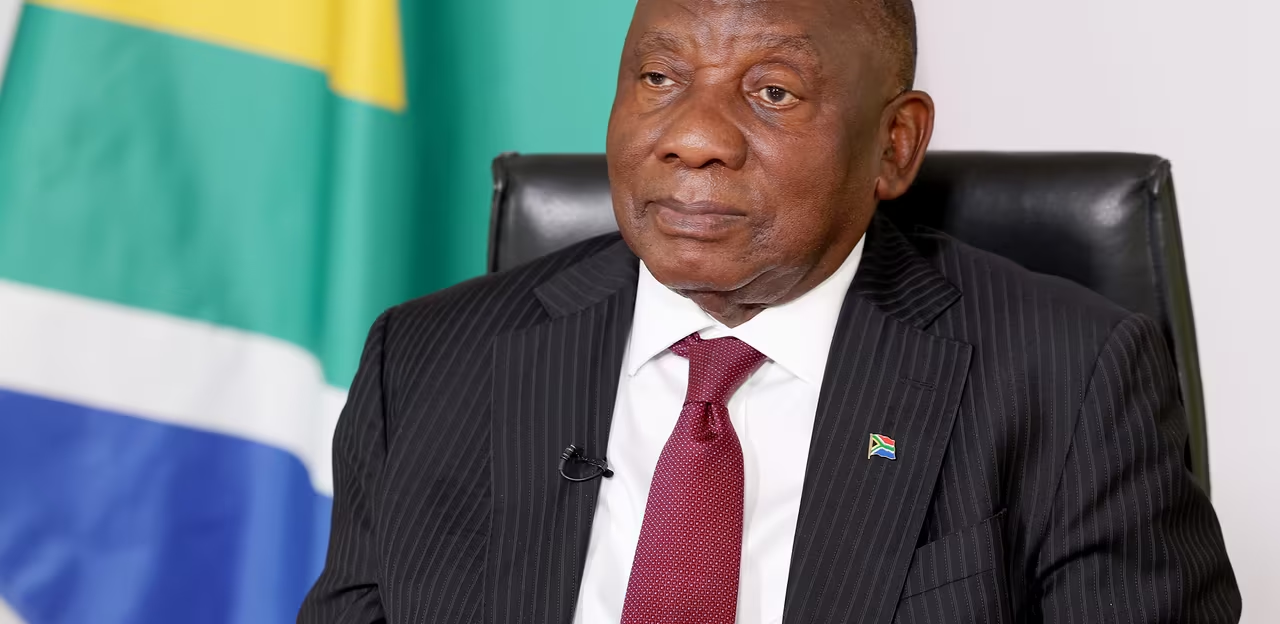
Legally, Ramaphosa may well survive at the end of the inquiry. The report heads to Parliament’s impeachment committee, which will hear evidence and decide whether to recommend that Ramaphosa be found guilty of serious misconduct or constitutional violations. Even if it does, the recommendation still has to go back to the full National Assembly and removing a president there takes a two-thirds majority, 267 of 400 MPs.
On that maths, the president is comfortable: the ANC currently holds 159 seats, which means 26 ANC MPs would need to defect, along with ALL opposition parties, to remove Ramaphosa. That’s… unlikely.
The real threat Phala Phala poses to Cyril Ramaphosa may be political rather than legal; a months-long Section 89 impeachment inquiry could become the biggest sustained political test of his presidency, unearthing facts that may shift how votes fall.
The ANC Phala Phala impeachment committee explained
While his ultimate political survival is ensured, the committee is a pretty big constitutional first. No South African president has ever been impeached; the only modern removals – Thabo Mbeki in 2008 and Jacob Zuma in 2018 came at the behest of the ANC’s national executive committee, not from Parliament. So, no Section 89 impeachment committee has ever sat in democratic South Africa. Think less “quick parliamentary hearing” and more “months-long political courtroom drama”. And you can imagine how opposition parties will make a meal of that.
The committee will be able to hear evidence under oath, while Ramaphosa gets legal representation and the chance to cross-examine witnesses. Its job is not to remove him directly, but to decide whether the Ngcobo panel’s findings, including alleged conflicts of interest and misuse of state resources, amount to serious constitutional misconduct.
After that, the whole thing goes back to the National Assembly for the actual impeachment vote, which, as mentioned, he’ll likely survive. But the damage may have already been done politically.
That’s especially true if firebrands like EFF leader Julius Malema are on the committee, his party took the matter to the Constitutional Court.
Of course, we don’t yet know exactly who will sit on the committee, just the parties. The 31-member committee pulls in representatives from 16 of parliament’s 18 parties, turning the inquiry into something between a constitutional process and South Africa’s most tense group project.
And Parliament clearly tried to spread the political risk around.
The ANC gets nine seats, the DA five, the MK Party three, the EFF two, and twelve smaller parties one seat each, according to Speaker Thoko Didiza’s Wednesday announcement.
We will find out who those parties will send by Friday, 22 May, according to Didiza’s deadline. And then the fireworks will begin when the actual committee meetings start.
Phala Phala context
Last Friday, the Constitutional Court handed Cyril Ramaphosa a bigger political problem than many expected. Judges agreed with the EFF and ATM that Parliament should not have simply voted away the Ngcobo panel’s 2022 findings, which suggested that Ramaphosa may have serious constitutional questions to answer over Phala Phala without first properly examining them. The rule MPs used to dismiss the findings was also declared unconstitutional.
The panel had found a prima facie case against Ramaphosa linked to the 2020 burglary at his Limpopo game farm, where more than $500 000 in foreign currency was allegedly stolen from a couch. (“Prima facie” is basically legal shorthand for: there’s enough smoke here to investigate whether there’s actual fire.)
Rather than resign, Ramaphosa has revived a previously abandoned High Court challenge against the Ngcobo report itself. If he wins, the findings underpinning the impeachment process could collapse before the inquiry finishes. If he loses, the whole thing unfolds in full public view.
And that’s the rub.
While the ANC is in full support of its president, months of public hearings could change the atmosphere entirely. Unlike a sudden motion of no confidence, the Section 89 process would subject the Ngcobo panel’s findings to constant public scrutiny, giving opposition parties like the EFF and MK Party a national stage in the run-up to the 4 November local government elections.
Internally, it could also harden the succession question within the ANC ahead of the 2027 elective conference, where the contest to succeed him will decide who governs after 2029.
ANC support for Ramaphosa
For now, the ANC seems firmly at his back. The party’s top leadership, the NEC, met urgently earlier this week to discuss the ruling and reached a decision: a formal endorsement of his refusal to step down and explicit backing for his challenge to the Ngcobo panel report. Then there was his first National Assembly question session since the Constitutional Court ruling eight days earlier that had put the impeachment inquiry back into play. While the MK Party and the EFF walked out before he had finished, his party’s MPs gave him a standing ovation.
But a couple of months is a long time in politics. The legal process is now inseparable from the political one. Phala Phala is no longer just a scandal about missing cash on a game farm: it is becoming a test of Ramaphosa’s authority, the ANC’s unity, and the stability of South Africa’s coalition era.