The giant reptiles reclaiming the world's most visited city
BBC | 22.01.2026 20:00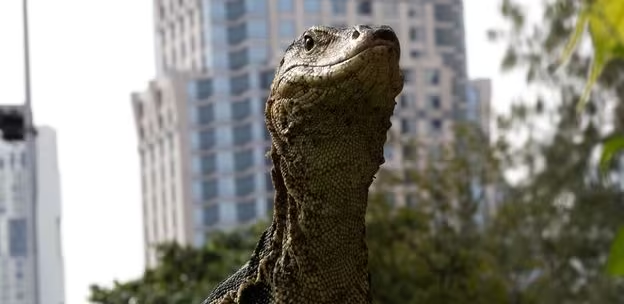
Once driven to the city's edges, Bangkok's giant monitor lizards are now thriving in parks and canals – and becoming an unexpected part of the visitor experience.
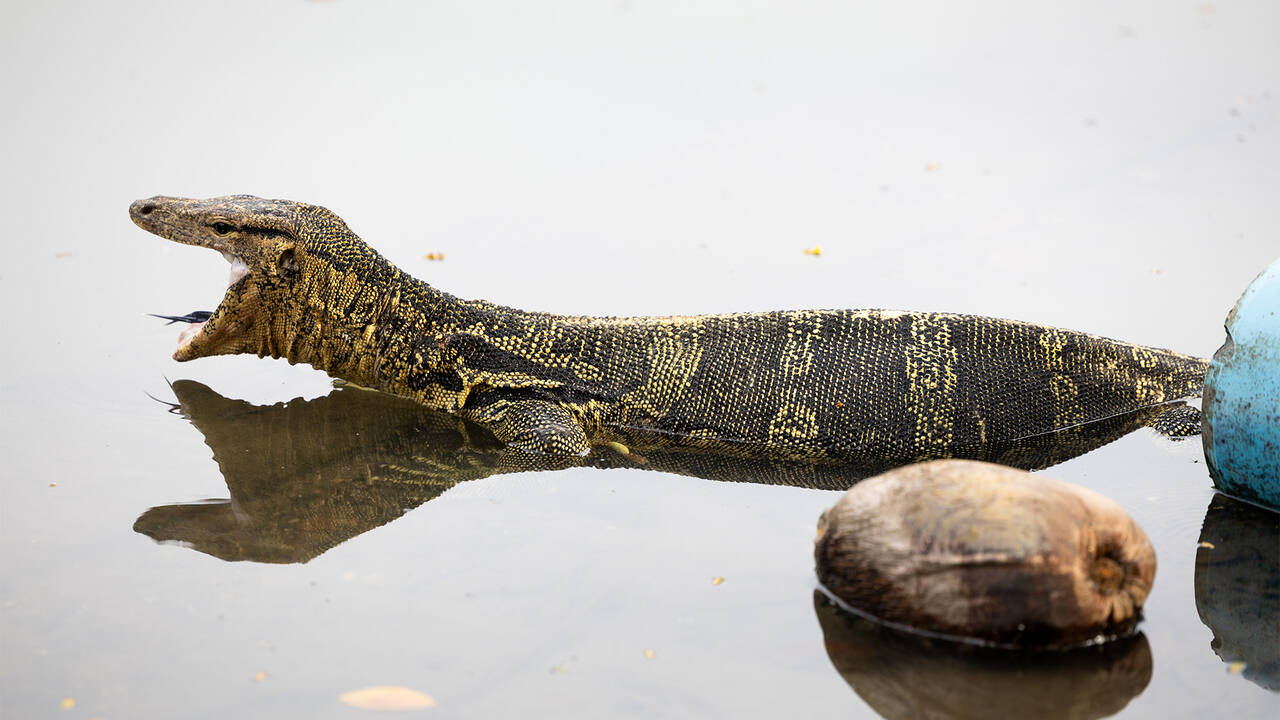
Shortly before dawn in one of Bangkok's largest inner-city green spaces, there is a stillness in the canals that surround Lumphini Park. Barely a ripple disturbs its large ponds. But as the day breaks in the Thai capital, the first scaly snouts emerge from the water’s surface.
These are Asian water monitors, the world's second-largest lizard after the Komodo dragon.
For travellers, Bangkok's monitor lizards are not an attraction in the traditional sense, but a reminder of how nature persists even in the world's most-visited city. To encounter these ancient reptiles, a species which dates back millions of years, in Lumphini Park – a short walk from luxury hotels, shopping malls and embassies – is to glimpse the city's ecological past, when this was an area of wetlands and waterways rather than expressways and skyscrapers. Watching the lizards bask beside joggers and picnickers is a unique travel experience: one that requires no ticket, no guide and no curated enclosure, only an early morning walk through the city's green heart.
While Lumphini Park is the easiest place for visitors to spot them, Bangkok's water monitors are far from confined to a single green space. Once pushed to the city's edges, the reptiles have quietly adapted to life in the megacity, patrolling many of the almost 1,700 canals that still thread through neighbourhoods, from residential backstreets to busy commercial zones. Several hundred water monitors are thought to live in and around Lumphini Park alone, drawing locals, tourists and photographers into uneasy proximity with an animal that has long divided public opinion.
"Their population in Bangkok is much, much greater than you'd ever see in the wild," said Michael Cota, a retired associate at Thailand's National Science Museum, speaking from his study in northern Thailand. Surrounded by leaning towers of academic papers – including several of his own – he explained why. "When it comes to food, they'll eat anything they can get a hold of, dead or alive. They're extreme generalists."
"Head to Lumphini Park," he had told me earlier, with a giddy grin. "That's where you'll get to know them properly."
One December morning, before the city had fully awakened, I set off on the hunt, cutting through Bangkok's endless maze of streets. But inside Lumphini Park, an early sight of the ancient water monitor lizards offered the first clue about what life was like here before Bangkok's founding as a tiny trading outpost on the west bank of the Chao Phraya River in the early 15th Century.
 Mirja Vogel
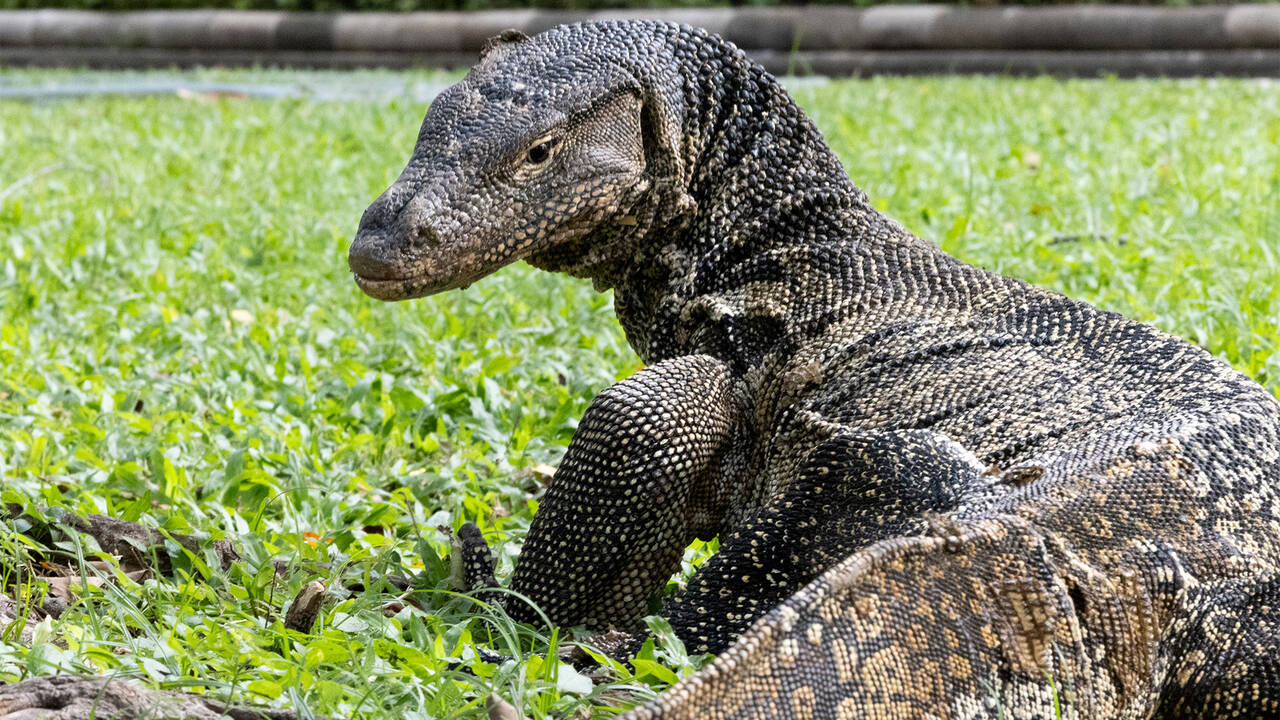
On the pond’s shore, where mottled leaves from giant rain trees had settled, hundreds of thick, overlapping roots protruded from the earth. I moved closer to the water's edge, careful not to trip over the tree's bulbous veins. Suddenly, one of the "roots" moved. A swaggering brown, pockmarked tail, which had been perfectly camouflaged seconds ago, trailed behind a lizard nearly 2m (6.5ft) long as its muscular legs propelled it forward into the water with a splash.
Later that morning behind a busy food stand, with the cook occupied by a queue of hungry customers, six smaller lizards sunk their claws into the muddy shore and pulled themselves from the water to hurriedly chew through a bag of discarded bones.
More like this:
Throughout the day, with the city's skyline behind them, I watched the reptiles as the park filled up. Unlike wildlife parks or zoos, Lumphini Park offers no queues, feeding times or barriers between people and lizards. For visitors, that lack of orchestration can be disorienting – and occasionally unnerving – but it is also what makes the experience distinct.
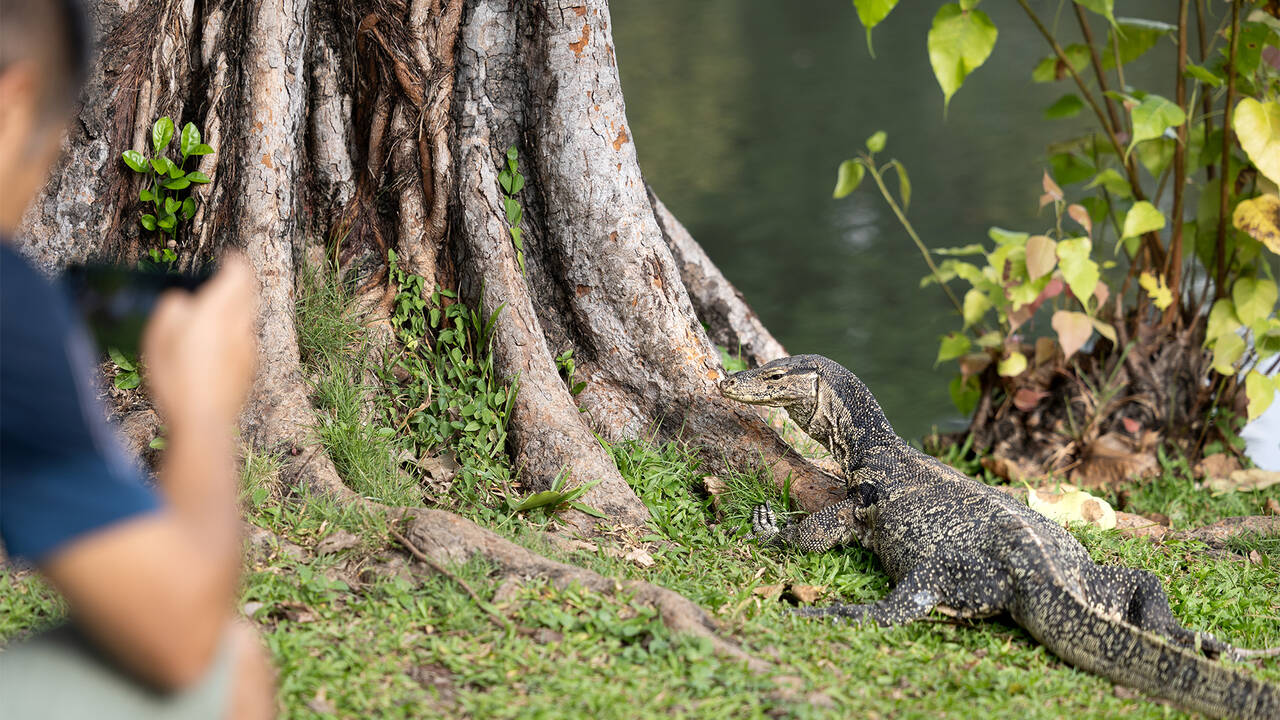
The lizards basked in the sun, unfazed by exercise classes. It seemed as if they were posing for tourist photos, before getting bored and returning to the water. As I headed back along the canal path, I witnessed almost a dozen feasting on bags of leftovers under the shade of a bridge.

Elsewhere in the city, the coexistence is not always so calm. At the Golden Mount Fire Station, 5km (3.1 miles) from the park, the emergency dispatch line rang. It was one of four calls that came in that day requesting a stray monitor lizard be removed from somebody’s home.
Water monitors roam freely across the city during the day, especially when it’s raining. Lumphini Park offers the most reliable sightings, but visitors should keep a healthy distance. Never feed the lizards, and avoid approaching them on land, where they may feel threatened. While Bangkok's monitors are highly accustomed to humans, respecting their space helps protect both visitors and the city's fragile urban ecosystem.
"On average, we get more calls about rescuing water monitor lizards and removing snakes than fires here," said S Ruengdach, a firefighter of 30 years, as he brandished a huge protective glove he wears when handling them. "They like the rain, so they venture out more in public during wetter weather."
For generations, Bangkok's water monitors have struggled with reputational problems. Cota believes the stigma was born long before Thailand's industrialisation, when most families lived in open shelters along waterways. Monitor lizards would sniff out dead people before their friends and families found them and then likely feed on them until they were chased away.
 Mirja Vogel
In Thai folklore, the animals were cast as dirty and unlucky, and their common name, hia, evolved into one of the language's most offensive insults. As scientific research expanded, officials introduced a formal term – tua-ngoen tua-thong – to avoid using the slur altogether.
"But it's important to separate the old and the new view of them," said Ice Russameesritrakul, who owns the popular vegetarian restaurant Gyofu in Bangkok's Chinatown. "In old times, people said they were unlucky. But right now, their symbolism is changing. Some younger people think they're cute and lucky. I know lots of people who will drop everything to buy a lottery ticket if a big water monitor accidentally finds its way inside their home."
Social media is definitely on the lizard's side. TikTok and Instagram are awash with clips of the reptiles clattering through shopping centres and tripping up runners. Brave tourists aren’t afraid to get up close and personal for selfies when they see one basking next to a canal.
"It was a bit of shock to stumble on a very large sunbathing lizard here," said British tourist Philip Mountford, shortly after taking a photo of one in Lumphini Park. "I would never have expected to find such a prehistoric-looking creature living so comfortably in an urban environment like Bangkok."
No formal census exists, but estimates suggest thousands of water monitors now live across Bangkok. The Thai government has made attempts to reduce their numbers, including a large-scale removal from Lumphini Park in 2016. Yet today, the reptiles are more visible than ever. Part of that is changing attitudes. A wave of social media engagement driven by younger Thais and international tourists has turned the lizards into unlikely urban icons. In response to increasing enquires about where to spot them, park authorities even installed a giant water monitor statue in the centre of Lumphini Park last year.
Some, including Cota, think embracing the lizards would be a welcome change to years of stigma. "Why not promote them for tourism? A lot of people find them fascinating," he said.
"Instead of pushing them out of Bangkok, make them a real part of the city's future."