Real Politics: MK’s money crisis exposes the price of power
Scrolla | 14.09.2026 14:40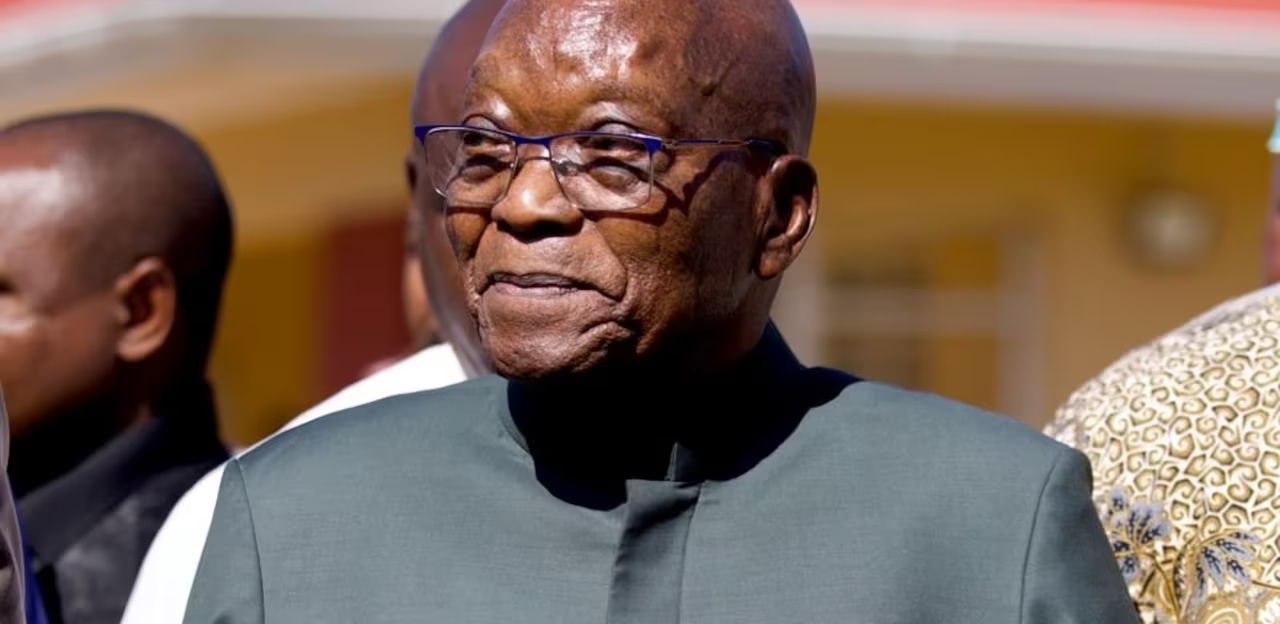
Party levies may offer a cleaner form of political funding, but they become a tool of control when parties can remove representatives who refuse to pay, writes Zukile Majova in Real Politics.
Jacob Zuma’s uMkhonto Wesizwe Party has demonstrated that it can mobilise millions of angry voters. It has not yet demonstrated that it can build, finance and govern a durable political institution.
Two months before the municipal elections, its apparent cash shortage has exposed the gap between the power of Zuma’s name and the weakness of the organisation constructed around it.
MK emerged from the 2024 election with 58 seats in the National Assembly, the official opposition benches and political dominance in KwaZulu Natal. It achieved in a matter of months what many opposition parties have failed to accomplish over decades.
But votes do not automatically create an institution. A functioning party needs reliable income, audited accounts, competent administrators, regional offices and systems capable of paying staff and contesting thousands of municipal wards.
MK appears to have built its electoral machinery faster than its financial foundations.
Its latest confrontation with its own public representatives illustrates the problem. Zuma and party treasurer Brian Molefe reportedly instructed KwaZulu Natal MPLs to settle outstanding party levies within seven days. Failure to pay would, they warned, be treated as an automatic resignation.
One representative was reportedly told that R96,000 was outstanding.
This is more than a story about MK struggling for cash. It exposes an overlooked feature of South African politics. Taxpayers pay the salaries of MPs, MPLs and councillors. Political parties claim a share of those salaries, while controlling whether the representatives remain party members and retain their seats.
The practice is not unique to MK. It is widespread across the political spectrum.
The Electoral Commission’s latest political funding report shows that the EFF collected R50.9-million from membership fees and levies during the 2024/25 financial year. The ANC collected R49.7-million, the DA R36.7-million, the IFP R23.8-million, the Patriotic Alliance R8.5-million and ActionSA R6-million. MK reported R2.5-million from the same category.
These are significant sums, particularly for smaller parties. Membership fees and levies represented about 87% of the EFF’s total income, 56% of the PA’s, 38% of the IFP’s and 34% of MK’s. For the ANC and DA, which have larger and more diverse funding networks, the proportions were about 14% and 18%.
The figures demonstrate why public representatives are important financial assets to their parties. Every parliamentary or council seat brings political influence, public funding and a potential monthly contribution from the person occupying it.
There is nothing inherently improper about this arrangement. Political parties are expensive institutions to operate. They employ staff, maintain offices, commission research, communicate with voters and contest elections. Asking representatives who gained office through the party to contribute towards its upkeep can be defended as organisational solidarity.
Levies may also present less risk than dependence on a handful of wealthy donors expecting access or policy influence. Money collected from party members and representatives can help build a more self-sufficient organisation.
The problem arises when a contribution becomes the price of retaining public office.
Former BOSA Gauteng MPL Ayanda Allie was required to contribute 10% of her salary to the party. She acknowledged withholding the payment but said she was paying for constituency travel and accommodation herself because BOSA would not cover those expenses.
The disagreement formed part of the breakdown between Allie and BOSA. She was expelled and later joined ActionSA.
Her case raises an important question. If a representative must choose between paying a party levy and financing work among constituents, to whom is that representative ultimately accountable: voters, the legislature or the party treasurer?
South Africa’s proportional representation system gives party headquarters enormous power over the answer. Most legislators do not hold constituencies that they won in their own names. They enter legislatures through party lists and ordinarily lose their seats if they lose membership of the party that nominated them.
For an ordinary national MP, that can mean losing an annual remuneration package worth about R1.32-million.
The result is a formidable enforcement mechanism. A demand from the party is never an ordinary invoice. Behind it stands the possibility of disciplinary action, expulsion and unemployment.
Zuma’s attempt to treat nonpayment as an “automatic resignation” takes this logic to an extreme. A political party cannot simply convert a disputed debt into a voluntary resignation by declaring it so. But it can follow its disciplinary processes, expel a member and replace that person with another candidate from its list.
That turns party finance into an instrument of political control.
The Electoral Commission’s reporting system does not allow the public to see the full picture. It combines ordinary membership subscriptions with levies paid by public representatives. It is therefore impossible to determine from the published totals how much came from ordinary members and how much was collected from taxpayer funded political salaries.
Voters also cannot easily establish the rates charged by different parties, whether levies are calculated on gross or after tax income, whether ministers pay more than ordinary MPs, or what sanctions apply when payments fall into arrears.
The ANC’s accounts establish that it received R49.7-million in membership fees and levies. They do not reveal what proportion of an MP’s or councillor’s salary the party claims.
The EFF’s R50.9-million is even more striking, but the published category does not show whether that money came mainly from public representatives or the wider membership.
This is a material weakness in a disclosure system intended to reveal who finances political power.
There are other gaps. Donations below the disclosure threshold appear as aggregated amounts, while loans can provide parties with substantial funding without immediately being treated as donations. Income from commercial activities, affiliated organisations and benefits provided in kind can also make the real source of political influence difficult to follow.
MK demonstrates the other side of this limited transparency. Its audited statements recorded total income of just R7.2-million for 2024/25 outside the separate public funding system, including only R380,555 in disclosed donations above the threshold. Yet it ran a national campaign, established structures across the country and became South Africa’s third largest party.
Those figures invite legitimate questions about how its campaign was financed and why a party that won millions of votes is now pursuing its own MPLs for arrears shortly before a crucial election.
MK has not been declared legally bankrupt. But an apparent cash shortage could damage its municipal campaign. Local elections require money for deposits, transport, posters, polling agents, rallies, communications and candidate support across thousands of wards. Zuma’s popularity cannot pay organisers or create reliable financial controls.
The deeper lesson extends beyond MK. South Africa needs political parties that are financially sustainable without being captured by large donors. Representative levies can contribute to that objective, but they should be transparent.
Parties should publish their levy schedules. The Electoral Commission should report membership subscriptions separately from contributions by public representatives. Loans, arrears and forgiven debts should be disclosed clearly. Parties should also distinguish genuine disciplinary misconduct from disputes about money.
MK’s difficulties have opened a useful window into the hidden economics of South African politics. The state funds parties directly. It pays the representatives whom those parties nominate. Parties then reclaim part of those salaries and retain the power to remove representatives who do not comply.
A levy may be one of the cleaner ways of financing a political organisation. But when the organisation demanding the money also controls party membership, discipline and ultimately the seat, the levy becomes more than a contribution.
It becomes the price of remaining in public office.
Sharp political analysis, delivered straight to you.
Subscribe free
Pictured above: Jacob Zuma.
Image source: uMkhonto Wesizwe/X