6000 Dead for Demanding Freedom: How Iran Uses Quran 5:33 to Execute Anyone Who Protests
Medium | 05.02.2026 00:00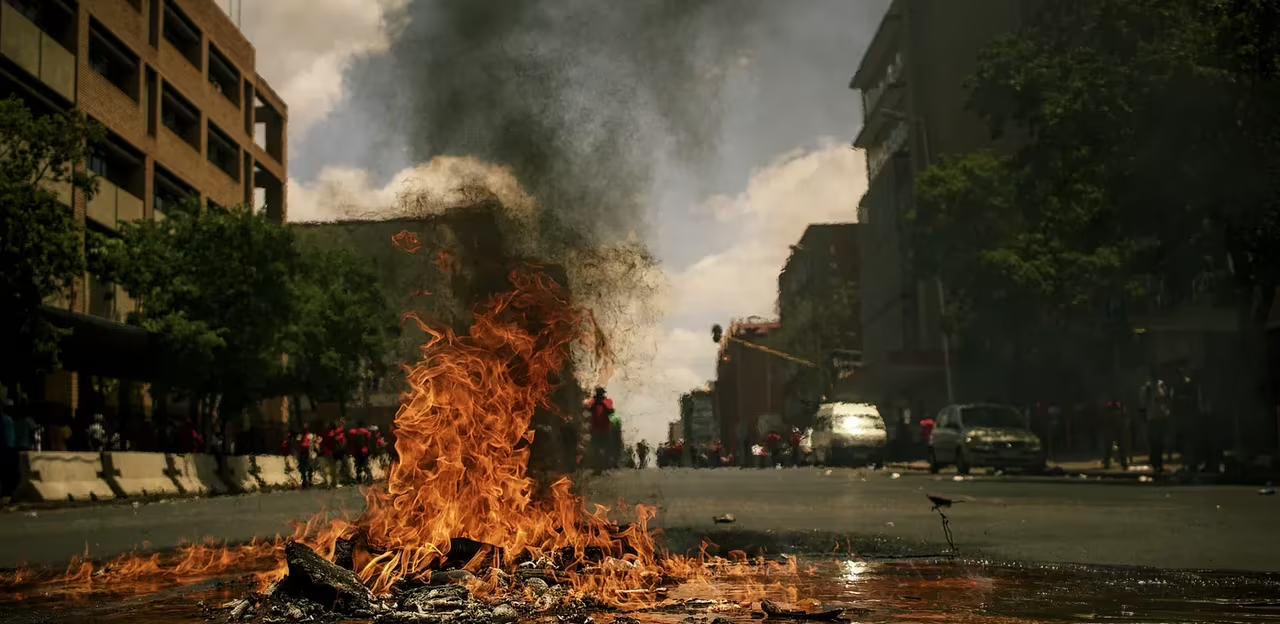
6000 Dead for Demanding Freedom: How Iran Uses Quran 5:33 to Execute Anyone Who Protests
What’s happening in Iran right now is the deadliest crackdown in the Islamic Republic’s 47-year history. The regime is using one Quranic verse to justify killing thousands. Here’s what that verse says, and here are the names of those who died because of it.
26 min read
·
1 hour ago
--
Listen
Share
I wake up every morning in February 2026 and check if my friends in Iran are still alive. I scroll through lists of names posted on Instagram before the regime’s cyberpolice take them down. I see faces I recognize. She was nineteen. He was twenty-three. They went to a protest asking for jobs, for bread, for the government to stop stealing while people starve. Now they’re bodies in a morgue, and the Islamic Republic of Iran says they were waging war against God and deserved to die.
At least six thousand people have been killed in Iran in the past six weeks. That’s the confirmed minimum from human rights organizations counting bodies despite a near-total internet blackout. The Iranian government admits to killing 3,117. Independent investigators have confirmed 6,842 deaths and are investigating 11,280 more. Some estimates, based on morgue videos and hospital reports that leaked before the internet was shut down, suggest the real number could be thirty thousand or more.
Thirty thousand people. In six weeks. That’s more than five hundred people killed every single day. That’s a 9/11 death toll happening every week. That’s genocide happening in real time while the world scrolls past it on social media.
And the Islamic Republic of Iran has a legal justification for every single killing. They cite one verse from the Quran, claim that anyone who protests is committing the crime described in that verse, and use it as a religious and legal mandate to kill thousands.
Let me show you exactly what that verse says, exactly how they’re using it, exactly who has died because of it, and exactly why the world needs to pay attention before the death toll reaches numbers we can’t even comprehend.
The Verse That Kills: Quran 5:33
Here is the verse, word for word, from the Sahih International translation of the Quran:
“Indeed, the penalty for those who wage war against Allah and His Messenger and strive upon earth [to cause] corruption is none but that they be killed or crucified or that their hands and feet be cut off from opposite sides or that they be exiled from the land.”
Read that again. The penalty for those who wage war against Allah and His Messenger. The penalty is death, or crucifixion, or amputation, or exile.
In Islamic jurisprudence, this crime is called “moharebeh” — waging war against God. It’s one of the most serious crimes in Islamic law. The penalty is death.
Now here’s how Iran is using it in 2026:
Attorney General Mohammad Movahedi-Azad announced in January 2026 that all protesters will be charged with moharebeh. Not some protesters. Not violent protesters. Not armed insurgents. All protesters. Anyone who took to the streets demanding economic relief, anyone who chanted slogans against the government, anyone who raised their voice against the regime.
Judiciary Head Mohseni-Ejei declared there will be “no leniency, mercy or compromise” for those charged with moharebeh. He demanded swift trials and decisive action. Decisive action means death.
Think about what this means. A man stands in the street and shouts that he can’t afford bread because the Iranian rial has collapsed and inflation is eating his family alive. The Islamic Republic says he is waging war against God. The penalty for waging war against God, according to Quran 5:33, is death.
A woman removes her hijab in protest of mandatory veiling laws and posts a video online. The regime says she is causing corruption on earth, which is part of the crime defined in Quran 5:33. The penalty is death.
Six thousand people are dead because the regime decided that protesting economic collapse equals waging war against God, and Quran 5:33 says the penalty for that is death.
How It Started: December 28, 2025
To understand why thousands are dying in Iran right now, you need to understand that the Islamic Republic has destroyed Iran’s economy through corruption, mismanagement, and spending billions on proxy wars across the Middle East while Iranians starve.
In January 2025, the Iranian rial was trading at approximately 700,000 rials to one US dollar. By January 2026, it had collapsed to 1.5 million rials to one dollar. The currency lost more than half its value in a year.
Inflation hit 42 to 48 percent officially, but real inflation for food and essentials was over 70 percent. A family that could buy groceries for a week with 500,000 rials in 2024 needed 1.5 million rials for the same groceries in January 2026. Wages didn’t increase. Jobs disappeared. People couldn’t afford to eat.
The government cut electricity. They cut natural gas supplies. People were freezing in winter because the regime couldn’t keep the power on. And while ordinary Iranians froze and starved, regime officials lived in mansions, drove luxury cars, and sent their children to universities in Europe.
On December 28, 2025, protests erupted in Tehran’s Grand Bazaar. Shopkeepers and merchants, traditionally conservative supporters of the regime, closed their shops and marched. They weren’t radicals. They weren’t Western agents. They were people who couldn’t pay their bills and couldn’t feed their families.
The protests spread. Kermanshah, Mashhad, Isfahan, Shiraz, Tabriz. Within days, demonstrations had erupted in dozens of cities across Iran. People poured into streets demanding economic relief, demanding the regime stop stealing, demanding accountability.
The regime’s response was bullets.
January 8, 2026: The Day Iran Became a Slaughterhouse
January 8, 2026, will go down in history as one of the deadliest days of state violence against civilians in the 21st century.
The Islamic Revolutionary Guard Corps, Iran’s ideological military force, was deployed to Tehran and other major cities. They were given orders to crush the protests by any means necessary. There were reports that foreign militias, including the Fatemiyoun Brigade composed of Afghan fighters loyal to Iran, were brought in to help suppress Iranians.
Security forces opened fire on unarmed protesters with live ammunition.
In Tehran alone, at least 217 people were killed on January 8 according to confirmed reports from the Human Rights Activists News Agency. But witnesses on the ground, before the internet was shut down, reported seeing hundreds of bodies.
Estimates suggest that between two thousand and six thousand people were killed on January 8 and 9, 2026, in a forty-eight-hour period of mass slaughter.
A video leaked from a Tehran morgue showed 366 bodies. This single morgue, in a single city, on a single day. Bodies piled on top of each other. Bodies with gunshot wounds to the head and chest. Bodies of young people who had been alive that morning. CBS News verified the video.
Hospitals were overwhelmed. Doctors and nurses, working under threat of arrest if they spoke publicly, described operating rooms filled with patients suffering from gunshot wounds. They described running out of blood for transfusions. They described watching people die because there were too many wounded and not enough medical staff.
One doctor, who cannot be named because naming him would mean his arrest and likely execution, sent a message that was smuggled out of Iran: “We are treating war casualties. But this is not a war. This is our government shooting our people. I have treated twelve patients with gunshot wounds to the head. Twelve. They were shot by snipers. Deliberately targeted. Murdered.”
And then, on January 8, 2026, at approximately 6:00 PM Tehran time, the internet went dark.
The Islamic Republic shut down internet access across Iran. It wasn’t a complete blackout at first, but it was close. Mobile data stopped working. Most websites became inaccessible. Social media was blocked. Messaging apps were cut off.
The regime wanted to massacre Iranians in the dark, where the world couldn’t see.
Without internet, videos stopped coming out. Photos stopped leaking. The world lost its window into the horror. What we know about the death toll after January 8 is fragmentary, pieced together from satellite phone calls, from people who escaped to neighboring countries, from families who managed to get word out about their dead.
But we know the killing didn’t stop on January 8. The protests continued. The bullets continued. The bodies continued piling up in morgues.
The Names of the Dead
Let me give you names. Not statistics. Not numbers. Names of real people who are dead because they protested an economy that made their lives impossible.
These are just a few of the thousands killed. Their names were documented by human rights organizations before the internet blackout made documenting deaths nearly impossible. Each name represents a life, a family destroyed, a future erased.
Sadegh, 24 years old, from Tehran. Killed January 8, 2026. He was studying engineering. He went to a protest demanding the government fix the economy so he could find a job after graduation. He was shot in the chest by security forces. His mother saw the video of his death online before the internet was cut. She watched her son die on someone’s phone camera.
Maryam, 19 years old, from Kermanshah. Killed January 9, 2026. She was a university student. She removed her hijab during a protest, waving it in the air while chanting “Woman, Life, Freedom.” Security forces shot her six times. Her body was returned to her family three days later. The regime demanded her family pay for the bullets before they could claim her corpse.
Reza, 31 years old, from Mashhad. Killed January 7, 2026. He was a shopkeeper. His business was failing because customers couldn’t afford to buy anything. He joined a protest asking for economic relief. He was beaten to death by Basij militia. Witnesses say they beat him with batons for five minutes while he was on the ground. He died of head injuries.
Zahra, 16 years old, from Shiraz. Killed January 10, 2026. She went to a protest with her older brother. They were both shot. Her brother survived. Zahra died before reaching the hospital. She was sixteen years old. She wanted to be a doctor.
Ahmad, 42 years old, from Isfahan. Killed January 11, 2026. He was a father of three. He couldn’t feed his children because his salary, which hadn’t increased in two years, couldn’t keep up with food prices that had doubled. He protested. He was shot in the head by a sniper. His wife is now a widow raising three children alone in an economy where she has no way to support them.
Fatima, 27 years old, from Tabriz. Killed January 8, 2026. She was a teacher. She made videos criticizing the regime’s economic policies and posted them online. Security forces came to her home and arrested her. She was killed in detention. Her family was told she died of natural causes. The bruises on her body when they received her corpse told a different story.
These six names represent six out of at least six thousand dead. Multiply their stories by a thousand. Then multiply again. That’s the scale of what Iran has done to its own people in six weeks.
And every single one of them, according to Iran’s Attorney General, was committing the crime of moharebeh. Waging war against God. According to Quran 5:33, they deserved to die.
The Regime’s Justification: “They Are Enemies of God”
Supreme Leader Ayatollah Ali Khamenei, the man who has ruled Iran with absolute power since 1989, gave the order. In a speech broadcast on state television in early January 2026, before the full extent of the massacre became clear and before the internet blackout hid the horror, Khamenei declared that the protests were the work of foreign enemies, particularly the United States and Israel, working to destabilize the Islamic Republic.
He ordered security forces to crush the protests “by any means necessary.”
Think about what that phrase means when it comes from a Supreme Leader with absolute power. It means there are no limits. It means shoot to kill. It means arrest, torture, execute. It means use whatever force is required to make the protests stop. And that’s exactly what happened.
Attorney General Mohammad Movahedi-Azad announced that all protesters would be charged with moharebeh. Not incitement. Not disturbing the peace. Not illegal assembly. Moharebeh. Waging war against God and His Messenger. The crime defined in Quran 5:33 that carries the death penalty.
Judiciary Head Mohseni-Ejei, the man who oversees Iran’s court system, declared that there would be “no leniency, mercy or compromise” for those accused of moharebeh. He demanded that judges conduct swift trials and deliver decisive punishments.
Swift trials mean show trials. Defendants are not allowed real lawyers. Evidence is fabricated. Confessions are extracted through torture. Verdicts are predetermined. And the punishment for moharebeh is death.
Between January 2026 and now, thousands of Iranians have been arrested. Human rights organizations estimate at least 10,600 arrests directly connected to the 2026 protests, though the real number is likely much higher because the internet blackout prevents full documentation.
Some are being tried in groups. Fifty defendants at a time, all charged with moharebeh, all facing death sentences. The trials last hours, not days or weeks. Defense lawyers, when they’re allowed at all, are given minutes to prepare. The outcome is always the same: guilty, death penalty.
The regime broadcasts these trials on state television. They want Iranians to see what happens when you protest. They want people to know that if you take to the streets, you will be declared an enemy of God, and you will die.
And they cite Quran 5:33 as the legal and religious justification for every execution.
This Isn’t the First Time: Mahsa Amini and the 551 Who Died Before
What’s happening in Iran in 2026 is not new. The scale is unprecedented, the death toll is staggering, but the pattern is familiar. The Islamic Republic has been killing protesters and calling it Islamic justice for decades.
Let me tell you about Mahsa Amini, because what’s happening now started with what happened to her.
On September 13, 2022, Mahsa Amini, a 22-year-old Kurdish woman from Saqqez, was visiting Tehran with her family. She was arrested by Iran’s morality police for allegedly wearing her hijab improperly. Her crime? Some of her hair was showing.
She was taken to a detention center for “re-education” about proper Islamic dress. Three days later, on September 16, 2022, she was dead.
The regime claimed she had a heart attack. Medical scans leaked by doctors showed massive head trauma. Witnesses who were arrested with her said they heard screaming coming from the room where morality police had taken her. Mahsa Amini was beaten to death for showing her hair.
Iran erupted. Protests spread across every major city. Women removed their hijabs in the streets and burned them. They cut their hair publicly. They chanted “Woman, Life, Freedom” in Farsi, Kurdish, and Azeri. They demanded an end to mandatory hijab. They demanded accountability for Mahsa’s death. They demanded dignity.
The regime’s response was the same as it is now: bullets.
Between September 2022 and May 2023, at least 551 protesters were killed according to documentation by Iran Human Rights and the Human Rights Activists News Agency. That number includes children. At least 68 minors were killed during the Mahsa Amini protests. Children shot for demanding freedom.
Four protesters were executed after being charged with moharebeh. The same charge being used now. The same Quranic verse cited as justification.
Mohsen Shekari was the first. He was 23 years old. He was accused of blocking a street and wounding a Basij militia member with a knife. He was arrested, tried in a closed hearing, denied a real lawyer, and sentenced to death for moharebeh. He was hanged on December 8, 2022, less than three months after his arrest.
Majidreza Rahnavard was hanged four days later, on December 12, 2022. He was 23 years old. He was accused of killing two Basij militia members. His trial was closed. His family wasn’t notified of his execution until after he was dead. The regime hung his body from a construction crane in a public square as a warning.
Mohammad Mehdi Karami and Seyed Mohammad Hosseini were hanged together on January 7, 2023. Both were in their twenties. Both were accused of killing a Basij member during protests. Both were tortured into confessing. Their families were told about their executions after their bodies were already cold.
All four were charged with moharebeh. All four were executed under Quran 5:33. All four were killed for protesting.
The Mahsa Amini protests eventually subsided under the weight of brutal repression. Thousands were arrested. Hundreds remain in prison. The mandatory hijab law is still enforced. Women are still beaten for showing their hair. And Mahsa Amini is still dead, killed by a regime that cited Islamic law as justification.
But the anger didn’t disappear. It simmered beneath the surface. And when the economy collapsed in late 2025 and people couldn’t afford food, the rage exploded again.
And this time, the regime decided not to kill hundreds. They decided to kill thousands.
The Other Verses They Use to Oppress
Quran 5:33, the verse about moharebeh, is the one the regime uses to kill protesters. But it’s not the only Quranic verse the Islamic Republic uses to oppress Iranians. Let me show you the others, because they form a comprehensive legal and religious framework of oppression.
For Mandatory Hijab: Quran 24:31 and 33:59
Quran 24:31 states in the Sahih International translation:
“And tell the believing women to reduce [some] of their vision and guard their private parts and not expose their adornment except that which [necessarily] appears thereof and to wrap [a portion of] their headcovers over their chests and not expose their adornment…”
Quran 33:59 states:
“O Prophet, tell your wives and your daughters and the women of the believers to bring down over themselves [part] of their outer garments. That is more suitable that they will be known and not be abused.”
The Islamic Republic uses these verses to justify mandatory hijab laws that have been in effect since 1983. Women in Iran are legally required to cover their hair and wear modest clothing in public. The penalty for violating hijab laws includes fines, imprisonment, and beatings.
Mahsa Amini died because of these laws. She was arrested for allegedly violating Quranic commands about women’s dress as interpreted and enforced by the regime. She was beaten to death for showing her hair in violation of what the regime claims is God’s command in Quran 24:31 and 33:59.
Thousands of women have been arrested for hijab violations. In July 2023, the regime announced it had closed over 2,000 businesses whose female employees or customers were not properly veiled. Surveillance cameras monitor compliance. Women who remove hijab in their cars can have their vehicles confiscated.
All of this is justified by citing two Quranic verses about women’s modesty.
For Women’s Legal Inequality: Quran 2:282 and 4:11
Women in Iran are legally worth half of men. This is codified in Iranian law based on Quranic verses.
Quran 2:282 addresses testimony:
“And bring to witness two witnesses from among your men. And if there are not two men [available], then a man and two women from those whom you accept as witnesses — so that if one of the women errs, then the other can remind her.”
In Iranian courts, a woman’s testimony is legally worth half that of a man’s testimony. If two witnesses are needed to prove a fact, you can have two men, or one man and two women. A single woman’s word is not sufficient where a single man’s word would be.
Quran 4:11 addresses inheritance:
“Allah instructs you concerning your children: for the male, what is equal to the share of two females.”
Women in Iran inherit half of what men inherit. When a father dies, his sons receive twice the inheritance his daughters receive. This is Islamic law as written in the Quran and enforced by the Islamic Republic.
Think about what this means in practice. A woman’s father dies. Her brother inherits the family home. She inherits half the value. She cannot challenge this in court because Quran 4:11 explicitly gives men twice the inheritance of women, and Iranian law is based on Islamic law.
A woman is raped. She needs witnesses to prove it in court. If she has one male witness, that’s sufficient testimony. If she has only female witnesses, she needs two women to equal one man’s testimony. And if the male witness disputes her account, her testimony is worth half his.
This is all based on Quranic verses that the regime has turned into legal code.
For Male Authority Over Women: Quran 4:34
Quran 4:34 is one of the most controversial verses in the Quran. The Sahih International translation states:
“Men are in charge of women by [right of] what Allah has given one over the other and what they spend [for maintenance] from their wealth. So righteous women are devoutly obedient, guarding in [the husband’s] absence what Allah would have them guard. But those [wives] from whom you fear arrogance — [first] advise them; [then if they persist], forsake them in bed; and [finally], strike them.”
Men are in charge of women. That’s what the verse says. And women who are disobedient can be struck according to the verse’s instruction.
Iranian law allows husbands significant control over their wives. A woman cannot travel outside Iran without her husband’s permission. A woman cannot work in certain jobs without her husband’s consent. Divorce laws heavily favor men. A man can divorce his wife easily; a woman needs specific grounds and often her husband’s agreement to divorce.
And domestic violence is widespread and often legally protected because Quran 4:34 is interpreted as giving husbands the right to discipline their wives, including through physical punishment.
Women who report domestic violence to police are often told to go home and obey their husbands. The verse that says men can strike disobedient wives is used to justify legal impunity for domestic abusers.
For Lashing as Punishment: Quran 24:2
Quran 24:2 prescribes lashing as punishment:
“The [unmarried] woman or [unmarried] man found guilty of sexual intercourse — lash each one of them with a hundred lashes, and do not be taken by pity for them in the religion of Allah.”
Iran uses lashing as punishment for various crimes, not just sexual immorality. Drinking alcohol, adultery, theft, and even political crimes can result in sentences of lashing. Protesters have been sentenced to lashing. Women who violate hijab laws have been sentenced to lashing.
The regime cites Quran 24:2 as justification for flogging as an Islamic punishment ordained by God.
Thousands Are Being Tried, Sentenced, and Executed Right Now
While the world’s attention has moved on, while social media has stopped showing videos from Iran because the internet blackout prevents them from getting out, the Islamic Republic’s courts are conducting mass trials of protesters.
As of early February 2026, at least 10,600 people arrested during the protests are awaiting trial or have been tried. Many have already been sentenced. Some have already been executed, though the regime is not announcing execution numbers publicly because international pressure increased after they executed protesters during the Mahsa Amini protests.
The trials are shams. Defendants are brought before revolutionary courts in groups. Fifty people tried together, all charged with moharebeh, all denied real legal representation, all facing predetermined guilty verdicts.
Evidence is fabricated. Security forces claim protesters threw Molotov cocktails or attacked security personnel. Video “evidence” is edited or staged. Confessions are extracted through torture. Defendants are beaten, subjected to psychological torture, threatened with harm to their families, until they sign confessions written by interrogators.
One leaked document from inside Iran’s judiciary described the process: Arrested protesters are taken to detention centers run by the Revolutionary Guards. They are held in solitary confinement. They are interrogated repeatedly. They are told that if they confess, they will receive lighter sentences. They are told if they don’t confess, their families will be arrested. They are tortured until they break.
Then they are brought to court. The trial lasts hours. The judge reads the charges: moharebeh, corruption on earth, acting against national security. The prosecution presents the forced confession and fabricated evidence. The defense lawyer, if there is one, has no real ability to challenge anything. The verdict is read: guilty. The sentence is read: death.
And Quran 5:33 is cited as the legal and religious basis for the death sentence.
Some defendants are executed within days of their trials. Others sit in prison cells waiting for execution dates. Some learn they’re going to be executed when guards come to their cells at dawn and tell them to prepare.
Families often don’t know their loved ones have been executed until days later. The regime sometimes buries executed protesters in unmarked graves and doesn’t return bodies to families. They don’t want funerals to become protests.
This is happening right now. As you read this, protesters arrested in January 2026 are being tried in Iranian courts. As you read this, people are being sentenced to death for the crime of demanding economic relief. As you read this, people are being hanged for waging war against God when all they did was shout that they couldn’t afford bread.
What They’re Actually Protesting For
Let me be clear about something that Western media often gets wrong. The protesters in Iran are not demanding regime change. They are not calling for American intervention. They are not agents of Israel or the CIA. They are ordinary Iranians who cannot afford to live and who went to the streets to demand that their government stop destroying the economy.
They want jobs. Iran’s unemployment rate, especially for young people, is catastrophic. University graduates cannot find work. People with advanced degrees are driving taxis or selling vegetables because there are no jobs in their fields. The economy is so broken that even people with jobs can’t afford basic necessities.
They want food. A kilogram of chicken that cost 150,000 rials in 2024 costs 400,000 rials in 2026. Rice prices have more than doubled. Bread, the staple of Iranian diet, has become a luxury item for many families. Parents are choosing between feeding their children and paying rent.
They want electricity. The regime cuts power for hours every day, leaving homes dark and cold in winter. They want natural gas so they can heat their homes. They want infrastructure that works.
They want the regime to stop spending billions on proxy wars in Yemen, Syria, Lebanon, and Iraq while Iranians starve. They want the regime to stop enriching itself through corruption while the economy collapses. They want accountability for the theft of national resources.
These are not revolutionary demands. These are survival demands. Food. Heat. Jobs. The ability to live without choosing between medicine and bread.
And for making these demands, six thousand people are dead.
And the regime says they were waging war against God.
The Internet Blackout: Hiding Massacre in Darkness
On January 8, 2026, at approximately 6:00 PM Tehran time, the internet went dark across most of Iran. Mobile data networks stopped functioning. Access to international websites was blocked. Social media platforms became inaccessible. The Islamic Republic imposed a near-total internet blackout designed to prevent videos and information about the massacre from reaching the outside world.
Before the blackout, the world could see what was happening. Videos showed security forces firing into crowds. Photos showed bodies in the streets. Live streams showed the scale of the protests and the brutality of the crackdown.
Then the internet died, and the world went blind.
What we know about the death toll after January 8 comes from fragmentary sources. Satellite phone calls from people who managed to get expensive satellite communication devices. Messages smuggled out through neighboring countries. Information pieced together from the few people who escaped Iran and told their stories to human rights organizations.
The internet blackout is not just about controlling information. It’s about controlling the narrative. Without videos, the regime can claim protesters were violent. Without photos, they can deny the death toll. Without evidence, they can massacre with impunity.
Network monitoring organizations documented the blackout. Internet connectivity in Iran dropped to less than 10 percent of normal levels on January 8. Some areas had zero connectivity. The blackout has been partially lifted in some cities as of February 2026, but access remains heavily restricted and monitored.
And this means the true death toll is unknown. The 6,842 confirmed deaths documented by the Human Rights Activists News Agency represent only what could be verified despite the blackout. The real number could be ten thousand. Could be twenty thousand. Could be thirty thousand.
We may never know the full extent of what Iran did to its own people in those dark days after January 8, 2026. The regime made sure of that when they killed the internet along with killing thousands of Iranians.
The World’s Deafening Silence
Six thousand people dead in six weeks. At least 10,600 arrested. Mass trials. Death sentences. Executions. An internet blackout hiding ongoing massacre.
Where is the United Nations?
Where are the emergency sessions of the Security Council?
Where are the sanctions?
Where is the International Criminal Court?
Where is the global outrage that appears when atrocities happen in countries that don’t have oil or strategic importance?
The silence is deafening. Yes, there have been statements. The UN High Commissioner for Human Rights expressed concern. Some Western governments issued condemnations. But concern and condemnation don’t stop bullets. They don’t prevent executions. They don’t save lives.
Compare this to global reaction when Russia invaded Ukraine. Massive sanctions. Military aid. International solidarity. Daily news coverage. Ukraine’s flag everywhere. World leaders visiting Kyiv to show support.
Now look at Iran. Six thousand dead in six weeks, and it barely makes headlines anymore. The protests started in December 2025. By late January 2026, most news organizations had moved on to other stories. The massacre disappeared from front pages while the bodies kept piling up.
Why?
Partly because Iran has oil and natural gas. Europe needs energy. Countries are reluctant to impose sanctions that might affect global energy markets. Economic interests outweigh human rights.
Partly because Iran has nuclear ambitions and regional influence. Governments worry about destabilizing the Middle East further. They fear that if Iran’s regime collapses, chaos will follow. Better the devil you know, even if that devil is killing thousands of its own people.
Partly because the internet blackout succeeded. Without constant video evidence, without daily photos of bodies in the streets, the massacres became abstract. Numbers on a page don’t create the same urgency as videos of people being shot.
And partly because the world has decided that some lives matter less than others. When protesters are killed in Hong Kong, the world pays attention. When protesters are killed in Iran, it’s just another day in a Middle Eastern country with a repressive government.
But most fundamentally, the world is silent because Iran gets to claim religious justification for its massacres. When the regime says protesters are waging war against God, when they cite Quran 5:33, when they frame mass murder as defending Islam, Western governments become hesitant to criticize too forcefully for fear of being accused of Islamophobia.
And the Islamic Republic knows this. They know that wrapping tyranny in religion creates a shield. They know that claiming to enforce God’s law makes governments reluctant to intervene. They know they can kill thousands and call it Islamic justice, and the world will issue statements of concern but take no meaningful action.
So the killing continues. The trials continue. The executions continue. And the world watches and does nothing.
The Questions That Haunt Me
After learning that at least six thousand Iranians have been killed in six weeks, after understanding that the regime charges all protesters with moharebeh and sentences them to death under Quran 5:33, after seeing that the Islamic Republic uses multiple Quranic verses to oppress women and justify inequality, after watching the world stay silent while thousands die, I have questions that won’t let me sleep.
How can protesting economic collapse be considered waging war against God?
How can a verse about defending against aggressors who threaten the Muslim community be twisted into justification for killing people who want jobs and food?
How can showing your hair be a crime worthy of arrest, beating, and potentially death?
How can a woman’s testimony be worth half a man’s testimony and anyone call that justice?
How can inheritance laws that give men twice what women receive be defended as divine will?
How can the international community watch six thousand people die in six weeks and issue statements of concern instead of taking action?
How can the United Nations, created to prevent mass atrocities, sit idle while a member state massacres its own population?
How is this different from genocide? The UN defines genocide as acts committed with intent to destroy, in whole or in part, a national, ethnic, racial, or religious group. Iran is destroying Iranians who demand freedom. They are systematically killing a political group. If killing six thousand protesters in six weeks isn’t genocide, what is?
How many people need to die before the world decides Iranian lives matter as much as Ukrainian lives, or Hong Kong lives, or any other lives?
How long will we let Iran hide behind religion to justify tyranny?
And the question that keeps me awake at night: How many more will die while we debate whether it’s appropriate to criticize a regime that claims to be enforcing Islamic law?
What You Need to Understand About This Moment
Right now, as you read this in February 2026, people are sitting in Iranian prison cells waiting to be executed for protesting. They are charged with moharebeh. They have been sentenced to death under Quran 5:33. Some know their execution date. Some don’t. All of them know they’re going to die for demanding that their government stop destroying the economy.
Right now, families in Iran are searching for loved ones who disappeared during the protests. They call hospitals. They check morgues. They go to detention centers and beg for information. Some find their family members in prison. Some find them in morgues. Some never find them at all.
Right now, the Islamic Republic is conducting mass trials where dozens of people are tried together, all charged with waging war against God, all sentenced to death in proceedings that last hours.
Right now, Iranian women are being arrested for removing their hijab, beaten in detention, fined or imprisoned, all justified by Quranic verses about women’s modesty that the regime has turned into weapons of oppression.
Right now, the internet blackout continues in many parts of Iran, hiding ongoing violence from the world’s view. We don’t know how many more have died since early February. We don’t know how many are being tortured in detention. We don’t know the full horror because Iran has made sure we can’t know.
And right now, the world is largely ignoring all of this. News cycles have moved on. Social media is focused on other crises. Six thousand dead and counting, and it’s not trending anymore.
This is the moment you’re living in. A moment where a government is using religious texts to justify killing thousands of its own people for demanding economic survival. A moment where Quranic verses written fourteen centuries ago are being cited as legal justification for massacre. A moment where the world is choosing economic interests and political convenience over human lives.
And you have a choice to make.
What You Can Do
Will you read this and forget it by tomorrow?
Will you acknowledge that this is happening and then scroll past to the next thing?
Will you care about this atrocity as much as you care about atrocities committed by governments the West wants you to oppose?
Or will you refuse to let six thousand dead people disappear into silence?
Share this. Make people know what Iran is doing. Make people understand that the regime is using Quran 5:33 to justify mass execution of protesters. Don’t let the internet blackout succeed in hiding genocide.
Demand action from your government. If you live in a democracy, contact your representatives. Demand sanctions on Iranian officials responsible for the massacre. Demand that your government support Iranians fighting for freedom. Demand that Iranian lives matter as much as any other lives.
Support organizations documenting the atrocities. Iran Human Rights, the Human Rights Activists News Agency, Amnesty International. They are counting the dead when the regime tries to hide them. They are documenting names and faces. They are preserving evidence for future accountability.
Amplify Iranian voices. When Iranians manage to get information out despite the blackout, share it. Translate it. Make sure the world hears from the people living through this horror.
Reject the narrative that criticizing Iran is Islamophobic. The Islamic Republic of Iran does not represent Islam. It represents a tyrannical regime using religion to justify oppression. You can criticize Iran’s use of Quranic verses to execute protesters without being anti-Muslim. The millions of Muslims around the world who oppose theocracy prove that.
And most importantly: Remember their names. Sadegh, 24, shot for demanding jobs. Maryam, 19, shot six times for removing her hijab. Reza, 31, beaten to death for protesting economic collapse. Zahra, 16, wanted to be a doctor. Ahmad, 42, couldn’t feed his three children. Fatima, 27, made videos criticizing the government.
They are six out of six thousand. Six thousand human beings with names and families and dreams who are dead because the Islamic Republic of Iran decided that demanding economic relief equals waging war against God.
Don’t let them be forgotten. Don’t let their deaths mean nothing. Don’t let Iran massacre thousands and get away with it because the world couldn’t be bothered to pay attention.
How many more need to die before you care enough to act?
How many more executions under Quran 5:33 before the world says this interpretation of Islam is being used to justify tyranny?
How many more families destroyed before someone, somewhere, does something meaningful to stop this?
The answers to those questions depend on you. On whether you’ll share this. On whether you’ll demand action. On whether you’ll refuse to forget.
Six thousand are dead. More are dying every day. Executions are happening right now. Trials are happening right now. Arrests are happening right now.
The massacre is ongoing.
What will you do?
SOURCES
Death Tolls & Protests:
- Iran Human Rights (Norway-based NGO): Death toll documentation
- Human Rights Activists News Agency (HRANA): 6,842 confirmed deaths + 11,280 under investigation (as of Feb 1, 2026)
- Iranian government official figure: 3,117 (as of Jan 21, 2026)
- Guardian, Time, NPR reporting on estimates ranging to 36,500
- CBS News verified morgue video showing 366 bodies
Internet Blackout:
- Network monitoring organizations documented January 8, 2026 shutdown
- Internet connectivity dropped to less than 10% of normal levels
Regime Statements:
- Attorney General Mohammad Movahedi-Azad statements on moharebeh charges
- Judiciary Head Mohseni-Ejei statements on “no leniency”
- Supreme Leader Khamenei speeches (state media)
Quranic Verses:
- All verses cited from Sahih International translation
- Quran 5:33, 24:31, 33:59, 2:282, 4:11, 4:34, 24:2
Mahsa Amini Protests (2022–2023):
- Iran Human Rights documentation: 551+ killed
- 4 executions verified (Mohsen Shekari, Majidreza Rahnavard, Mohammad Mehdi Karami, Seyed Mohammad Hosseini)
- Mahsa Amini death: September 16, 2022
Iranian Law:
- Mandatory hijab law (1983)
- Women’s testimony worth half (based on Quran 2:282)
- Women inherit half (based on Quran 4:11)
- Iranian Penal Code provisions
Economic Data:
- Iranian rial exchange rates
- Inflation estimates from various economic sources
Dear Readers, due to internet blackout, verification of events after January 8, 2026, is limited to information that has been smuggled out or reported by people who escaped Iran. Death toll estimates vary significantly because comprehensive documentation is impossible under blackout conditions. All figures presented represent either confirmed minimums or ranges based on available evidence.
![[RECIPE] Overstuffed Portobello Mushrooms with Cashew Cream](https://cdn.thefuse.co.za/images2/5/f/4/8/e/5f48e84d-7f15-390c-ab96-5b803b59b298-1173x660.jpg)