Ammouta or Al Ahly's haphazard approach: which is the wrong fit for the other?
Goal | 23.11.2026 23:49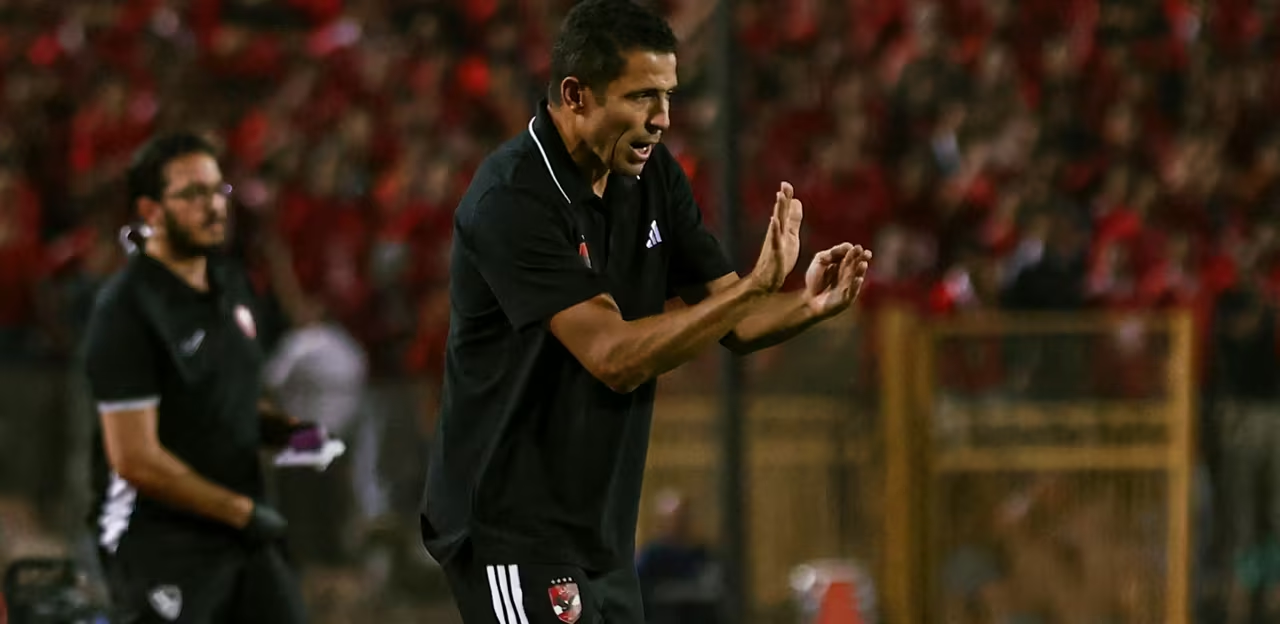
The 2-0 defeat to Pyramids has reopened the debate over Al Ahly's tactical identity and the way the club have handled their coaching appointments in recent years. A side used to competing for trophies and winning titles looked unable to impose their rhythm in a head-to-head clash with one of their direct rivals for the title, while Pyramids appeared clearer in their ideas and better able to put them into practice.
A defeat that may not have surprised a sizeable share of Al Ahly fans, given the fierce and persistent criticism of coach Hussein Ammouta, has reopened the debate over the decision to hand the Moroccan the job. It's a puzzling question heard often in Al Ahly circles, and it gets louder after every slip-up. The team's performances haven't matched the expectations of supporters who are impatient to see the side restored to their powerful best after the disappointment of last season, which ended without a trophy.
The most objective question now isn't how to judge Hussein Ammouta on a single match. It's how well his ideas suit Al Ahly, and whether the board chose the right coach or simply threw a new name into a system that has fundamentally lacked a stable tactical identity over the past few years.
Read more: "More than 90%": former Real star criticises Flick's decision against Villarreal
On paper, Ammouta's CV is strong. He led Wydad to the 2017 CAF Champions League and the Moroccan league title, won the 2021 Africa Cup of Nations with Morocco's home-based national team and took Jordan to the 2023 Asian Cup final, the greatest achievement in the national team's history. Success at those stops didn't necessarily mean his style fitted Al Ahly's demands, though.
Ammouta doesn't clearly belong to the defensive school. Nor is he a coach who builds his approach on possession and constant pressing. He favours organisation and tactical discipline, adapting his plan to the opponent and exploiting transitions and space. That flexibility can be an asset in knockout matches. It also raises further questions about his ability to lead a team whose fans expect them to take the initiative and impose their style, rather than simply adapt to the opposition.
Read more: Liverpool's four-goal win in focus: PSV coach challenges Mbappe, and a frank view on Mourinho
Pyramids expose the gap: Al Ahly caught between slow transitions and a lack of balance
Against Pyramids, Al Ahly couldn't move the ball at the required speed or build out of their own areas in an organised way, and they never turned possession into a real threat. Problems surfaced in defensive transitions, in the space between midfield and defence, in the speed of recovery and in the cover behind the players pushing forward. That points to a recurring flaw in distances and the distribution of roles. These weren't just individual errors.
The blame doesn't rest with Ammouta alone, though. The board have left key needs unaddressed. Al Ahly need a striker who can finish chances and move between the centre-backs, and a strong, quick centre-back who can deal with space. They've badly lacked that since the board failed to keep Wessam Abou Ali. They also need a pivotal holding midfielder to protect the centre, cover the full-backs when they push forward and help build attacks under pressure. Those positions are key to the team's balance and their ability to compete, particularly as the current options can't be relied upon. Their form varies from match to match and from opponent to opponent.
Joker card or Moroccan star? PSG's crisis muddles Enrique's thinking
Absences of influential players also unsettled the line-up, chief among them Emam Ashour, who can drive forward with the ball and break the opposition's lines. Emam missed the four matches before the Pyramids clash for technical reasons, then returned to the squad and made a lacklustre appearance off the bench today. Injuries to other players have also reduced the coaching staff's options. That only deepens the puzzle of why Al Ahly's many signings in recent years have failed: they haven't given the team balance, and they leave the head coach's hands tied when he needs them most.
From Koller to Ammouta: are Al Ahly paying the price for haphazard choices?
The bigger responsibility lies with the way the club run their football. Since Pitso Mosimane left, Al Ahly have gone through Ricardo Soares, Marcel Koller and José Riveiro, with Emad El-Nahhas taking charge on an interim basis more than once, then Jess Thorup and now Ammouta. Each coach brings their own philosophy and needs, but the board have never clearly said what identity they want to build, or what criteria they use to choose a head coach. You can't change philosophy with every coach, demand that the team keep a consistent personality, then punish the next coach with the sack.
Compare Ammouta's start with that of Marcel Koller, the longest-serving coach at Al Ahly under Mahmoud El Khatib's presidency, and it's clear results alone don't settle the verdict on an appointment. In Ammouta's first 14 official matches (domestic and continental), Al Ahly won 11, drew two and suffered their first defeat today, scoring 30 goals and conceding seven. According to Koller's match record, the team also won 11 and drew two of his first 13 matches in charge. The two starts were identical in wins and draws. Ammouta holds the edge in goals.
Read more: Catalan response to Perez: "If VAR had existed 100 years ago, you would have won the Champions League twice"
Koller lasted around 960 days and took charge of 161 matches with Al Ahly, according to Transfermarkt data. Against Pyramids, he won five of eight meetings, with two draws and one defeat, and his team scored 13 goals and conceded nine. Ammouta lost his first meeting with the same opponents 2-0. That's too small a sample for a historical comparison between the two coaches, but it hands the Moroccan an early test.
Realistically, though, the similar numbers don't address what bothers Al Ahly fans most: the style of play, the defensive weakness and the lack of connection between the lines. The problem isn't the number of wins alone. It's the team's ability to impose their personality and control the big matches. Hence the phrase Al Ahly supporters hate to hear: "Al Ahly no longer strike fear".
Responsibility here lies with Mahmoud El Khatib, the board and everyone in charge of football at the club, even allowing for the fact that other opinions have often been sidelined in favour of the club president's vision. Before choosing a coach, the club must define the shape of the team, its needs, the players capable of carrying out the coach's ideas and the time required to build the project. Change coaches without reforming the process of selection, planning and recruitment, and every new head coach will inherit the flaws of their predecessor. Then they'll be expected to deliver instant results with resources that may not suit their ideas.
Ammouta shouldn't stand alone in the dock. Nor can he be absolved of responsibility for a team that retreats into reacting and lacks solutions. He must prove he can produce football that matches Al Ahly's stature and history. The board, in turn, must prove they chose a coach for a clear project and are ready to meet his needs. Most importantly, they must show they accept responsibility without always making the coach the scapegoat.
The real question is no longer just whether Ammouta suits Al Ahly. It's whether the Al Ahly board know what coach they want and what team they're trying to build.
journalism and writing are a passion before they are a profession. Since taking my first steps down this path in late 2010, I have been weaving my stories across the pages of Egyptian and Arab websites. I don’t view sports in general—and soccer in particular—as merely a game, but rather as a canvas of life that reflects the pulse of societies and carries within it social and cultural stories that intertwine with the threads of politics to shape people’s consciousness.
I delve into covering and analyzing soccer from multiple angles: I cover the game from multiple angles where storytelling meets analysis, and where the pitch connects to broader social and cultural narratives.
Over time and as my experience grew, my passion expanded to draw connections between the economics of the game, modern technology, and cryptocurrencies—all of which have become part of a soccer industry that extends far beyond the boundaries of the field.
My experience has spanned several prominent Arab outlets: in Egypt, Jordan, and Saudi Arabia, such as Goal (Saudi edition) and Koora, where I have worked as a multi-tasking desk editor since 2019."I don't just cover stories, I find them where others aren't looking, then reshape them until they're worth reading.
with analytical depth and a human touch to deliver an unforgettable story to the reader.
My Story with Soccer
My passion for soccer began early, specifically at the age of six during the 1994 World Cup. The atmosphere at home was different; the whole family was awake to watch the matches even though they were broadcast at dawn, and that is where my true passion was born. I was captivated by Romário’s mesmerizing skills, amazed by Thomas Brulin, and impressed by the physical and technical prowess of the Nigerian national team led by the late Rashidi Yakini, while the image of Roberto Baggio missing his penalty kick in the final remains etched in my memory as the first dramatic moment I experienced with the game.
As the years passed and my fascination with international soccer grew, certain matches remained defining moments in my football education, such as the 2001 UEFA Cup final between Liverpool and Spain’s Alavés—that wild 5-4 clash whose intensity didn’t subside until the 117th minute, when an own goal sealed the title for the Reds, cementing it in my memory as an unforgettable match.
My Best Soccer Memories
Unforgettable moments include Real Madrid’s 2002 Champions League victory, Liverpool’s historic 2005 final, and Egypt’s 2006, 2008, and 2010 African Cup of Nations triumphs under Hassan Shehata.
My All-Time Team
Buffon
Cafu - Paolo Maldini - Ramos - Roberto Carlos
Zinedine Zidane - Iniesta
Diego Maradona
Lionel Messi - Ronaldo “The Phenomenon” - Cristiano Ronaldo
My Favorite Articles:
The Ronaldo Mystery... Death in a Foreign Land!
Third dimension.. Barefoot... Has Messi Really Settled
The Debate Over the Greatest of All Time?
(2) Messi Chases Pelé... Has the Debate Over the Greatest of All Time Really Been Settled?
Third dimension: The Terrifying Test... Salah Inherits the Crown of the Seven Years
The Fortune of Cryptocurrencies... Messi Alone Among America’s Stars
The Champions’ Disaster and Barcelona’s Betrayal... How Will
Blockchain Technology Solve the Great Crisis?
The story of crypto levers... Is
Laporta gambling with Barcelona’s future?
Chaos in the land of samba... Will Ancelotti escape the vortex of pressure?
Social media accounts: