Can the Subaltern Be Digitized, Indexed, and Searched?
Medium | 27.01.2026 03:31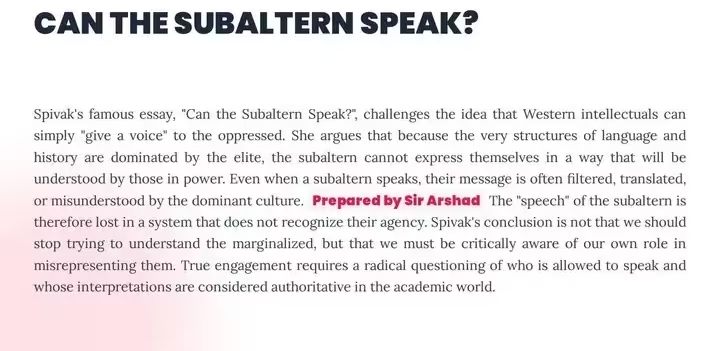
Can the Subaltern Be Digitized, Indexed, and Searched?
5 min read
·
1 hour ago
--
Listen
Share
Can the Subaltern Be Digitized, Indexed, and Searched?
In 1988, Gayatri Chakravorty Spivak asked a question that still unsettles the humanities: “Can the subaltern speak?” Her concern was not merely about speech in a literal sense, but about representation, power, and epistemic violence who gets to appear in systems of knowledge and who is structurally erased.
More than three decades later, we live in a world where knowledge is no longer archived primarily in dusty libraries or colonial records, but in databases, algorithms, and digital platforms. Today, visibility is determined less by who speaks and more by who is digitized, indexed, and searchable.
This shift invites a necessary rephrasing of Spivak’s question for the digital age:
Can the subaltern be digitized, indexed, and searched?
This article explores that question through the intersection of postcolonial theory and digital humanities, drawing especially on the work of David M. Berry, who warns us that digital systems are never neutral. Instead, they quietly reproduce older hierarchies of power under the appearance of technological progress.
From Speech to Searchability: Updating Spivak
Spivak’s argument in Can the Subaltern Speak? is often misunderstood. She does not claim that marginalized people are literally mute. Rather, she argues that dominant epistemological systems do not allow subaltern voices to appear as authoritative knowledge. When the subaltern speaks, their speech is filtered, translated, or overwritten by elite discourses colonial, academic, or institutional.
In the digital age, this filtering no longer happens only through scholars or colonial administrators. It happens through:
Digitization policies
Metadata standards
Search algorithms
Platform governance
If a community’s history is not digitized, it does not enter the digital archive.
If it is digitized but poorly indexed, it remains invisible.
If it is indexed but not optimized for dominant languages or search engines, it is effectively silenced.
Thus, speech has been replaced by searchability as the condition of visibility.
David M. Berry and the Politics of Digital Knowledge
In Understanding Digital Humanities (2012), David M. Berry argues that digital humanities should not be reduced to a set of tools or techniques. Instead, it represents a “computational turn” a fundamental transformation in how knowledge is produced, organized, and accessed.
Berry insists on a crucial point:
Software, databases, and algorithms are not neutral tools; they actively shape what can be known.
This insight is deeply post-structuralist and, when extended, profoundly postcolonial. Just as colonial archives selected which histories were worth preserving, digital archives now decide what is worth digitizing.
Berry shows that:
Digital archives are built by institutions with power
Metadata categories reflect Western epistemologies
Search engines privilege dominant languages and regions
In this sense, the digital archive becomes a neo-colonial space, where older hierarchies reappear in new technological forms.
Digitization as Inclusion—or as Erasure
Digitization is often celebrated as democratizing knowledge. While this can be true, it hides a dangerous assumption: that everything can, and will, be digitized equally.
In reality:
Indigenous knowledge is often oral, contextual, and non-linear
Subaltern histories may resist standard archival formats
Many communities lack resources for large-scale digitization
When such knowledge is excluded from digital systems, the absence is not neutral. It produces what scholars call “digital silence.”
As Berry suggests, what remains undigitized becomes ontologically fragile it exists socially but not epistemically. In a world where research, education, and even activism rely on search engines, to be unsearchable is to be unseen.
Indexing, Metadata, and Epistemic Violence
If digitization decides what enters the archive, indexing decides how it can be found.
Metadata keywords, tags, categories may appear technical, but they are deeply ideological. They determine:
How a text is classified
What terms describe a community
Which narratives are foregrounded
Postcolonial scholars have long warned that naming is power. In digital archives, this power is exercised through metadata schemas that often:
Prioritize English and European languages
Use colonial terminology
Ignore local categories of meaning
This creates a subtle but persistent form of epistemic violence, echoing Spivak’s concern that the subaltern is always represented within dominant frameworks.
Algorithms as the New Gatekeepers
Perhaps the most troubling dimension of the digital question is searchability.
Search engines do not merely retrieve information; they rank, filter, and prioritize it. Algorithms decide:
What appears on the first page
What is buried
What is never shown at all
Scholars like Safiya Umoja Noble have demonstrated how search algorithms reproduce racial and colonial biases (Algorithms of Oppression, 2018). From this perspective, the subaltern may be digitized and indexed and still remain invisible.
Berry’s critique helps us see algorithms as discursive structures, similar to what Foucault described as regimes of knowledge. They shape not only access to information but the very conditions of intelligibility.
Can the Subaltern Be Digitized on Their Own Terms?
This brings us to the ethical heart of the question.
The problem is not digitization itself, but digitization without agency.
Postcolonial digital scholars argue for:
Community-controlled archives
Indigenous metadata systems
Multilingual platforms
Context-sensitive digitization
Projects such as Mukurtu CMS and community-based digital archives demonstrate that digital humanities can become a space of resistance, not just reproduction.
In such models, the subaltern is not merely digitized by institutions but participates in shaping how knowledge is stored, described, and accessed.
Rethinking Digital Humanities as a Critical Practice
David M. Berry calls for a critical digital humanities one that interrogates power rather than celebrating technology. When combined with Spivak’s postcolonial critique, DH becomes a site for asking uncomfortable but necessary questions:
Who decides what becomes data?
Who controls digital memory?
Whose knowledge remains offline and why?
Seen this way, digital humanities is not a neutral field but a political and ethical project.
Conclusion: From Speaking to Being Found
Spivak taught us that the subaltern cannot simply “speak” their way into power structures designed to exclude them. Berry shows us that, in the digital age, visibility itself is structured by code.
Thus, the question “Can the subaltern be digitized, indexed, and searched?” is not rhetorical. It is a demand for accountability, inclusivity, and critical awareness.
If digital humanities fails to address this question, it risks becoming a technologically updated version of the colonial archive. But if it takes this challenge seriously, it can help build a future where digital space becomes not a site of erasure, but of ethical remembrance and resistance.