REAL POLITICS: The curse of identity politics ready to bite the Democratic Alliance
Scrolla | 13.02.2026 21:14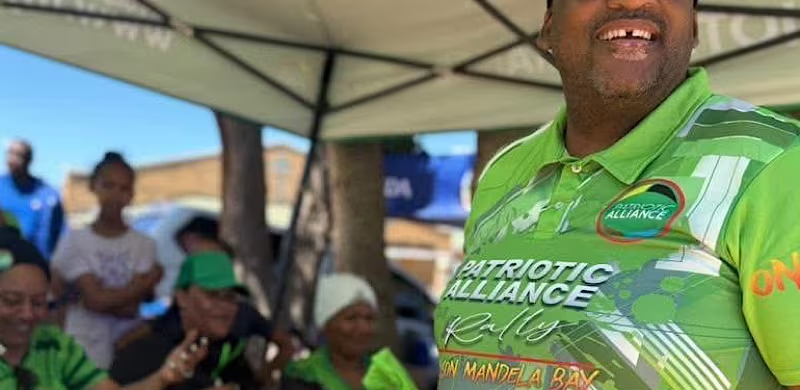
The Democratic Alliance faces a growing threat in its Western Cape stronghold as identity politics reshapes the battlefield ahead of the 2026 local government elections, writes Zukile Majova in Real Politics.
The real political war before 2026 has already begun.
Many expect Gauteng to be the main prize in the next local government elections. But the first serious blows are landing in the Western Cape. That is where the Patriotic Alliance is testing the strength of the DA on its own turf.
The PA, led by former jailbirds Gayton McKenzie and Kenny Kunene, has moved from political sideshow to serious contender in a short space of time. In the 2021 municipal elections the party managed to win just one seat in George. Today, it is chipping away at DA control ward by ward.
The party has won four consecutive by-elections in George since January, taking wards from the DA and slashing its support from dominant majorities to heavy defeats.
On 21 January the PA stunned the DA by winning Wards 17 and 27 in George. In one of those wards the party’s support jumped from 1% to 60%. Weeks later, on 11 February, it captured Ward 16 in New Dawn Park.
The momentum did not stop there. This week the mayor of Saldanha Bay left the DA and joined the PA and that single move cost the DA control of the municipality.
Speaking outside Parliament, McKenzie declared: “The DA will not be in charge next week. We are taking over Saldanha. The mayor there has joined the PA and you can’t blame her. She’s joining the fight of the leading political party. The DA’s time in the Western Cape is over.”
The PA believes it can win at least 15% of the vote in the Western Cape. It has marked the province as its main battleground.
For years the DA relied heavily on coloured voters to win Cape Town and the province from the ANC. But frustration has been building in many coloured communities. Residents complain that wealthier suburbs receive better services while coloured and black townships are left behind.
Gang violence and drug dealing continue to tear through parts of the Cape Flats. Dozens of people die every month. President Cyril Ramaphosa has deployed soldiers to some of these areas in an effort to stabilise the situation.
McKenzie has positioned his party as the political home of coloured voters who feel ignored. This week he openly declared that coloured communities across South Africa form the base of the PA.
There are about five million coloured people in South Africa. More than three million live in the Western Cape. Nearly 600,000 live in the Northern Cape. The Eastern Cape has more than 500,000, many in Gqeberha and towns such as Graaff-Reinet. Gauteng has smaller but visible communities in places like Eldorado Park, Westbury, Coronationville and Newclare.
The PA is tapping into this shared identity and sense of marginalisation. It presents itself as multiracial, but its campaign message speaks directly to coloured pride and grievance. Alongside smaller parties such as the National Coloured Congress, it is reshaping politics in the province.
Election numbers suggest the DA cannot afford to ignore this shift. In 2024 the ANC dropped nationally from 57.5% to 39%. Yet in the Western Cape the DA grew its support by only one percentage point to 53%. That is still below the more than 57% it secured in 2014.
The party’s grip is no longer unshakeable.
If identity based mobilisation continues to grow, the Western Cape could become vulnerable to a coalition led by the ANC after 2029.
At the same time the DA is stretching its resources. Much of its energy is focused on Gauteng. Helen Zille, the party’s most recognisable figure, is active in Johannesburg. That leaves space for rivals to organise in the Cape provinces.
The PA is not limiting itself to the Western Cape. In October it won Johannesburg Ward 29 from the African National Congress in a by-election. In September it secured its first ward in Kou-Kamma in the Eastern Cape.
Coalition politics adds another layer. In 2016, 27 municipalities were hung. By 2021 that number had jumped to 66. In 2026 as many as 100 councils could produce no outright winner.
In that environment small but disciplined parties become kingmakers. If McKenzie plays his hand carefully, the PA could secure greater influence in coalition governments. Kunene, once known as the sushi king, is already positioning himself as the party’s mayoral candidate in Johannesburg.
Identity politics can energise voters who feel unseen. But it can also redraw political maps in unexpected ways. In the Western Cape, that shift may be the factor that finally tests whether the DA’s long dominance can survive the next decade.
Image source: X