Papa Penny Alleges That Ngizwe Nchunu Came To Apologize To Him And To All The Tsonga Nation
iReport South Africa | 19.04.2026 20:12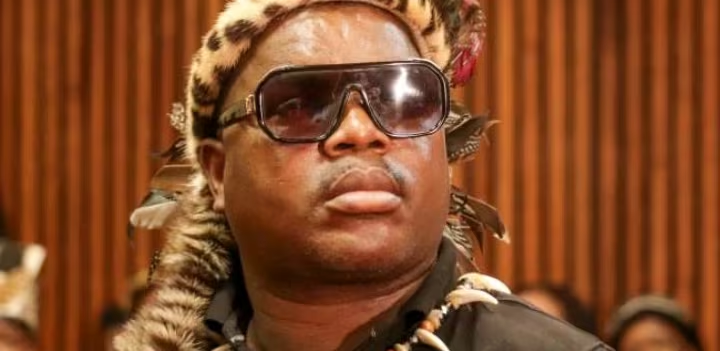
Xitsonga music icon and politician Papa Penny Penny has made a bold claim, stating that Ngizwe Mchunu personally approached him to apologise—both to him and to the Tsonga nation.
Papa Penny, who is associated with the uMkhonto weSizwe Party and serves as a Member of Parliament, said the apology came after tensions that had sparked public debate. While details of the initial dispute were not fully outlined, the development suggests an attempt to ease divisions and restore relations.
According to Papa Penny, the apology was not only directed at him as an individual but extended to the broader Tsonga community. The statement has drawn attention across political and cultural circles, given the sensitivities often surrounding ethnic identity and representation in South Africa.
The Tsonga community, one of the country’s major cultural groups, has historically been vocal about issues of recognition and respect. Any perceived slight or misunderstanding can quickly escalate into a broader national conversation, particularly when public figures are involved.
While Ngizwe Mchunu has not yet publicly confirmed the apology at the time of reporting, Papa Penny’s remarks have already generated mixed reactions. Some supporters view the move as a positive step toward reconciliation, while others are calling for clarity and official confirmation.
Political analysts note that such gestures—whether symbolic or formal—can play an important role in diffusing tensions, especially in a diverse society where cultural sensitivities run deep. However, they also caution that public claims of this nature often require verification to avoid further misunderstandings.
Papa Penny has built a reputation as both a cultural figure and a political voice, often speaking on issues affecting his community. His involvement in national politics has added weight to his statements, making them more impactful beyond the entertainment sphere.
As the story develops, attention will likely turn to whether there will be a public acknowledgment or joint statement confirming the apology. For now, the claim has opened a conversation about accountability, respect, and unity among South Africa’s diverse communities.
Whether this moment leads to lasting reconciliation remains to be seen, but it has once again highlighted the intersection of culture and politics in shaping national discourse.