India’s Freedom Was a Collective Sacrifice, Not a One-Man Story
Medium | 27.01.2026 11:34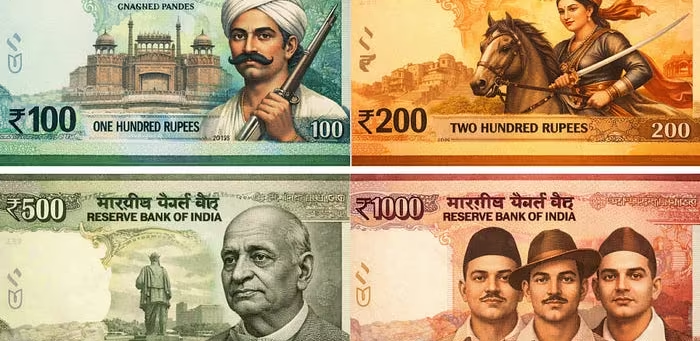
India’s Freedom Was a Collective Sacrifice, Not a One-Man Story
Follow
2 min read
·
1 hour ago
Listen
Share
One nation, many heroes – recognition must be shared.
India’s independence was not achieved by a single leader or a single ideology. It was the outcome of decades of struggle involving mass movements, revolutionary actions, political negotiations, and above all, sacrifice by countless individuals. Yet, when we look at India’s most visible national symbol – its currency – we see the dominance of one individual. This creates a narrow representation of a struggle that was, in reality, deeply collective.
Mahatma Gandhi played an important role in mobilizing people through non-violent movements. However, freedom did not come through moral pressure alone. The British Empire faced resistance on multiple fronts, many of which were led by martyrs who paid with their lives.
Revolutionaries like Bhagat Singh, Sukhdev, and Rajguru represented a fearless generation that believed sacrifice and direct action were necessary to awaken the nation. Their execution shook the entire country. Protests erupted across cities and villages, and even those who disagreed with their methods acknowledged the emotional and political impact of their martyrdom. British records themselves admitted that Bhagat Singh had become a symbol far more dangerous than any living leader.
Get Dev Vaani’s stories in your inbox
Join Medium for free to get updates from this writer.
Subscribe
Subscribe
Similarly, Chandrashekhar Azad kept the revolutionary movement alive despite constant pursuit by colonial authorities. His refusal to be captured alive became a lasting symbol of resistance and dignity. These revolutionaries may not have led movements in millions, but they changed the mindset of the youth, making freedom a matter of urgency rather than gradual reform.
The Quit India Movement of 1942 further demonstrated that the struggle had gone beyond any one individual. Even after top leadership was arrested, the movement spread spontaneously across the country. People sabotaged colonial infrastructure, formed parallel governments, and challenged British authority without centralized control – proof that the freedom movement had become a people’s uprising.
After independence, leaders like Sardar Vallabhbhai Patel ensured that freedom translated into unity. By integrating hundreds of princely states, Patel completed the task of nation-building. Without this effort, political freedom would have remained incomplete.
When one face dominates national imagery, it unintentionally suggests that freedom was achieved through one man’s vision alone. This overlooks the blood, courage, and sacrifice of martyrs who never lived to see independence but made it possible.
Honoring multiple freedom fighters does not diminish anyone’s contribution. Instead, it reflects historical truth. India was not freed by one individual – it was won by many, through struggle, sacrifice, and unity of purpose. Our national symbols should reflect that shared legacy.
⸻