Fears of new arms race as US-Russia nuclear weapons treaty due to expire
BBC | 04.02.2026 21:42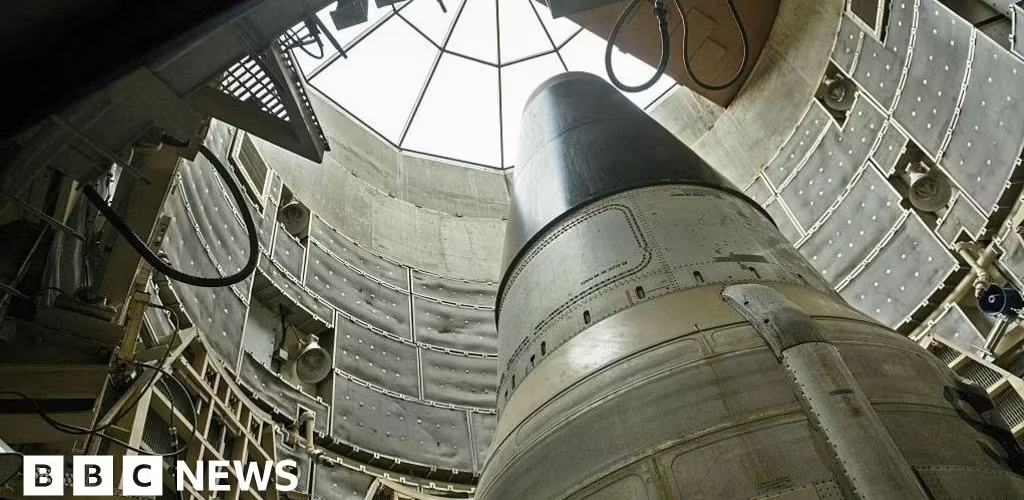
The last nuclear weapons control treaty between the US and Russia is due to expire on Thursday, raising fears of a new arms race.
The Strategic Arms Reduction Treaty, known as "New START" and signed in 2010 was one of a handful of agreements designed to help prevent a catastrophic nuclear war.
The treaty capped the number of deployed strategic nuclear warheads for each party to 1,550. It also established some transparency including data transfer, notifications and on site inspections.
The treaty's expiry effectively marks an end to the arms control co-operation between Washington and Moscow that helped bring an end to the Cold War.
On Wednesday, Pope Leo urged the US and Russia to renew the treaty, saying the current world situation required "calls for doing everything possible to avert a new arms race".
The original Start treaty - signed in 1991 by the US and the Soviet Union - barred each of the two signatories from deploying more than 6,000 nuclear warheads.
It was succeeded by New Start signed in 2010 in Prague by the US and Russia, the successor state to the dissolved Soviet Union.
Despite a technical suspension three years ago, both countries were still thought to be abiding by the treaty.
The agreement prevented the uncontrolled build-up of nuclear weapons and provided the two countries with the largest nuclear arsenals with transparency measures to avoid misjudging each other's intentions.
Its expiry follows a worrying pattern. Other long-standing arms control treaties have already fallen by the wayside.
They include:
- The Intermediate-Range Nuclear Forces Agreement, which largely eliminated the deployment of shorter-range nuclear weapons within Europe
- The Open Skies Treaty, which allowed signatories, including the US and Russia, to fly unarmed reconnaissance flights over each other's territory to monitor military forces
- The Conventional Armed Forces in Europe Treaty, which limited the numbers of tanks, troops and artillery systems both Russia and Nato forces could deploy within Europe
Britain's former head of the armed forces, Admiral Sir Tony Radakin has warned that the architecture and frameworks that helped keep the world safe "now risks unravelling".
In a speech last year he described the collapse of these key arms control treaties as "one of the most dangerous aspects of our current global security", along with "the increasing prominence of nuclear weapons".
Russia's Dmitry Medvedev, who as the then president signed the New Start treaty in 2010, said its expiration should "alarm everyone". This is a sobering comment from a politician whose recent rhetoric has included nuclear threats.
US President Donald Trump has sounded less concerned. Last month, he told the New York Times: "If it expires, it expires… We'll just do a better agreement".
Washington believes that any future arms control treaty should also include China, which has been building up its nuclear arsenal.
Meanwhile, Russia has long argued that any future arms control treaty should include France and the UK - Europe's nuclear powers.
Darya Dolzikova, a senior Research Fellow with the UK-based RUSI's Proliferation and Nuclear Policy Programme, said the expiration of New Start was "concerning, because there are drivers on both sides to expand their strategic capabilities".
Both the US and Russia are currently modernising their nuclear forces and increasing their strategic capabilities. A new arms race is already under way.
Dolzikova said that for Russia "there appears to be some concerns about their ability to penetrate US air defences". This has only increased with Trump's plans to build a "Golden Dome" to protect North America from long-range weapons.
But Russia has also been developing new weapons designed to overcome air defences. They include Poseidon - a new intercontinental, nuclear armed and nuclear powered undersea autonomous torpedo, and also Burevestnik – a nuclear armed and powered cruise missile.
The US, Russia and China are all developing long-range hypersonic missiles which can manoeuvre at speeds of more than 4,000 mph (6,437kmh), and are much harder to shoot down.
Dolzikova said those expanding military capabilities would "only make it harder" to reach a new arms control treaty.
This is along with what she called the "growing salience of nuclear weapons". More, not fewer, countries appear to want them as a deterrent.
Nor does the US or Russia appear to be in a rush to sign a new arms control treaty.
The subject was on the agenda when Russian President Vladimir Putin met Trump in Alaska last year - but nothing happened.
A new deal is still possible - but the expiry of the New Start signals a more volatile, dangerous era.