The R-Word and the Responsibility of Those in Power
Medium | 19.12.2025 08:17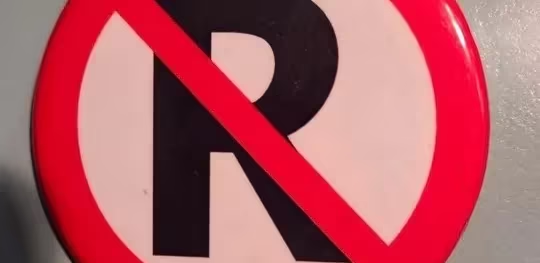
The R-Word and the Responsibility of Those in Power
5 min read
·
1 hour ago
--
george cassidy payne
When the President of the United States uses a word meant to wound, it is not a question of legality. It is a question of dignity. Every time a leader normalizes dehumanizing language, they signal who is worth respect, and who is expendable.
When Donald Trump called Minnesota Governor Tim Walz the R-word, some rushed to defend him: freedom of speech. He can say what he wants. He is protected. End of discussion.
But this is not a freedom-of-speech issue. It is a freedom-of-dignity issue.
Donald Trump is not a private citizen muttering into the void. He is the most powerful man in the free world, wielding a global microphone and the authority of the presidency. The real question is whether a president who degrades the vulnerable honors the dignity of the office, or hollows it from within.
Presidential speech matters because it shapes public life. Words from the Oval Office draw boundaries, authorize ways of seeing, and signal what is acceptable. They do work in the world.
BJ Stasio, a Peer Specialist 2 with the New York State Office for People With Developmental Disabilities, explains:
“When national leaders use the R-word casually, it reactivates real harm for people who were once labeled, limited, and underestimated. As someone who has lived with that label, and now leads within the disability rights movement, I know firsthand how the stigma impacts lives.”
For decades, Stasio has confronted the stigma associated with the word. Under the Obama administration, official documents avoided it. Today, its casual use signals deliberate erosion of dignity.
“Politicians often put their foot in it and move on,” Stasio adds. “But for those who have carried this stigma their whole life, it has real consequences. You have to stay true to who you are. You have to keep standing up. I know what I can and cannot tackle. I can tackle this. I can raise my voice and say no. I truly believe that Trump’s goal is to open institutions back up, and we have to resist that.”
Nicole LeBlanc, Self-Advocate Advisor and Disability Employment Consultant, underscores the emotional and systemic weight of this language:
“Seeing the R-word insult return to everyday language is enraging. Many people with autism, especially those diagnosed in adulthood, have complex trauma histories from bullying and verbal abuse. Research shows they are more likely to be bullied than the general population, leading to high rates of PTSD, anxiety, and other challenges. People with disabilities want respect, love, acceptance, and access to services that allow us to thrive, not just survive. Using hateful language fuels negative attitudes, health disparities, and higher abuse rates. Respect is not optional.”
Dr. Gary Schaffer, disABLED School Psychologist, Mental Health Counselor, and author, adds:
“The ‘R’ word is not a neutral word without negative connotations tied to it. It is ‘hate speech’ on full display, reducing a person’s learning and behavioral differences to something negative, laughable, and minimizing their overall value to society. As a school psychologist and person with disabilities, when the President of the United States openly says the ‘R’ word, he is giving a green light to discriminate, to segregate, and to lack empathy not only against the intellectually disabled, but to anyone with learning and behavioral differences. This is dangerous given that prior to 1975, many students with disabilities were denied access to an education because they were viewed as unable to learn.”
Max Donatelli, USAF Vietnam Veteran and disabilities advocate, wrote in The Buffalo News:
“The public disrespect shown by this president to people with intellectual and developmental disabilities is unprecedented. Our country deserves better.”
To understand why this word carries such weight, it helps to look at its history. The verb to retard has been used in English since the late 15th century to mean “to make slow or slower; keep back, hinder, or delay.” In the late 19th and early 20th centuries, retarded became a neutral medical and educational term to describe individuals with intellectual disabilities or “retarded mental development.” It was considered more humane than previous clinical terms like “idiot,” “imbecile,” and “moron,” which had already acquired negative connotations.
By the 1960s, however, retard and retarded began to acquire negative, insulting meanings in casual speech. The noun retard, used offensively to describe a person with an intellectual disability or a foolish person, appears in American English from around 1970. Over time, its widespread use as a slur rendered it unacceptable in professional and legal contexts. Terms such as “intellectual disability” or “developmental disability” have largely replaced it, and organizations like the Special Olympics actively campaign to end the use of the “R-word.”
These voices — Stasio, LeBlanc, Schaffer, Donatelli — highlight a central truth: normalizing dehumanizing language causes harm that is personal, systemic, and enduring. Advocacy is not optional. It is a moral and civic responsibility.
Trump’s use of the R-word is not just an insult; it communicates to millions that labeling human beings this way is acceptable, even legitimate. Taboos are ethical boundaries. When a president violates them, it is instructive.
Words alone are dangerous — but when paired with policy, the harm compounds. As Dr. Martin Luther King Jr. said:
“It may be true that the law cannot make a man love me, but it can keep him from lynching me, and I think that’s pretty important.”
Rhetoric that degrades, combined with policies that remove protections, signals which lives are valued, and which are negotiable. Civil rights and access are not abstractions. They are the minimum conditions that make respect and inclusion possible.
Consider the SOAR program, which helped people with severe mental health challenges and disabilities navigate Social Security benefits. Ending federal support did more than remove bureaucracy; it left people on the streets, without healthcare or stability. Cuts to special education and ADA guidance send the same message: accessibility is optional, inclusion an inconvenience.
Consider the decision to cut ASL interpretation from White House briefings. Many saw this as just another expression of Trump’s vanity. But in the broader context of dehumanization, it contributes to a larger pattern.
Harm becomes systemic, not all at once, but sentence by sentence, joke by joke, policy memo by policy memo. Erosion of dignity rarely announces itself as violence. It begins as permission, to mock, dismiss, reduce. When granted by those in power, it spreads.
This is not about fragility. It is about responsibility. A president’s words do more than reveal character, they instruct the nation in who it is permitted to become. When language degrades, paired with hollowed-out protections, dignity ceases to be shared and becomes a privilege rationed by power.
The question is no longer whether such language is legal. It is whether we will accept a politics that treats some people’s humanity as expendable, and whether we will recognize, before it spreads further, that a nation willing to bargain away dignity at the margins will eventually find it gone at the center.


