EGM prospect, Cardiff question and power of three
BBC | 06.01.2026 17:16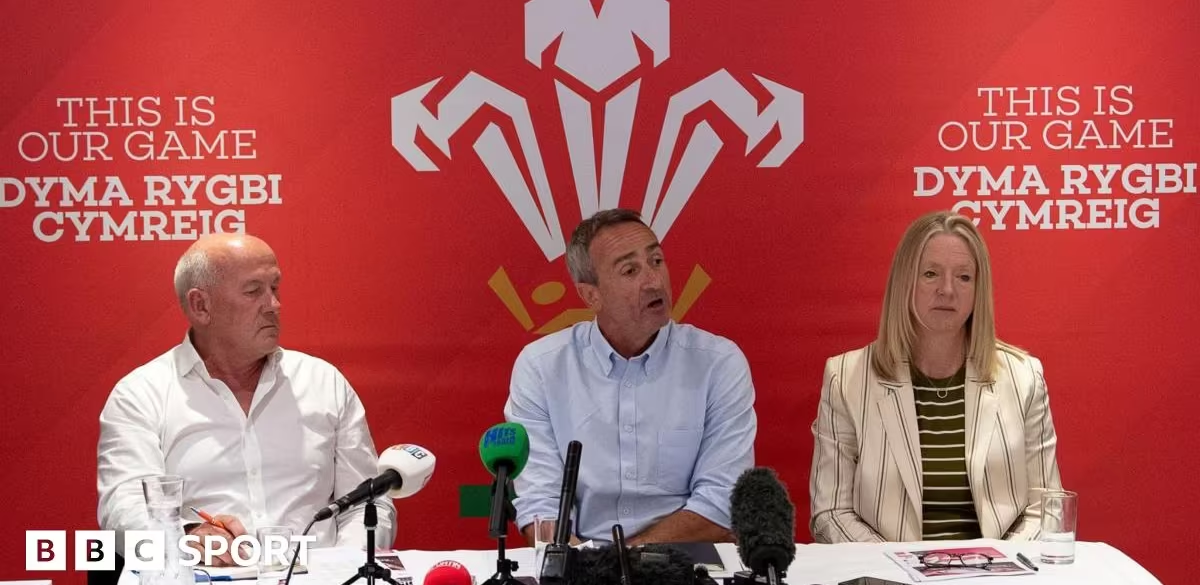
It might be a new year but Welsh rugby faces the same old problems.
January will be a busy time for players and coaches as they compete on the domestic front in the United Rugby Championship (URC) and European tournaments.
Wales head coach Steve Tandy will then prepare his squad for the international stage when the Six Nations starts in February.
It will prove just as hectic for the game's administrators as they try and find a solution to Welsh rugby's mounting problems.
BBC Sport Wales looks at the key off-the-field questions that need to be resolved sooner rather than later.
The Welsh Rugby Union (WRU) seems to attract crisis meetings with extraordinary general meetings (EGM) held in 2014, 2020 and 2023.
There is now the prospect of another emergency gathering, less than three years after the previous one.
Clubs are being urged by a Welsh district, Central Glamorgan Rugby Union, to call for an EGM and hold a vote of no confidence in chair Richard Collier-Keywood and Professional Rugby Board (PRB) chair Malcolm Wall.
The district has written a letter that will be sent out to clubs looking to get the 10% of support needed.
Around 30 of the near 300 clubs in Wales will be required to support the plans so we wait to see whether the process gathers any momentum.
The annual general meeting (AGM) was held at the end of November, a day after Wales' record 73-0 defeat against South Africa in Cardiff.
There was not much dissent that day with Collier-Keywood even considering that as a mandate for change. Five weeks on, things have changed in some quarters.
The call to arms from Central Glamorgan, included the words: "We see the meandering between different versions of a plan, causing chaos, confusion and uncertainty, spending extortionate amounts of money on external consultants, combined with the current board's inability to define and deliver a clear strategy for rugby in Wales.
"This is causing reputational damage to Welsh rugby across the world when we were once held in such high esteem."
All this comes at a time when the WRU are pushing to get through its radical changes to the domestic game.
The WRU launched a strategy in October, which included cutting one of the men's professional sides from four to three.
The governing body announced three licences would be granted - one to a team in Cardiff, one in the west and one in the east.
Negotiations have continued with Ospreys, Scarlets, Cardiff and Dragons but nothing was resolved on this issue before the end of 2025.
If an agreement cannot be reached in January, a six-month tender process could open to determine the successful trio.
Details of the licences have recently been released to the professional sides, who have expressed reservations at certain aspects of the document with further discussions expected.
The WRU wants control over rugby affairs at the surviving three sides while still asking backers to put money into the ventures.
That issue has also provided a major stumbling block in negotiations, which the Dragons raised in November, and delayed the process.
The WRU plans are being driven through by director of rugby and head of elite performance Dave Reddin, with chief executive Abi Tierney returning this month to lead the organisation after having time off for cancer treatment.
Integral to the reduction in numbers could be the sale of the WRU-owned Cardiff.
Welsh rugby's governing body took over the Arms Park outfit after Cardiff temporarily went into administration in April 2025.
The WRU has since been looking for new investors, with Ospreys owners, Y11 Sports and Media, linked to buying Cardiff. This could enable the WRU to get to its magic number of three.
The WRU and Y11 have both declined to comment, fuelling the fears of Ospreys supporters about the survival of their team, while Cardiff fans have been vocal on social media against any such takeover.
"Work has continued to secure a sustainable long-term future for the Cardiff club and its supporters," said the WRU.
"This is a significant decision and will be taken with the thorough scrutiny and due diligence it deserves."
There is another consortium looming on the horizon with former Cardiff director Martyn Ryan joined by a party that includes three television and film producers based in the United States of America.
It will be decision for the WRU about what is best for Cardiff or what is more beneficial to its final plans.
The final bids are expected by mid-January with a potential decision expected by the end of the month.
Events are dragging on with Wales already losing captains Jac Morgan and Dewi Lake to Gloucester next season and Aaron Wainwright set to join Leicester.
The growing uncertainty in Welsh rugby has been cited as contributory factors for the departures and persuading other players to stay is proving tricky.
Tandy is preparing his side for the start of his first Six Nations campaign when he takes Wales away to face England on Saturday, 7 February.
What Tandy and his squad will not want is the off-the-field uncertainty affecting Wales as they bid to avoid a third consecutive Six Nations wooden spoon and win a game in the tournament for the first time since 2023.
It seems inevitable Welsh rugby's crisis will linger on because there is no easy outcome. Whatever is decided there will be public outcry, while financial issues and legal ramifications could emerge.
Money-matters remain at the heart of these dilemmas. Collier-Keywood has recently reiterated there is not enough cash to fund four competitive sides in Wales but that has not silenced the doubters about this statement.
People accept change is needed. Especially after a year where the Wales men's team suffered record defeats against Argentina, England and South Africa and the women's side failed to win a game at the World Cup.
But as ever, Welsh fans are divided about how that change will occur and do not want their own little aspect of Welsh rugby upset.
How much this constant drama is testing the patience of the average fan, along with the national side's poor form, will be revealed by the crowds that attend home Six Nations matches against France, Scotland and Italy in February and March.
Poor attendances will have a further negative effect with revenue from the men's home games accounting for more than 50% of the WRU's turnover.
Just another crucial reason why this needs to be solved quickly.