The World Cup is here. So why does nobody care?
Explain | 10.06.2026 19:19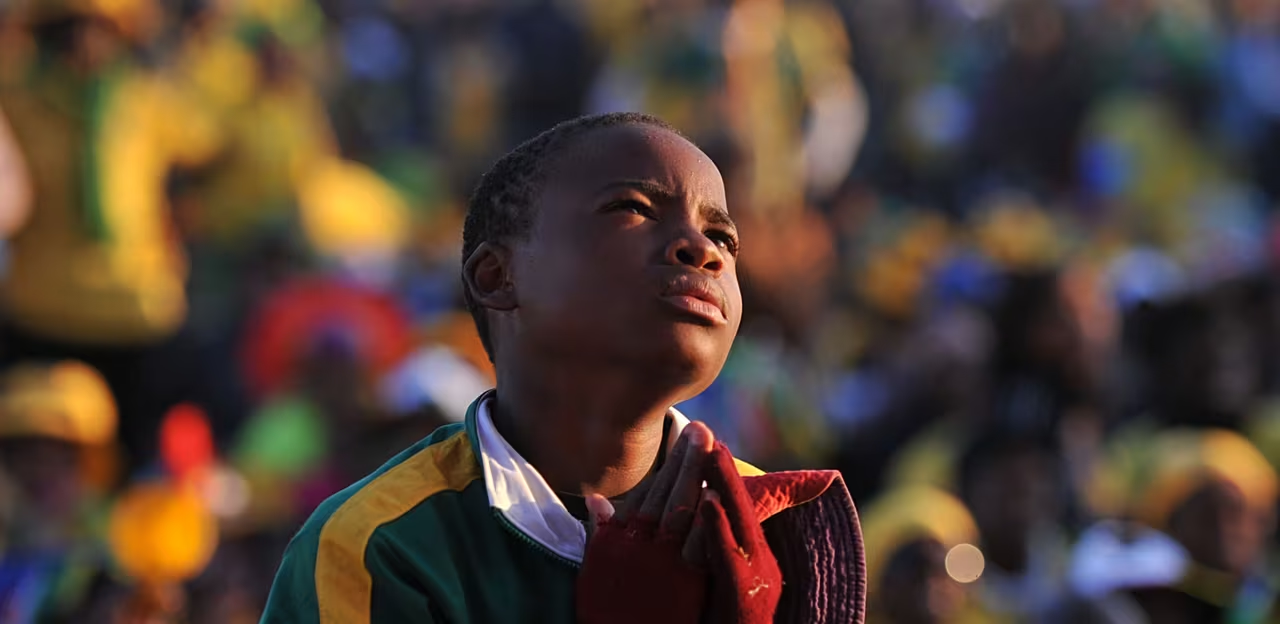
This week, I asked friends, colleagues and family a very simple question: Are you feeling the World Cup hype?
The answer was almost unanimous.
No.
Of course, a few conversations in my circle are not a national survey. But for the biggest football tournament on the planet, you would expect some of the excitement to have escaped the sports pages and entered everyday life by now.
Not to mention that the same fixture that gave us Siphiwe Tshabalala’s left foot, Desmond Tutu dancing in the stands, and one of the most goosebump-inducing opening goals in World Cup history in 2010 is set for a reprise. Mexico vs South Africa opens the tournament at the Estadio Azteca on 11 June.
Usually, there is a moment before a tournament when the switch flips. Conversations begin drifting towards football. People who have not watched a full match since the last World Cup suddenly have strong opinions about formations. This time, that moment feels delayed.
This is especially strange, as it should be a huge moment for South African football. Bafana are back at the World Cup after 16 years away, making their first appearance since hosting the tournament in 2010.
I was seven years old when South Africa hosted the World Cup, so I didn’t fully understand the tactics, the politics, or the economic debates surrounding the tournament. But I understood the feeling: you couldn’t escape it.
Township streets had flags everywhere. Bafana jerseys were not just sportswear: they were a national uniform. People spoke about Tshabalala, Teko Modise, and Steven Pienaar like they were family members expected at Sunday lunch.
Football fan Busisiwe Moima remembers that build-up the same way. She told /explain/ the years before 2010 felt full of pride and anticipation. South Africans watched stadiums being built, roads and transport systems being upgraded, and the country preparing to welcome the world.
“There was a growing sense of national pride, unity, and excitement as 2010 approached,” she said.
In 2010, the World Cup wasn’t just a tournament: it was a national project. South Africa wasn’t only watching football: we were hosting the planet.
Then, we were inside the story. This time, we’re watching from far away.
The 2026 World Cup is being hosted across three countries: the United States, Canada, and Mexico. It is also the biggest edition in the tournament’s history, with 48 teams playing 104 matches across 16 host cities. The tournament runs from 11 June to 19 July.
A bigger World Cup means more matches, more groups, more permutations, and more teams to keep track of. For hardcore fans, that’s heaven. For casual fans, it can feel like homework. The old World Cup format had a simple rhythm: 32 teams, 64 matches, one month of chaos. The new version is bigger, longer, and more complex.
There is also the bigger problem of modern football: it never stops. Between domestic leagues, the Champions League, Afcon, the Euros, friendlies, transfer rumours, and club ownership drama, the football calendar has become one long, never-ending scroll.
In the past, the World Cup felt like an interruption. Everything stopped for it.
That may be why the hype feels muted. Not because the World Cup has stopped mattering, but because football has become so constant that even its biggest event has to fight for attention. There is less space for anticipation when fans are already exhausted.
For South Africans, there may be another layer too. Life is expensive. People are tired. The country has a lot going on. When you are worrying about jobs, transport, food prices, crime, school fees or whether your municipality has water this week, it takes a lot for even the World Cup to break through the noise.
If Bafana walk out against Mexico on Thursday, wearing that badge, in a World Cup opener that echoes 2010, something might shift. Perhaps the memories will return. Perhaps the group chats will wake up. Perhaps the aunties who claim not to care will suddenly be asking what time the game starts.
The World Cup is still football’s biggest stage. And football has a funny way of making people care very quickly. One goal, one save, one ridiculous refereeing decision, and suddenly the whole country is emotionally invested again. Ask anyone who was around in 2010. Sometimes all it takes is one left foot.