What we know about controversial Venezuela boat strike
BBC | 04.12.2025 00:32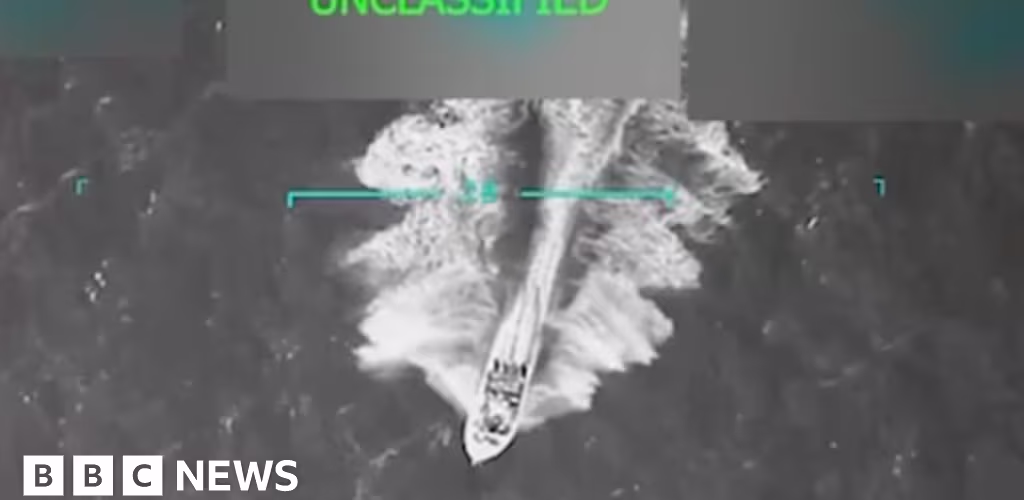
A US strike against an alleged drug boat in the Caribbean has become the focal point of controversy, with shifting narratives and mounting questions on Capitol Hill.
An initial strike on the boat reportedly left two survivors clinging to the burning vessel before a second strike killed both - prompting concerns that US forces violated laws governing armed conflict.
It was the first in a series of ongoing attacks that have left more than 80 people dead in both the Caribbean and Eastern Pacific.
While US officials have insisted the strike was lawful, a full picture is still emerging of what happened and who was ultimately responsible for the decision.
Here's what we know about the strike and its aftermath.
Trump's 2 September announcement
The US public first learned of the strike on 2 September, when Trump surprised reporters in the Oval Office by announcing that just moments beforehand, the US had "shot out a boat, a drug-carrying boat" that was travelling from Venezuela.
Later the same day, the president posted on Truth Social that the strike had killed 11 members of Tren de Aragua, a Venezuelan gang designated as a foreign terrorist organisation earlier this year.
Trump's post also included a video of the attack, showing the boat being struck by an unidentified munition and catching on fire.
A US official later confirmed to CBS, the BBC's US partner, that a total of four missiles were used in the operation.
Nearly no further information about the target was provided at the time.
While Trump said the vessel was heading to the US, Secretary of State Marco Rubio said the same day that it was "probably headed to Trinidad or some other country in the Caribbean".
The following day, Rubio changed course, saying that it was "headed towards, eventually, the United States".
Defence Secretary Pete Hegseth told Fox News at the time that he watched the strike "live".
"We knew exactly who was in that boat. We knew exactly what they were doing," he said.
In subsequent days, US officials argued the strike was legally justified.
Media report sparks controversy
Similar strikes continued regularly in both the Caribbean and Pacific in the weeks and months that followed, with the 2 September one being largely overshadowed by the escalating military campaign against drug traffickers.
On 28 November, however, the Washington Post reported that two people had survived the first strike on 2 September and that Hegseth had ordered a second attack to kill them.
Hegseth immediately condemned the reporting as "fabricated, inflammatory and derogatory", while Pentagon spokesman Sean Parnell said the "entire narrative was false".
The report drew concern from Democratic and Republican lawmakers alike.
In a joint statement on 29 November, the ranking Republican and Democrat on the Senate Armed Services Committee said they would take "bipartisan action to gather a full accounting" of the operation.
A similar statement was made by lawmakers of the House of Representatives.
That Sunday, 30 November, several lawmakers explicitly expressed concern that the attack violated international law.
One, Virginia Democratic Senator Tim Kaine, told CBS the "double-tap" strike "rises to the level of a war crime if true".
Republican Mike Turner, who formerly led the House Intelligence Committee, said the 2 September incident was "completely outside of anything that has been discussed with Congress" about the military campaign.
Watch: "I did not personally see survivors", Hegseth says of second deadly boat strike
White House and Trump confirm second strike
Hours after Senator Kaine made his comments, President Trump addressed the issue directly, telling reporters on Air Force One that he "wouldn't have wanted" a second strike on the boat.
He added that Hegseth told him he did not order the second strike and that he believes him "100%".
The following day, White House press secretary Karoline Leavitt confirmed - for the first time - that a follow-up strike was ordered on 2 September.
That order, she said, came from US Navy Admiral Frank Bradley, who at the time of the attack was in charge of Joint Special Operations Command, or JSOC.
Adm Bradley had been promoted in the interim. He is now overall commander of US Special Operations Command, to which JSOC is subordinate.
In a prepared statement, Leavitt defended Bradley's actions, saying he was "well within his authority and the law".
Hegseth says 'he did not personally see survivors'
During a marathon cabinet meeting at the White House on 2 December, Hegseth again confirmed he had watched the initial strike as it took place before moving on to other meetings.
At the time of the attack, Hegseth said he "did not personally see survivors", which he attributed to the flaming wreckage and "the fog of war".
Later that day, the defence secretary recalled, he was informed that Bradley decided to "sink the boat and eliminate the threat", a move he considered justified.
The defence secretary also suggested several hours may have passed before the second strike was ordered.
Trump, for his part, again said he "didn't know about the second strike", while also saying he considered it part of the broader operation.
"To me, it was an attack," he said. "It wasn't one strike, two strikes, three strikes."
By now, some observers had said they believe that Bradley could, theoretically, be held responsible.
"Under normal circumstances, it'd be court-martialled," former Air Force Secretary Frank Kendall told MS NOW.
"He'd be relieved of his duties and he'd be court-martialled."
"The administration makes up logic and rationale for the things it's doing that defy all legal history and all precedent, and that's basically what we're seeing here," he added.
With pressure mounting, Adm Bradley was reportedly expected to address lawmakers on 4 December to brief them on the operation behind closed doors.